

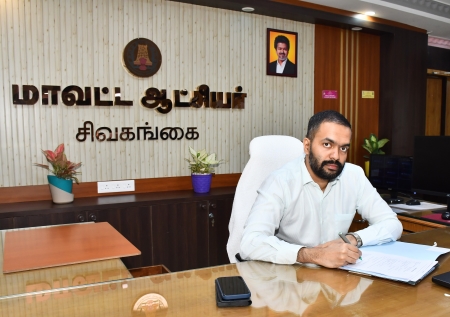
District Collector Office in Sivaganga
About Sivagangai District
Welcome to Sivagangai, a beautiful and historically significant district in Tamil Nadu, deeply characterized by its rich red soils and expansive landscapes of palms and acacias. Officially functioning as an independent district since March 15, 1985, after being carved out from the composite Ramnad District, it spans a vast area of 4,189 square kilometers. Centrally bounded by Madurai, Tiruchirappalli, Pudukkottai, and Ramanathapuram, Sivagangai serves as a vital administrative and cultural center. Home to over 1.3 million residents, the district boasts a highly commendable sex ratio of 1,003 females for every 1,000 males. Nourished primarily by the legendary Vaigai River and featuring highly revered ancient hillocks at Piranmalai and Kundrakudi, Sivagangai proudly offers a spectacular blend of deep natural beauty and enduring historical legacy.
District Admin Units
Local Bodies
Constituencies
General Information
- District: Sivagangai
- HeadQuarters: Sivagangai
- State: TamilNadu
- Total Area: 4189 Sq.Kms
- Sex Ratio: 1003 / 1000
Population Details
- Total: 13,39,101
- Male: 6,68,672
- Female: 6,70,429
- Urban: 4,12,845 | Rural: 9,26,256
Geography & Physiography
Sivagangai is distinctively defined by its beautiful red and clay soils, interspersed with a highly familiar landscape of robust palms and acacias. The legendary Vaigai River gracefully flows through the district, nourishing around 100 ancient tanks, complemented by spectacular natural hillocks at Piranmalai and Kundrakudi.
Climate & Demographics
Functioning as the 26th largest district in Tamil Nadu by population size, Sivagangai maintains a spectacular sex ratio of 1,003 females for every 1,000 males. With an average rainfall of 904.7mm, the district experiences a largely dry, sultry climate, featuring brilliant sunshine year-round with temperatures occasionally peaking at 43°C in summer.
District Formation
Boasting an immensely rich heritage, the district was officially born out of administrative reorganization. It was masterfully carved out of the massive composite Ramnad District following a 1984 government order, and proudly began functioning entirely independently with its own administrative headquarters on March 15, 1985.
Frequently Asked Questions about Sivagangai District
Who is the current District Collector of
The current District Collector and District Magistrate of Sivagangai is Thiru P. Akash, I.A.S.,.
How can I contact the Sivagangai District Collector Office?
You can seamlessly contact the Sivagangai District Collector Office for administrative or grievance purposes by calling the official Phone number at 241466, or by sending an email to [email protected].
How does the Collectorate promote tourism and heritage?
The administration actively preserves the stunning Chettinad architecture, promotes heritage tourism, and ensures that the deep cultural legacy of heroes like Maruthu Pandiyar and Velu Nachiyar is proudly honored.
What are the economic strengths of the district?
The district boasts a robust agricultural sector and significant mineral wealth, including high-quality graphite. The administration actively supports rural development and modern agricultural practices.
How does the administration empower the rural workforce?
The Collectorate is highly focused on expanding educational facilities, supporting cottage industries, and providing excellent healthcare to ensure inclusive prosperity across the district.

 JB Soft System