

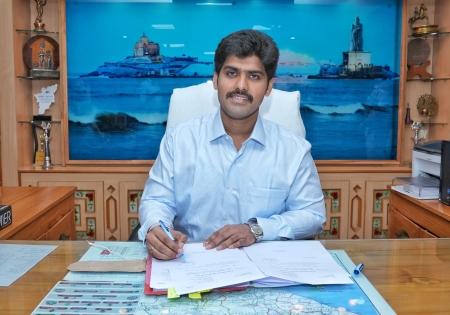
District Collector Office in Kanniyakumari
About Kanniyakumari District
Welcome to Kanniyakumari, a district of unparalleled historical and geographical significance, majestically located at the southernmost tip of peninsular India. Headquartered in Nagercoil, the district spans 1,672 square kilometers and boasts a profoundly rich human civilization dating back over 4,000 years. Once a thriving center of early megalithic culture akin to Mohenjo-Daro, the region has been a focal point of ancient trade and power, famously mentioned by early Greek scholars like Eratosthenes in 276 B.C. Ruled by an incredible succession of mighty empires—including the Pandyas, Cholas, Nayaks of Madurai, and the Travancore Kings—Kanniyakumari officially became a part of Tamil Nadu on November 1st, 1956, thanks to the monumental efforts of Marshal A. Nesamony. Today, this beautiful coastal district is a vibrant blend of deep ancient heritage, immense cultural diversity, and modern development.
District Admin Units
Local Bodies
Constituencies
General Information
- District: Kanniyakumari
- HeadQuarters: Nagercoil
- State: TamilNadu
- Total Area: 1672 Sq.Kms
Population Details
- Total: 18,70,374
- Male: 9,26,345
- Female: 9,44,029
- Density: 1119 / Sq.Km
- Urban: 15,39,802 | Rural: 3,30,572
Ancient Origins & Civilization
Human civilization in Kanniyakumari dates back 4,000 years, supported by Neolithic discoveries near Thoothur Village. Megalithic earthen jars and relics indicate a highly advanced city existed here, potentially rivaling Mohenjo-Daro, before being consumed by the sea. The Phoenicians and early Greek scholars, including Eratosthenes (276 B.C.), famously recorded the coastal harbor of Komari as a vital part of the ancient world.
Golden Age of Dynasties
For millennia, the district (historically Nanjil Nadu) acted as a dynamic battleground and cultural hub. It saw the rise and fall of incredible empires: the early Ayi Dynasty, massive dominance by the Pandyas (4th-9th century), integration into the mighty Chola Empire (10th century), and subsequent rule by Venad kings, the Vijayanagar Empire, Madurai Nayaks, and ultimately the powerful Travancore Kings under Bala Marthanda Varma in 1729.
Modern History & Formation
Following India's independence, tensions rose in the erstwhile Travancore state over the suppression of the Tamil language. Spearheaded by the legendary Marshal A. Nesamony and the Travancore Tamil Nadu Congress, massive peaceful agitations took place. Finally, on November 1, 1956, based on linguistic reorganization, the four taluks of Thovalai, Agastheeswaram, Kalkulam, and Vilavancode merged with Tamil Nadu to form the glorious Kanniyakumari District.
Frequently Asked Questions about Kanyakumari District
Who is the current District Collector of
The current District Collector and District Magistrate of Kanyakumari is Thiru M. Prathap, IAS.,.
How can I contact the Kanyakumari District Collector Office?
You can seamlessly contact the Kanyakumari District Collector Office for administrative or grievance purposes by calling the official Phone number at 279555, or by sending an email to [email protected].
What are the key tourist landmarks overseen by the administration?
The district proudly maintains the iconic Vivekananda Rock Memorial, the colossal Thiruvalluvar Statue, and stunning pristine beaches that attract global tourists.
How does the Collectorate support the local economy?
Beyond tourism, the administration heavily supports the vital marine fishing industry, agriculture, and high-quality education, ensuring widespread prosperity.
What steps are taken for coastal and environmental protection?
The district administration enforces strict eco-friendly policies and ensures top-tier disaster preparedness to protect its beautiful and ecologically sensitive coastline.

 JB Soft System