
Investing in Gold? Here Is How Your Profits Are Taxed
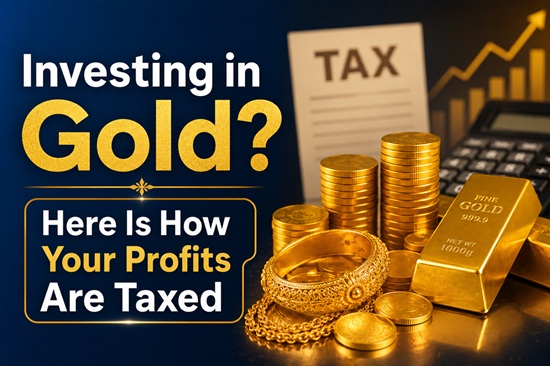
Gold is a popular investment option in India, with investors choosing different forms such as gold jewellery, coins, bars, gold mutual funds and Gold Exchange-Traded Funds (ETFs). However, when you sell your investment and make a profit, the tax treatment can vary depending on the type of gold investment and the holding period.
Here is a simple guide to understanding how profits from different gold investments are taxed.
Tax on Gold Jewellery, Coins and Bars
Physical gold, including jewellery, coins and bars, is treated as a capital asset for tax purposes.
If Sold Within Two Years
If physical gold is sold within two years of purchase, the profit is generally treated as a short-term capital gain.
The profit is added to the investor`s total income and taxed according to the applicable income tax slab rate.
If Sold After Two Years
If physical gold is sold after being held for more than two years, the profit is generally treated as a long-term capital gain.
A 12.5% tax is applicable on the long-term capital gains, subject to the applicable tax rules.
How Are Gold Savings Funds Taxed?
Gold savings funds offered by mutual fund companies invest in gold-related instruments, such as Gold ETFs.
According to the applicable tax treatment, profits from gold savings funds are taxed in a manner similar to physical gold.
Sold within two years: Profits are taxed according to the investor`s applicable income tax slab.
Sold after two years: Long-term capital gains are taxed at 12.5%, subject to the applicable rules.
What About Gold ETFs?
Gold ETFs have a different holding period for determining the applicable tax treatment.
If Sold Within One Year
If Gold ETF units are sold within one year of purchase, the profit is generally treated as a short-term capital gain and taxed according to the investor`s applicable income tax slab.
If Sold After One Year
If the units are held for more than one year, the gains are generally treated as long-term capital gains and taxed at 12.5%, subject to the applicable tax provisions.
Quick Tax Comparison
| Gold Investment | Short-Term Holding Period | Tax on Short-Term Gains | Long-Term Holding Period | Tax on Long-Term Gains |
| Gold Jewellery, Coins and Bars | Up to 2 years | As per income tax slab | More than 2 years | 12.5% |
| Gold Savings Funds | Up to 2 years | As per income tax slab | More than 2 years | 12.5% |
| Gold ETFs | Up to 1 year | As per income tax slab | More than 1 year | 12.5% |
The Bottom Line
Before investing in gold, it is important to consider not only the potential returns but also the tax implications when you sell.
The tax payable on your profits depends mainly on the type of gold investment and how long you hold it. Understanding these rules can help you plan your investments and avoid surprises at the time of sale.
Disclaimer: Tax rules may change based on amendments to income tax laws. Investors should verify the latest tax provisions or consult a qualified tax professional before making investment or tax-related decisions.
Top Stories
-
 Chennai Plans 30 AC Bus Stops and Modern Footbridges on Major Roads17/Aug/2026 4:25:30 PM
 -
Investing in Gold? Here Is How Your Profits Are Taxed17/Aug/2026 4:18:41 PM
-

-

-

-
 6 Smart Office Setup Tricks That Save Time and Money17/Aug/2026 3:12:09 PM