
Will AI Take Away Our Jobs? Opportunities Never Disappear - They Change
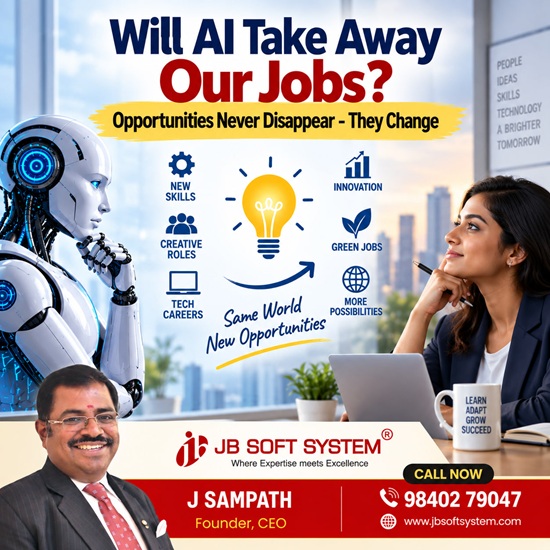
“Will AI take away my job?”
“Will machines replace people?”
“What will our children do in the future?”
These questions are becoming increasingly common as Artificial Intelligence, automation and robotics rapidly enter our workplaces and everyday lives.
The fear is understandable.
But perhaps we are asking the wrong question.
Instead of asking “Will jobs disappear?”, we should be asking:
“What new opportunities are emerging, and how should I prepare myself for them?”
Because the world will not vanish.
People will not disappear.
Human needs will not disappear.
And as long as human needs exist, responsibilities and opportunities will exist too.
The World Never Repeats Itself
There is an old philosophical observation:
You cannot step into the same river twice.
The water you stepped into a moment ago has already flowed away. New water has taken its place.
Life is similar.
The world we lived in yesterday is not exactly the world we live in today.
And tomorrow`s world will again be different.
Trying to preserve every existing job exactly as it is today is therefore unrealistic.
Opportunities change.
Roles change.
Tools change.
Methods change.
But human activity continues.
We Have Seen This Before
Imagine telling someone living 150 years ago about today`s professions.
Software Developer.
App Designer.
Digital Marketer.
Cybersecurity Specialist.
YouTuber.
SEO Specialist.
Cloud Engineer.
Social Media Manager.
Drone Operator.
Data Scientist.
None of these would have made much sense to them.
At the same time, many occupations that were once common have either disappeared or become extremely rare.
Yet humanity did not run out of work.
New technology destroyed certain tasks, transformed others and created entirely new industries.
AI is another powerful chapter in that continuing story.
AI M May Replace Tasks - Not Human Purpose
There is an important distinction between a job and a task.
A job consists of many tasks.
AI may automate writing a routine email.
It may prepare a report.
It may analyse thousands of records.
It may generate a design.
It may answer common customer questions.
It may even write software.
But businesses still need people to decide:
What should we build?
Why should we build it?
Is the answer correct?
Does this solve the customer`s problem?
What happens when something goes wrong?
Who takes responsibility?
Technology can execute more and more tasks.
But responsibility remains enormously valuable.
As Long as Two People Are Alive...
Imagine an extreme situation.
Suppose only two human beings were left in the entire world.
Would there be no work?
Quite the opposite.
They would immediately have responsibilities.
They would need food.
They would need shelter.
They would need safety.
They would need health.
They would need to communicate.
They would need to maintain whatever resources remained.
Each person would have something the other person needed.
And wherever there is a need, there is an opportunity to contribute.
That leads to a simple thought:
As long as the last two people are alive in this world, there will be responsibilities - and therefore opportunities.
The real question is not whether opportunity will exist.
The question is:
Will we recognise it?
From Typewriter to Computer to AI
Think about the tools we have already accepted.
The typewriter gave way to the computer.
Letters gave way to email.
Physical ledgers gave way to accounting software.
Paper maps gave way to GPS.
Bank c counters gave way to ATMs and mobile banking.
Traditional advertising expanded into digital marketing.
Servers moved into the cloud.
At every stage, some people feared change.
Others learned the new tool.
And some went one step further - they built businesses around the new tool.
That difference matters.
The Future Employee May Have AI Colleagues
Tomorrow`s workplace could look very different.
A salesperson may have an AI assistant researching prospects and preparing follow-ups.
A doctor may use AI to analyse medical information while making the final clinical judgement.
A teacher may use AI to prepare personalised learning material.
An accountant may use AI to identify anomalies while concentrating on compliance and financial decisions.
A software developer may use AI to generate routine code while concentrating on architecture and business requirements.
A manager may have several AI agents monitoring sales, operations, customers and reports.
So perhaps the future is not simply:
Human vs AI
It is more likely:
Human + AI
And people who learn how to work effectively with intelligent tools may become significantly more productive.
New Jobs Are Already Taking Shape
Just as the internet created jobs that previous generations couldn`t imagine, AI and automation are creating new roles.
We are likely to see growing demand for professions such as:
- AI Implementation Consultants
- AI Agent Managers
- AI Automation Specialists
- AI Trainers
- AI Knowledge Managers
- AI Security Specialists
- AI Governance Professionals
- AI-assisted Sales Specialists
- Generative Engine Optimisation (GEO) Specialists
- Robotics Technicians
- Drone Operators
- Data Governance Specialists
- Renewable Energy Technicians
- EV and Battery Specialists
- Digital Health Professionals
Some of today`s job titles may disappear.
Some will remain but change dramatically.&nbnbsp;
And completely new titles will emerge.
That has happened throughout human history.
Don`t Compete With the Tool - Learn to Use It
When calculators became common, successful accountants did not compete with calculators in arithmetic.
They used them.
When computers entered offices, successful professionals learned computers.
When the internet arrived, businesses learned websites, email and digital communication.
When smartphones arrived, entire industries adapted around mobile applications.
AI should be approached similarly.
Don`t spend all your energy asking:
“Can AI do what I am doing?”
Ask:
“How can I use AI to do what I am doing better?”
Then ask an even more powerful question:
“What can I do now that was impossible for me before AI?”
That is where new opportunities begin.
Your Value Is More Than Your Technical Skill
In an AI-powered world, knowing something is no longer enough.
Information is becoming inexpensive and instantly available.
But several human qualities remain enormously valuable:
Responsibility.
Judgement.
Trust.
Empathy.
Leadership.
Creativity.
Courage.
Relationship building.
Decision-making.
Adaptability.
Integrity.
A customer doesn`t merely want information.
They want someone who understands their problem and takes responsibility for solving it.
An employer doesn`t merely need someone who completes assigned tasks.
They need people who notice problems, take ownership and produce outcomes.
Therefore, the future may reward responsible people even more strongly than the past.
Don`t Prepare Children for Today`s Jobs
This is equally important for parents.
We should not prepare our children only for specific jobs that happen to be popular today.
The job may change before they reach the middle of their career. sp;
Instead, help them develop the ability to:
Learn.
Unlearn.
Relearn.
Communicate.
Think.
Question.
Create.
Collaborate.
Use technology.
Solve problems.
Take responsibility.
A person capable of continuous learning doesn`t need to predict exactly what the world will look like in 2040.
They can adapt when 2040 arrives.
How Good Are You? How Responsible Are You?
Ultimately, technology is only one part of the equation.
The more important questions are personal:
How useful can you become?
How quickly can you learn?
How well can you understand another person`s need?
How reliably can you solve a problem?
How much responsibility are you willing to take?
How much value can you create for another human being?
If we continue improving those qualities, technology doesn`t have to be something we fear.
It becomes another tool available to us.
Opportunities Don`t End - They Move
Every generation experiences change.
Agriculture changed.
Factories changed.
Transportation changed.
Communication changed.
Banking changed.
Commerce changed.
Computers changed offices.
The internet changed businesses.
Smartphones changed lifestyles.
And now AI is changing knowledge work.
The next transformation will come after AI too.
The river will continue flowing.
Our responsibility is not to stop the river.
Our responsibility is to learn how to move with it.
So when someone says,
“AI is coming. There may be no jobs left.”
perhaps we can look at it differently:
The world is not disappearing.
People are not disappearing.
Human needs are not disappearing.
Only the opportunities are changing.
Only the roles are changing.
Only the tools are changing.
And as long as the last two people are alive in this world, there will be responsibilities, problems to solve, value to create - and opportunities to serve one another.
What finally matters is not whether the world changes.
It certainly will.
What matters is:
- How good are we at what we do?
- How useful are we to others?
- How willing are we to learn?
- And how responsibly do we respond to change?
- J Sampath
About the Author
J. Sampath is the Founder and CEO of JB Soft System, a premier Chennai-based IT consulting and custom software development firm established in 2001. He is widely recognized for his unique philosophies on debt-free business growth, standard operating procedures (SOPs), and values-driven leadership. He regularly shares his business insights, operational frameworks, and morning reflections to empower the next generation of entrepreneurs.
Top Stories
-
Will AI Take Away Our Jobs? Opportunities Never Disappear - They Change09/Sep/2026 12:48:37 PM
-
 India’s Anti-Spam Framework Needs Dynamic Consent Enforcement09/Sep/2026 12:46:49 PM
 -
 Bigg Boss Tamil 10: Full and Final List of Contestants Who Entered the Show09/Sep/2026 12:27:44 PM
 -
 SRM Prime Hospital, Ramapuram: 24x7 Emergency Care and Multi-Speciality Healthcare in Chennai09/Sep/2026 12:18:45 PM
 -
 Tamil Nadu CM Vijay to Visit London for Investment Promotion09/Sep/2026 12:13:13 PM
 -
 Phoenix Marketcity Chennai: Shops, Restaurants, Entertainment and Location Guide09/Sep/2026 12:03:34 PM