
Gold Investment: 10-Year Returns, Gold Jewellery vs Gold ETFs - Which Is Better?
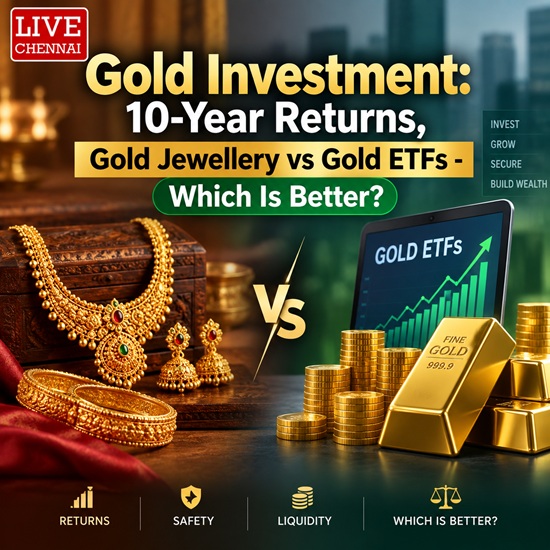
Gold has always held a special place in Indian households. Beyond its traditional value as jewellery, gold is also considered a form of savings and a financial asset that can provide support during emergencies.
With gold prices reaching significantly higher levels over the past decade, many investors are now asking an important question: Is gold still a good long-term investment? And when investing in gold, is it better to buy jewellery or choose financial products such as Gold ETFs?
Gold Price Growth Over the Last 10 Years
Gold has delivered strong returns over the past decade.
Gold price in 2016: ₹28,623 per 10 grams
Gold price in 2026: ₹1,53,250 per 10 grams
Based on these figures, the price of gold has increased more than five times over the 10-year period. This represents a strong annualized return over the period.
However, past performance does not guarantee similar returns in the future. Gold prices can fluctuate depending on factors such as inflation, interest rates, currency movements, global economic conditions and investor demand.
What Returns Can Gold Deliver Over the Next 10 Years?
Gold is generally considered a long-term asset that can help diversify an investment portfolio and act as a hedge against inflation.
Historical long-term returns have often been in the range of around 8% to 10% annually, although actual returns can vary considerably depending on the period considered.
Some market projections suggest that gold could continue to appreciate over the coming decade, but investors should not assume a fixed annual return. The future performance of gold will depend on several domestic and international economic factors.
Therefore, investors considering gold for the next 10 years should focus on long-term diversification rather than expecting guaranteed returns.
The Hidden Costs of Gold Jewellery
Gold jewellery may be attractive for personal use and traditional purposes, but it is not always the most efficient option purely as an investment.
When purchasing jewellery, buyers generally pay additional costs such as:
- Making charges
- Wastage charges, where applicable
- 3% GST on the transaction
These additional costs increase the amount paid at the time of purchase. When the jewellery is later sold, making charges and other purchase-related costs generally cannot be recovered in full.
For example, if a person spends ₹1 lakh on gold jewellery, the actual value of the gold content may be significantly lower than the total purchase price after accounting for making charges, wastage and GST.
The exact difference depends on the jewellery design, making charges, purity and the jeweller`s policies.
Gold ETFs: An Alternative to Physical Gold
For investors who want exposure to gold without purchasing jewellery, Gold Exchange Traded Funds (Gold ETFs) can be an alternative.
Gold ETFs are designed to track the price of gold and are traded on the stock exchange. They eliminate expenses associated with jewellery, such as making charges and wastage charges.
Some key advantages include:
Lower Additional Costs
Unlike jewellery, Gold ETFs do not involve jewellery-making or wastage charges. Investors instead pay fund-related expenses and applicable brokerage or transaction charges.
No Storage or Locker Costs
Physical gold jewellery requires safe storage. Gold ETFs are held electronically through the financial market infrastructure, eliminating the need for a personal locker for the investment.
Easy to Buy and Sell
Gold ETFs can be bought and sold through a demat and trading account during market trading hours, making them more convenient for investors who prefer financial-market investments.
Better Suited for Investment
Since Gold ETFs provide exposure to gold prices without jewellery-related costs, they can be more suitable for investors whose primary objective is investment rather than wearing or gifting gold.
Gold Jewellery vs Gold ETFs
| Feature | Gold Jewellery | Gold ETFs |
| Main purpose | Jewellery + savings | Investment |
| Making charges | Yes | No |
| Wastage charges | May apply | No |
| Storage requirement | Yes | No physical storage |
| Liquidity | Depends on buyer/jeweller | Can be traded on exchange |
| Gold exposure | Depends on purity and charges | Tracks gold price |
| Best suited for | Personal use, gifting and tradition | Portfolio diversification |
Which Gold Investment Is Better?
The answer depends on your objective.
If you want gold for wearing, gifting or traditional purposes, jewellery can serve that purpose. However, if your primary goal is to gain investment exposure to gold and avoid jewellery-related costs, Gold ETFs may be a more efficient option.
Investors should also consider other gold investment options, including gold mutual funds and government-backed gold-related products where available, and compare costs, liquidity, taxation and risk before investing.
Final Takeaway
Gold has delivered impressive growth over the past decade and can play a role in a diversified long-term investment portfolio. However, investors should not assume that the next 10 years will produce the same returns.
For pure investment purposes, Gold ETFs can offer a more cost-efficient way to gain exposure to gold than jewellery because they avoid making and wastage charges and do not require physical storage.
Before investing, compare the costs, taxation, liquidity and risk of each option and choose the one that best matches your financial goals.
Disclaimer: This article is for informational purposes only and is not financial or investment advice. Gold prices and returns can fluctuate, and past performance does not guarantee future returns. Investors should consider their financial goals and risk tolerance and consult a qualified financial advisor before investing.
Top Stories
-
 Tomorrow Panchangam September 10, 2026 | Auspicious Timings, Rahu Kalam, Gulikai09/Sep/2026 5:32:43 PM
 -
 5 ways a personal loan EMI calculator can make loan planning easier09/Sep/2026 5:22:29 PM
 -
Gold Investment: 10-Year Returns, Gold Jewellery vs Gold ETFs - Which Is Better?09/Sep/2026 5:16:35 PM
-
 Best Nightclubs in Chennai for a Night Out: Popular Weekend Party Spots09/Sep/2026 5:10:11 PM
 -
 Tamil Nadu Weather: Moderate Rain Likely in Chennai, Tiruvallur and Ranipet Today09/Sep/2026 5:08:58 PM
 -