
Business Must Win. Everyone Must Grow. - Thought leadership article by J Sampath, Founder and CEO of JB Soft System
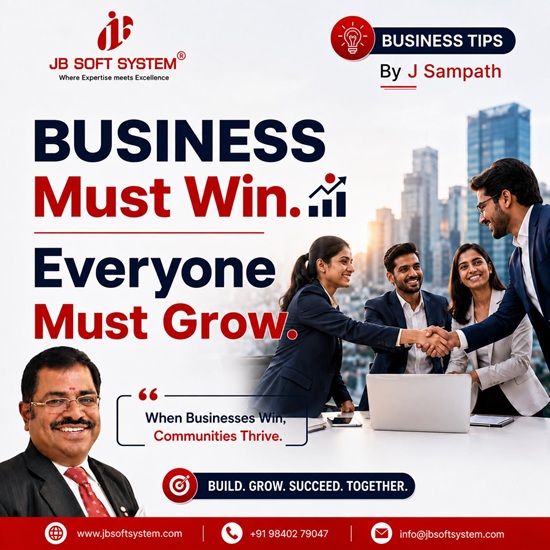
The Future of Business Is Fluid: Let the Business Win, Let Everyone Grow
Business must win. But business winning alone is not enough.
Employees must grow.
Customers must benefit.
Clients must succeed.
Vendors must prosper.
Families must feel secure.
Investors must see value.
Society must become stronger.
The real victory of a business is not merely higher revenue, greater profit, a larger team or a bigger market share.
The real victory is when everyone connected with the business feels that they are growing along with it.
And to achieve this in today`s rapidly changing world, businesses need one important quality:
Be Strong in Purpose, but Fluid in Approach
A business needs values. It needs discipline. It needs systems. It needs accountability.
But it should not become rigid.
What worked ten years ago may not work today. What works today may become irrelevant within the next three years or even the next few months.
Technology is changing.
Customer behaviour is changing.
The way people work is changing.
The way people learn is changing.
The way we communicate is changing.
Even the way information is created, stored, searched and consumed is undergoing a fundamental transformation.
So why should our business ideas remain unchanged?
Do not become emotionally attached to yesterday`s methods. Become committed to tomorrow`s possibilities.
AI Is Changing the Meaning of a "System"
Until recently, businesses spent enormous effort deciding how information should be entered into systems.
There were forms.
There were fields.
There were folders.
There were predefined formats.
There were databases with carefully designed structures.
Employees had to understand the system and enter information exactly the way the system expected.
AI is beginning to reverse this relationship.
Imagine a future where you simply provide the information documents, spreadsheets, emails, PDFs, images, voice recordings, videos, conversations or other forms of business data.
The intelligent system understands the information, organises it, connects it, retrieves what is relevant and presents it according to the rules, permissions and requirements of the organisation.
Instead of humans constantly adapting themselves to software, software will increasingly adapt itself to human needs.
Inputs will change.
Outputs will change.
Interfaces will change.
Communication itself will take new dimensions.
Therefore, business leaders cannot afford to build organisations based entirely on rigid assumptions about how tomorrow will work.
Don`t Chase Passion Into an Unrealistic Future
We often hear:
"Follow your passion."
"Think big."
"Never give up."
"Set massive goals."
These ideas can inspire us. But without context, they can also mislead us.
Passion without practicality can become obsession.
Ambition without sustainability can create instability.
A goal without regard for employees, customers, cash flow, market realities and families can create suffering instead of progress.
There is nothing wrong with dreaming big.
But a dream should create a better life not destroy the present while endlessly chasing the future.
Goals should stretch us, not break the ecosystem around us.
Business leaders should continuously ask:
Is this goal still relevant?
Is this method still relevant?
Is the market telling us something different?
Are our people growing with us?
Are our customers benefiting?
Are we creating stability along with growth?
Changing your method is not failure.
Changing your business model is not weakness.
Changing your goal after receiving new information is not giving up.
Evolution is intelligence.
No Business Should Fall Because Its Leaders Refused to Evolve
Businesses will naturally face difficulties. Markets will rise and fall. Technologies will disrupt industries. Competition will emerge.
Not every failure can be prevented.
But businesses should not collapse simply because leadership was unwilling to change an outdated idea, system, product, policy or goal.
A responsible leader must protect the organisation while continuously adapting it.
Sometimes we must expand.
Sometimes we must consolidate.
Sometimes we must invest.
Sometimes we must preserve cash.
Sometimes we must hire.
Sometimes we must reskill the existing team.
Sometimes we must automate.
Sometimes we must simplify.
Sometimes we must abandon something we once strongly believed in.
The destination may remain strong while the route keeps changing.
That is business flexibility.
Trust Is an Economic Asset
There is another dimension of business that we rarely discuss enough:
Trust.
When employees trust that an organisation is reasonably stable, they can focus on doing meaningful work.
When customers trust a company, relationships become stronger.
When vendors trust a business, cooperation improves.
When families trust the stability of employment and income, they can plan their lives with greater confidence.
When business owners trust their teams, delegation becomes possible.
When teams trust their leaders, collaboration becomes easier.
Trust creates invisible economic value.
But repeated uncertainty destroys it.
Imagine someone who has repeatedly witnessed organisations suddenly collapse, leadership disappear, salaries become uncertain or commitments get broken.
The next time that person joins an organisation, the mind naturally asks:
"How long will this last?"
That uncertainty follows the person.
And when millions of individuals begin living with uncertainty about their employment, income, businesses and future, it becomes more than an organisational problem.
It becomes a social problem.
Without individual peace, lasting harmony is difficult.
Without trust, cooperation weakens.
Without cooperation, brotherhood is challenged.
People begin living in fear of tomorrow instead of contributing confidently to today.
Business Leaders Carry a Larger Responsibility
A business leader is not responsible only for profit.
Every sustainable organisation supports an ecosystem.
An employee may support an entire family.
A vendor may employ another twenty people.
A customer may depend on your product for their own business.
A distributor may have invested years building a market around your brand.
A client may have trusted you with an important part of their operations.
Our decisions therefore travel much further than the walls of our offices.
This does not mean businesses should avoid difficult decisions.
Sometimes difficult decisions are essential for survival.
But decisions can still be taken with transparency, empathy, fairness and responsibility.
People should not merely be resources used for the growth of a business. They should be participants in that growth.
Build an Inclusive Business Ecosystem
The businesses of the future should increasingly ask:
How can we grow together?
Let employees gain skills, income, confidence and opportunities.
Let customers receive genuine value.
Let vendors grow along with the organisation.
Let partners have meaningful opportunities.
Let investors receive sustainable returns.
Let families experience greater security.
Let society benefit from the economic activity created.
And let the business itself become stronger and more profitable.
These objectives need not oppose one another.
The challenge of leadership is to design a business model in which they reinforce one another.
That is a much more meaningful definition of growth.
Solid Values. Fluid Methods.
Perhaps this is the leadership model required for the coming years:
Be solid about values.
Be fluid about methods.
Be solid about integrity.
Be solid about trust.
Be solid about commitments.
Be solid about creating value.
Be solid about people`s dignity.
But be fluid about technology.
Be fluid about processes.
Be fluid about organisational structures.
Be fluid about products.
Be fluid about communication.
Be fluid about business models.
Be fluid even about goals when reality provides better information.
Don`t protect an outdated process simply because *"this is how we have always done it."
Protect the purpose not necessarily the process.
From "My Victory" to "Our Victory"
The old entrepreneurial story often celebrates the individual:
"I built it."
"I won."
"I achieved my dream."
But perhaps the next generation of entrepreneurship needs a different story.
We built it.
We grew together.
We created value together.
We protected each other`s trust.
We became stronger together.
A great business should not leave exhausted employees, disappointed customers, struggling vendors and anxious families behind while celebrating its own success.
Its success should spread.
A New World Needs a New Business Mindset
The world ahead will not be built successfully with rigid organisations trying to control every change.
Neither will it be built through endless uncertainty where people never know what tomorrow holds.
We need something in between:
Stability in values. Flexibility in execution.
Businesses that adapt without losing their identity.
Leaders who change direction without breaking trust.
Technology that empowers people rather than merely replacing processes.
Goals that inspire without becoming unrealistic burdens.
Growth that includes the people who helped create it.
And organisations where success creates greater confidence and peace not greater fear.
Let the business win.
Let the employee win.
Let the customer win.
Let the client win.
Let the vendor win.
Let the investor win.
Let the family win.
Let society win.
Because ultimately, the greatest business is not one that simply becomes bigger.
It is one that becomes stronger while making everyone connected with it stronger too.
Business Tip
Build with trust. Lead with responsibility. Stay fluid enough to evolve. Grow in a way that allows everyone around the business to feel the growth.
That may be the most sustainable definition of business success in the new world.
- J. Sampath
Business Growth Strategist
About the Author
J. Sampath is the Founder and CEO of JB Soft System, a premier Chennai-based IT consulting and custom software development firm established in 2001. He is widely recognized for his unique philosophies on debt-free business growth, standard operating procedures (SOPs), and values-driven leadership. He regularly shares his business insights, operational frameworks, and morning reflections to empower the next generation of entrepreneurs.
Top Stories
-
Chennai Gold Rate Rises Sharply in Evening Trading; Sovereign Up by ₹1,28014/Aug/2026 6:46:26 PM
-
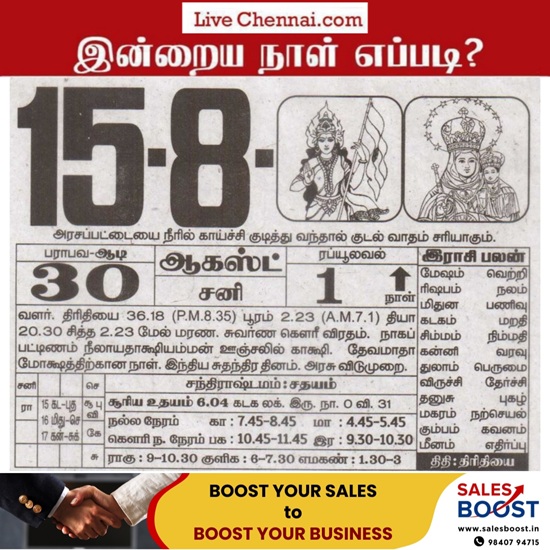 Tomorrow Panchangam August 15, 2026 | Auspicious Timings, Rahu Kalam, Gulikai14/Aug/2026 5:54:30 PM
 -
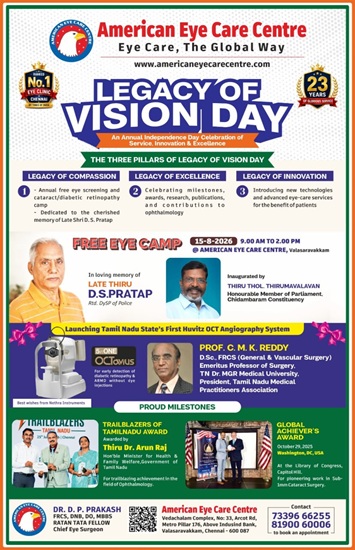 American Eye Care Centre to Host Legacy of Vision Day and Free Eye Camp in Chennai14/Aug/2026 5:48:10 PM
 -

-
 The Fastest Way to Grow Your Business Is to Grow Your Leadership14/Aug/2026 4:39:34 PM
 -
 Adambakkam Multi-Level Metro Station: Chennai Metro Phase 2 | See Full Video14/Aug/2026 4:34:06 PM