
Remembering E.V. Ramasamy on His Birth Anniversary and His Enduring Connection with Chennai
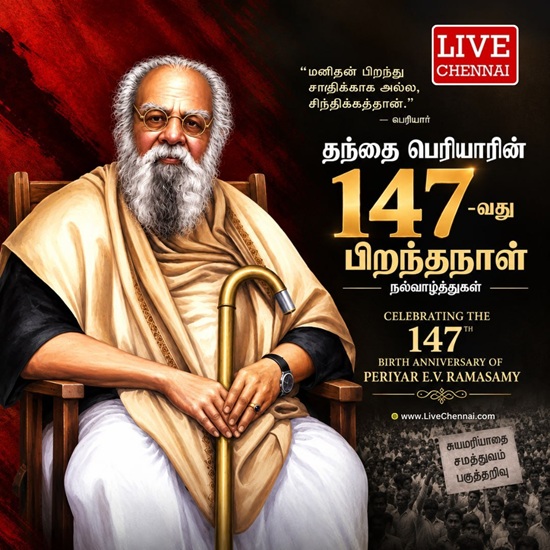
Some leaders are remembered for the positions they held. Some are remembered for the institutions they built. A rare few are remembered because they compelled an entire society to question beliefs that had gone unchallenged for generations.
Erode Venkata Ramasamy revered as Thanthai Periyar belonged to that rare category.
Born on September 17, 1879, Periyar entered the world 147 years ago. Tamil Nadu observes his birth anniversary as Social Justice Day, reflecting the continuing influence of his campaigns against caste discrimination, social inequality, denial of education, gender injustice and unquestioned authority.
Periyar was admired by many, strongly opposed by others and debated throughout his life. Yet few can deny the depth of his influence on modern Tamil Nadu. His questions altered political thought, family relationships, marriage practices, women’s rights, access to education, representation in public institutions and the meaning of human dignity.
Though born in Erode, Chennai became one of the most important centres from which his ideas travelled across Tamil society. From public meetings and protest movements to newspapers, books, institutions and Periyar Thidal, the city continues to preserve and debate his legacy.
From Erode Merchant to Fearless Social Reformer
Periyar was born into a prosperous trading family in Erode. His parents were Venkatappa Naicker and Chinnathayammal.
His formal schooling ended at a relatively young age, but his education did not. He learned through observation, travel, business, public administration, reading and constant engagement with people.
He successfully managed his family’s business and became involved in civic and public affairs in Erode. His experience in trade gave him practical organisational ability, while his public service exposed him to the inequalities that shaped everyday life.
A deeply significant experience in his early life was his visit to Kashi. Accounts of this journey describe how he encountered caste discrimination even in places associated with faith and charity. The experience strengthened his criticism of social hierarchy and religious practices that, in his view, denied equal dignity to human beings.
He gradually emerged as a man unwilling to accept tradition merely because it was old.
His essential question was simple but revolutionary:
If a practice humiliates another human being, why should society continue it in the name of custom, religion or authority?
His Years in the Indian National Congress
Periyar joined the Indian National Congress in 1919 and took part in campaigns including the Non-Cooperation Movement. He promoted khadi, opposed intoxicating liquor and supported national political mobilisation.
However, his political concern extended beyond freedom from colonial rule. He repeatedly raised the issue of social representation and opportunities for historically excluded communities.
Periyar eventually left the Congress in 1925. He believed political freedom would remain incomplete if caste hierarchy and social inequality continued within Indian society.
For him, independence was not simply about replacing a foreign ruler w with an Indian ruler. It had to transform the daily life and social status of the ordinary person.
Vaikom and the Fight for the Right to Walk
One of the defining episodes of Periyar’s public life was his participation in the Vaikom Satyagraha in present-day Kerala.
The movement opposed restrictions that prevented oppressed-caste communities from using roads surrounding the Vaikom temple. Periyar travelled to Vaikom, participated in the agitation, faced imprisonment and continued supporting the campaign.
The struggle was not merely about access to a road. It raised a much larger question:
Can a public pathway belong to one section of society and remain forbidden to another solely because of birth?
His role in the struggle earned him the title “Vaikom Veerar” the Hero of Vaikom.
For a modern metropolitan city like Chennai, the lesson remains relevant. Roads, schools, neighbourhoods, workplaces, parks, transport systems and public institutions must be equally accessible to every citizen.
A city becomes truly modern not when it builds taller structures, but when no human being is made to feel smaller.
The Birth of the Self-Respect Movement
In 1925, Periyar gave organised direction to what became known as the Self-Respect Movement.
The movement questioned caste hierarchy, hereditary privilege, gender inequality, religious orthodoxy and social customs that placed one individual above another.
Its central message was that every human being deserves dignity—not because of birth, wealth, caste, gender or religious status, but simply because they are human.
Self-respect, in Periyar’s understanding, was not personal pride or arrogance. It was the refusal to accept humiliation as destiny.
The movement encouraged people to ask:
- Why should birth determine a person’s status?
- Why should education be denied to certain communities?
- Why should women remain dependent throughout their lives?
- Why should rituals be valued more than mutual consent?
- Why should inherited beliefs be protected from examination?
- Why should anyone accept inferiority without questioning it?
These questions travelled through speeches, conferences, magazines, pamphlets, books, street campaigns and conversations in homes.
The Chengalpattu Conference and Chennai’s Wider Region
A landmark event in the history of the movement was the first provincial Self-Respect Conference held at Chengalpattu in 1929, close to Chennai.
The conference discussed issues that were extraordinarily progressive for its time: caste equality, women’s education, widow remarriage, inter-caste marriage, property rights for women, the rejection of caste titles and the conduct of marriages without compulsory priestly rituals.
The conference helped transform the Self-Respect Movement from a collection of ideas into a broad social programme.
Its location near Madras was significant. Madras was already an important centre of education, journalism, law, administration and political debate. Ideas discussed at Chengalpattu found their way into the public life of the city and, from there, across the Presisidency.
When Chennai Gave Him the Name “Periyar”
One of the most meaningful events connecting E.V. Ramasamy with Chennai occurred in November 1938.
At the Tamil Nadu Women’s Conference held in Madras, women leaders honoured E.V. Ramasamy with the title “Periyar,” meaning “the great one” or “the respected elder.”
The recognition was particularly significant because women were among the strongest beneficiaries and participants in the social reforms he advocated.
The title did not originate from political office or governmental authority. It emerged from a social movement that recognised his uncompromising advocacy for human dignity, particularly the emancipation of women and oppressed communities.
From that point onward, E.V. Ramasamy became known across generations simply as Periyar.
The Anti-Hindi Agitation in Madras
Chennai then Madras was also an important centre of the anti-Hindi agitations of the late 1930s.
Periyar opposed the compulsory introduction of Hindi in schools. He argued that language education should not become an instrument through which one linguistic community exercised authority over another.
His campaign was not merely about resisting a language. It was about the right of people to protect their mother tongue, determine their educational priorities and participate in India without surrendering their linguistic identity.
Public meetings, processions and arrests associated with the agitation made Madras an important battleground in Tamil Nadu’s language politics.
The later two-language approach followed in Tamil Nadu—Tamil and English—was shaped by this long history of language-based political mobilisation.
For today’s Chennai, one of India’s most global cities, the message can be understood in a constructive way:
Let Tamil remain our cultural foundation, while every language and skill required to engage with the world becomes part of our strength.
Language pride need not become hostility towards another language. True confidence protects one’s identity without denying another person’s dignity.
Journalism as a Tool of Social Change
Periyar understood that a movement could not survive on public meetings alone. It required a continuous exchange of ideas.
He used publications such as Kudi Arasu, Revolt, Pagutharivu and Viduthalai to question caste, superstition, patriarchy, social inequality and political authority.
Viduthalai, launched in 1935 and later converted into a daily newspaper, became one of the principal vehicles for carrying his ideas. Its long association with Chennai strengthened the city’s role as the publishing and intellectual centre of the Dravidian movement.
Long before television and social media, Periyar used the printing press as a public classroom.
His method offers a lesson for the digital age: communication platforms are powerful, but their social value depends on whether they spread knowledge, encourage thought and hold authority accountable or merely amplify anger and misinformation.
Women’s Freedom at the Heart of S Social Progress
Periyar’s views on women’s rights were radical for his time.
He questioned child marriage, compulsory widowhood, denial of education, unequal marriage customs, economic dependence and the belief that a woman’s life must always be controlled by a father, husband or son.
He advocated:
- Education for girls and women
- Equal dignity within marriage
- Widow remarriage
- The right of women to choose their partners
- Women’s right to property
- Economic independence
- Freedom from oppressive customs
- Greater participation in public life
For Periyar, the progress of a society could not be measured while half its population remained restricted by fear, dependency and unequal expectations.
This remains a pressing message for Chennai.
A city cannot call itself advanced merely because women receive degrees or enter the workforce. They must also be safe on the streets, treated equally at work, respected within families, represented in leadership and free to make decisions about their own lives.
Self-Respect Marriages and Human Equality
The Self-Respect Movement promoted marriages based on the consent and equality of the couple, without requiring compulsory religious rituals or the presence of a priest.
These marriages challenged caste restrictions, excessive expenditure and the unequal treatment of women.
In 1967, the government led by Chief Minister C.N. Annadurai gave legal recognition to Self-Respect marriages in Tamil Nadu. Thus, an idea raised through social reform eventually became part of the law.
This was one of Periyar’s greatest strengths: he did not merely ask individuals to think differently. He created public movements that eventually influenced legislation and institutions.
For today’s families, Self-Respect marriage carries a wider message:
The value of a marriage lies not in the cost of the ceremony, but in mutual consent, equality, understanding and dignity.
Justice Party and Dravidar Kazhagam
Periyar later became the leader of the Justice Party. In 1944, the movement was reorganised as the Dravidar Kazhagam.
He chose to keep the Dravidar Kazhagam primarily as a social movement rather than an electoral political party. Periyar believed that changing governments alone would not be enough; the deeper attitudes of society also had to change.
C.N. Annadurai, who had worked closely with Periyar, later took a different path and founded the Dravida Munnetra Kazhagam in 1949.
Though political paths separated, Periyar’s emphasis on social justice, representation, rationalism, Tamil identity and state rights continued to influence the Dravidian political parties that came to power in Tamil Nadu.
His impact can therefore be seen not only in one organisation, but across the political and social vocabulary of the state.
Periyar Thidal: A Living Centre in Chennai
Among Chennai’s strongest physical connections with Periyar is Periyar Thidal in Vepery.
Located on E.V.K. Sampath Road, Periyar Thidal has long served as an important centre associated with the Dravavidar Kazhagam, Periyar’s publications, public meetings, research and the preservation of his writings.
It also houses institutions dedicated to studying rationalism and social reform. The Periyar Rationalist Digital Library and Research Centre traces its origins to a library inaugurated at Periyar Thidal on September 17, 1974.
Periyar Thidal is not merely a memorial to a historical personality. It remains a place where his speeches, books, movement history and social questions continue to be studied and discussed.
In a city that is constantly rebuilding itself, such spaces are important. They preserve not only the memory of leaders, but also the history of ideas that shaped society.
Periyar’s Final Journey and Memorial in Chennai
Periyar continued travelling, speaking and campaigning into his nineties.
He died on December 24, 1973, at the age of 94, in Vellore. His body was brought to Chennai, where large numbers of people gathered to pay their respects.
His final resting place is at Periyar Thidal in Chennai.
The memorial stands in the city not as the resting place of a ruler, but of a social reformer who repeatedly rejected political office and devoted his life to public campaigns.
His journey from Erode to Vaikom, from Chengalpattu to Madras, from printed pamphlets to public policy became part of Tamil Nadu’s modern social history.
Periyar and Rationalism
Periyar’s rationalism was rooted in the belief that no idea should be protected from questioning merely because it was old, popular or associated with authority.
He encouraged people to examine claims through evidence, reason and human consequences.
His criticism of religion and religious symbols was forceful and often controversial. Supporters viewed his confrontational methods as necessary to challenge deeply entrenched discrimination. Critics considered some of his expressions excessive or offensive.
A complete understanding of Periyar requires acknowledging both his transformative influence and the controversies surrounding his methods.
To engage seriously with his legacy is not to accept every statement without question. That itself would contradict the spirit of inquiry he advocated. It is to examine his arguments, understand their historical setting and judge whether they advance equality and human dignity.
Rationalism must never become another form of unquestioning loyalty. Its purpose is to preserve the freedom to ask, examine, disagree and learn.
What Chennai Can Learn from Periyar Today
Chennai has grown into a major centre of healthcare, education, automobile manufacturing, information technology, finance, cinema, arts and entrepreneurship.
Yet a modern city must be measured by more than its economy, skylines, flyovers and technology parks.
It must also ask whether every resident is treated with dignity.
1. End discrimination in everyday life
Caste discrimination does not exist only in history books. It can appear in housing, marriage, employment, education, social networks and access to shared spaces.
Chennai must become a city where a person’s name, caste, religion, languauage, food choice or place of birth does not determine the respect or opportunity they receive.
2. Build equality within homes
Social justice begins at home.
Daughters and sons must receive equal education, freedom, nutrition, property and encouragement. Domestic work and caregiving should not automatically become a woman’s responsibility. Respect must be practised within the family before it is demanded from society.
3. Protect dignity at every workplace
From corporate offices and hospitals to shops, construction sites and sanitation work, every worker deserves respect.
Designation, salary and educational background may differ; human dignity does not.
Chennai’s growth must include fair wages, safe workplaces, protection from harassment and recognition of those whose labour keeps the city functioning.
4. Encourage scientific thinking
In an age of viral rumours, fabricated videos and artificial intelligence, rational thinking is more important than ever.
Before forwarding a message, people should verify it. Before accepting a medical claim, they should seek evidence. Before judging another community, they should question the source of the prejudice.
Modern rationalism begins with a small digital habit: pause, verify and then share.
5. Make quality education accessible
Chennai contains some of India’s finest schools, colleges and research institutions. But the quality of a child’s education should not depend entirely on family income.
A city faithful to social justice must strengthen public education, libraries, scholarships, digital access and learning support for first-generation students.
6. Debate without hatred
Periyar was a fierce critic of ideas and institutions. Modern public debate, however, must distinguish between challenging an idea and humiliating an individual.
Chennai should remain a city where people can disagree strongly without violence, threats, abuse or the denial of another person’s humanity.
7. Ensure technology reduces inequality
Artificial intelligence and automation are changing employment, education and business. These advances should not benefit only those who already possess wealth, English fluency and digital access.
Technology must reach government-school students, small traders, workers, women, senior citizens and people with disabilities—in Tamil as well as in English.
A Message to the People of Chennai
Dear Chennai residents,
We live in a city where ancient temples stand near technology corridors, where classical arts coexist with cinema, where traditional neighbourhoods meet a global workforce and where people arrive from every part of Tamil Nadu and India carrying different dreams.
Our diversity is our strength—but only when it is accompanied by equality.
Let us not remember Periyar only through statues, slogans and ceremonial garlands.
Let us remember him whenever we refuse to discriminate.
Let us remember him whenever we educate a daughter without limiting her dreams.
Let us remember him whenever we e respect a worker irrespective of occupation.
Let us remember him whenever we question misinformation before sharing it.
Let us remember him whenever we welcome an inter-caste couple with dignity rather than hostility.
Let us remember him whenever we give a first-generation learner an opportunity.
Let us remember him whenever we choose reason over rumour, equality over inherited prejudice and human dignity over social status.
The finest tribute Chennai can offer Periyar is not a larger celebration it is a fairer city.
A city where no one is considered high or low by birth.
A city where women walk with freedom and confidence.
A city where education opens doors for every child.
A city where work carries dignity.
A city where Tamil identity grows alongside global knowledge.
A city where disagreement produces discussion, not hatred.
A city where progress reaches the last person.
His Questions Still Walk Among Us
Periyar passed away more than five decades ago, but the questions he raised have not disappeared.
Are human beings truly equal in our homes and institutions?
Do women enjoy complete freedom and dignity?
Has caste ceased to influence opportunity?
Is education available to everyone?
Do we examine information before believing it?
Can we question authority without fear?
Does development include those at the margins?
As long as these questions remain relevant, Periyar remains relevant.
One may agree with him, disagree with him or critically examine his methods. But one cannot seriously discuss modern Tamil Nadu without engaging with the social questions he placed before its people.
On his birth anniversary, let Chennai remember Thanthai Periyar not merely as a portrait from the past, but as a continuing invitation to think.
Question what degrades humanity.
Reject what divides people by birth.
Educate without exclusion.
Respect without discrimination.
And build a society in which every person can stand with self-respect.
That would be the most meaningful tribute to Thanthai Periyar.
Top Stories
-
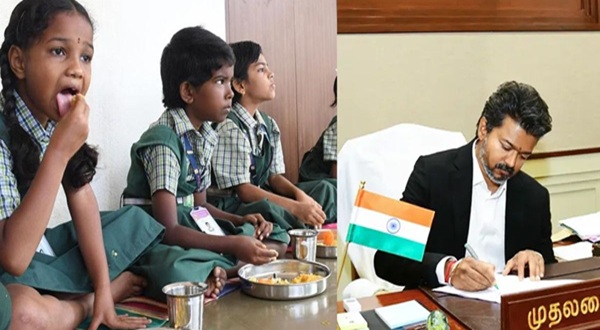 Kamarajar Breakfast Scheme to Expand to Classes 6–8 From September 2217/Sep/2026 10:18:53 AM
 -
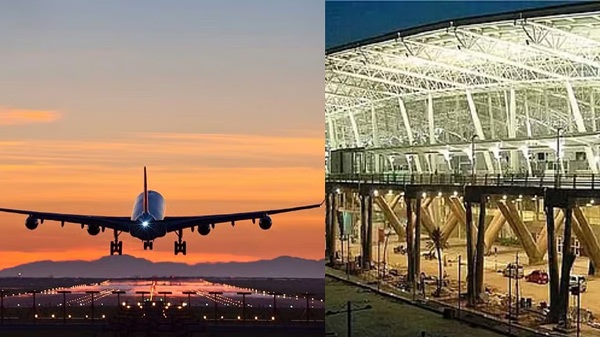 Chennai Airport to Handle 35 Million Passengers Annually by April 202717/Sep/2026 9:58:17 AM
 -
 Gold Rate Today in Chennai: 22K Gold Falls ₹55 Per Gram, Silver Unchanged17/Sep/2026 9:54:16 AM
 -
-
 CMWSSB to Suspend Sewage Pumping Stations in Royapuram, Teynampet for 16 Hours17/Sep/2026 9:45:29 AM
 -
Remembering E.V. Ramasamy on His Birth Anniversary and His Enduring Connection with Chennai17/Sep/2026 9:37:09 AM