
Tambaram: The Untold History of Chennai’s Southern Gateway
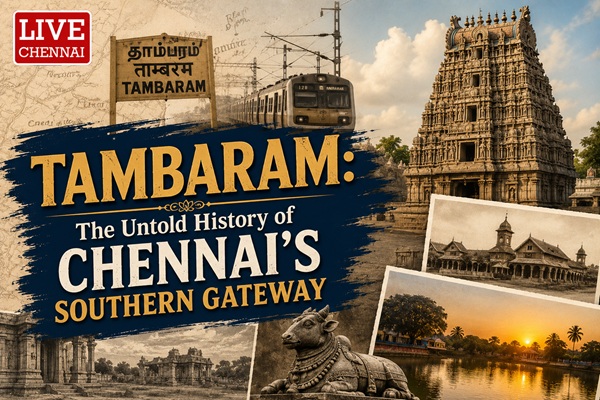
Today, Tambaram is best known as a bustling railway junction, a major bus hub and one of Chennai’s fastest-growing suburban centres. But beneath the traffic, commercial streets and residential neighbourhoods lies a much older story.
Tambaram’s history stretches across centuries from Chola-era settlements and temple inscriptions to colonial military camps and the arrival of electric suburban trains. Its transformation from an agrarian landscape into a major urban gateway reflects the wider evolution of Chennai itself.
From “Taamapuram” to Tambaram
One of the earliest known references to Tambaram appears under the name “Taamapuram” in a 13th-century inscription associated with the Marundeeswarar Temple at Tirukachur, near Chengalpattu.
The reference places Tambaram’s name in the historical record centuries before Madras emerged as a major colonial city.
During the Later Chola period, from around the 9th to 12th centuries CE, the wider region formed part of Churathur Nadu. This suggests that the area around present-day Tambaram was once part of an established agrarian and temple-centred landscape, rather than simply an undeveloped stretch outside the city.
The Chola Legacy Around Tambaram
One of the most important historical landmarks in the region is the Dhenupureeswarar Temple at Madambakkam, located near Tambaram.
The temple is believed to have been constructed between 956 and 973 CE during the reign of Parantaka Chola II, also known as Sundara Chola, the father of Rajaraja Chola I.
The inscriptions at the temple offer a glimpse into the social and economic life of the period. The original name associated with the presiding deity was Sittreri Udaiya Nayanar, meaning the “lord of the small lake”—a reference that connects the temple to the local water system and settlement.
Inscriptions from the Chola, Pandya and Vijayanagara periods also point to continued patronage, land grants and religious activity over several centuries.
For anyone exploring the lesser-known history of Chennai, these temples provide an important reminder that the southern suburbs were once part of a network of agrarian settlements, temple communities and traditional villages.
From Temple Landscape to Military Camp
Tambaram`s strategic importance grew during the colonial period.
By the late 17th century and the era of the Carnatic Wars, the area was used as a camp by the British East India Company. Its location along the southern approach to Madras made it useful for military movement and logistics.
This strategic role continued into the 20th century with the establishment of the Tambaram Air Force Station. The military presence added another layer t to the area`s identity, transforming Tambaram from an essentially agrarian region into an important strategic location connected to the expanding city.
Thus, Tambaram developed an unusual combination of identities: an area shaped by ancient temples and agricultural settlements, while also becoming an important military and transport corridor.
The Railway Revolution
Perhaps no development changed Tambaram more dramatically than the arrival of the railway.
On 2 April 1931, the first electric suburban train service in the Madras region began operating between Madras Beach and Tambaram. The service was inaugurated by Governor Sir George Frederick Stanley.
The electrification of the suburban railway marked a major turning point. Tambaram became the southern terminus of one of the city`s earliest electric suburban corridors, making daily commuting between the city and its southern outskirts easier.
Over the decades, improved rail connectivity encouraged residential development, commercial activity and population growth. What had once been a peripheral settlement gradually became an important suburban centre.
Tambaram: Chennai’s Southern Gateway
Today, Tambaram remains one of the most important transportation hubs in Chennai`s southern region.
The railway station connects the suburbs with central Chennai and destinations farther south, while major road corridors carry thousands of commuters and travellers every day.
Yet the modern traffic and urban development can easily obscure the area`s deeper past.
The name Taamapuram, the Chola-era temple landscape, the colonial military camp and the 1931 electric railway are not isolated chapters. Together, they explain how Tambaram evolved from an ancient settlement landscape into one of Chennai`s most important southern gateways.
The Untold History of Tambaram
Tambaram`s story can be understood through three major transformations.
First came the temple and agrarian landscape, represented by ancient inscriptions, Chola settlements and historic temples.
Then came the military era, when its strategic location turned Tambaram into an important colonial camp and later a defence centre.
Finally came the suburban revolution, led by the railway and followed by rapid residential and commercial expansion.
That is what makes Tambaram`s history particularly fascinating. It is not simply the story of a Chennai suburb it is the story of how centuries of history, transport, defence and urbanisation came together to create one of the city`s most important southern gateways.
Top Stories
-
 Mettur Dam Water Released for Cauvery Delta Irrigation: CM Vijay Opens Sluice Gates01/Sep/2026 1:02:17 PM
 -
Tambaram: The Untold History of Chennai’s Southern Gateway01/Sep/2026 11:55:51 AM
-
 Tamil Nadu Announces ₹55,628 Crore Power Infrastructure Projects01/Sep/2026 11:52:46 AM
 -
 PM Modi Urges Indians to Avoid Unnecessary Foreign Trips, Overseas Weddings and Gold Purchases01/Sep/2026 11:49:12 AM
 -
 5 Best Temples to Visit in and Around Tambaram, Chennai01/Sep/2026 11:45:33 AM
 -
 5 Best Places to Visit in and Around Tambaram, Chennai01/Sep/2026 11:34:59 AM