
MSME Amendment Bill 2026 Passed: Faster Payments, Stronger Recovery & Major Benefits for Small Businesses
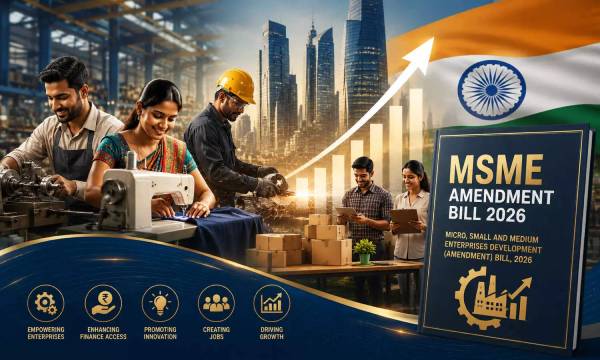
In a significant development for India`s Micro, Small and Medium Enterprises (MSME) sector, Parliament has passed the Micro, Small and Medium Enterprises Development (Amendment) Bill, 2026.
The Lok Sabha passed the Bill on August 7, 2026, following its passage in the Rajya Sabha on August 3, 2026. The amendment updates the MSMED Act, 2006, after two decades and aims to create a stronger and more business-friendly framework for India`s MSMEs.
According to the Ministry of Micro, Small & Medium Enterprises, the number of MSMEs registered on Udyam has increased from around 1.65 crore as of April 1, 2023, to about 9.16 crore, and the sector provides employment to more than 40 crore people.
What Changes for MSMEs?
One of the most important areas addressed by the amendment is the long-standing problem of delayed payments to Micro and Small Enterprises.
For many small businesses, getting an order is only the first challenge. Receiving payment on time is equally important. When payments are delayed for months, businesses can face difficulties in paying salaries, suppliers, taxes and other operating expenses.
The new amendments seek to make the payment and dispute-resolution system faster and more effective.
Key Highlights of the MSME Amendment Bill 2026
1. Udyam Registration gets stronger legal recognition
The amendment incorporates MSME classification based on the twin criteria of investment in plant/machinery and turnover into the Act. It also gives permanence to the Udyam Registration Portal as a digital, free and voluntary registration platform for MSMEs.
2. Faster action on delayed-payment disputes
The amendment strengthens the mechanism available to Micro and Small Enterprises for resolving disputes involving delayed payments.
Importantly, if an application challenging an award or payment order remains pending for more than six months, courts can order payment of at least 50% of the awarded amount to the Micro or Small Enterprise supplier.
3. Time limits introduced for dispute resolution
The amended framework introduces timelines intended to prevent payment disputes from continuing indefinitely.
Mediation is required to be completed within 90 days from the date fixed for the first appearance. If mediation fails, the matter must be referred for arbitration within 30 days, while the award is to be made within 90 days from completion of pleadings.
4. Stronger mechanism to recover MSME dues
Another major provision strengthens recovery of amounts due to MSMEs.
Mediated settlement agreements or arbitral awards covered under the framework can be recovered as arrears of land revenue through the appropriate district authorities. This could make enforcement considerably more effective for eligible businesses that have already secured an award or settlement.
5. Faster invoice settlement through TReDS
Central Public Sector Enterprises (CPSEs) will be required to route settlement of invoices for goods and services procured from MSMEs through the Trade Receivables Discounting System (TReDS).
TReDS helps MSMEs improve liquidity by facilitating financing against trade receivables rather than simply waiting for the buyer`s normal payment cycle.
6. States can establish more Facilitation Councils
The amendment also gives State Governments greater flexibility in forming Micro and Small Enterprises Facilitation Councils (MSEFCs).
More councils could help distribute cases and enable quicker handling of delayed-payment disputes.
7. Ease of Doing Business gets a boost
The amendment moves towards a more trust-based regulatory system by replacing certain conviction-based fines with graded civil penalties.
For specified compliance failures, the framework provides warnings for first instances and progressively higher penalties for subsequent violations rather than treating every lapse through criminal-style provisions.
Why This Matters to Small Businesses
For an MSME, cash flow is the lifeline of the business.
A company may have good sales and profitable orders on paper, but if customers delay payments for several months, the business can still struggle.
The MSME Development (Amendment) Bill, 2026 attempts to address this practical problem through a combination of faster dispute resolution, stronger recovery mechanisms, digital invoice financing and clearer timelines.
For MSMEs supplying products or services to larger organisations and public-sector enterprises, these changes could become particularly significant.
A Step Towards a Stronger MSME Ecosystem
India`s MSMEs play a major role in employment generation, entrepreneurship, manufacturing, services and regional economic development.
The effectiveness of the amendments will ultimately depend on their implementation, including how quickly dispute-resolution mechanisms operate and how efficiently the new payment provisions are enforced.
For entrepreneurs and small-business owners, however, the direction is encouraging: doing business should not only mean getting more orders - it should also mean getting paid on time.
Source: Ministry of Micro, Small & Medium Enterprises, Government of India – Press Information Bureau.
Top Stories
-
 MBBS, BDS Rank List to Be Released on August 10 in Tamil Nadu09/Aug/2026 6:30:39 PM
 -
 Mobile Phones to Be Banned Inside Major Tamil Nadu Temples from September 109/Aug/2026 5:30:52 PM
 -
-
 August 10, 2026 Panchangam - Nalla Neram, Rahu Kalam, Yamagandam & Auspicious Timings08/Aug/2026 8:43:13 PM
 -
 Tomorrow Panchangam August 09, 2026 | Auspicious Timings, Rahu Kalam, Gulikai08/Aug/2026 8:41:33 PM
 -
 Why Do Your Feet Hurt at Night? Common Causes and Ways to Find Relief08/Aug/2026 12:02:29 PM