
Prime Minister Narendra Modi’s 76th Birthday: From Vadnagar to the Country’s Highest Democratic Office!
Life Journey, National Leadership, Connections with Chennai and a Special Message for Chennai Residents
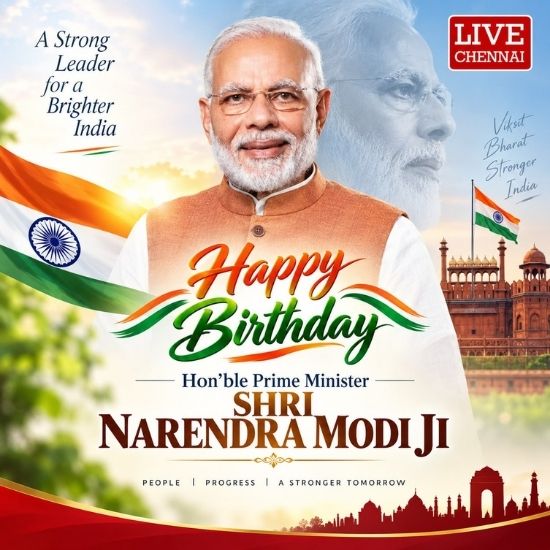
Indian Prime Minister Narendra Damodardas Modi is celebrating his 76th birthday today.
Born into a humble family in the small town of Vadnagar in Gujarat, his journey to becoming the Prime Minister of India for the third consecutive time is one of the notable journeys in contemporary Indian political history.
His supporters praise him as a determined leader who has improved the country’s infrastructure, expanded digital governance, taken welfare schemes to people on a large scale, and enhanced India’s position on the global stage.
At the same time, his economic decisions, centralisation of power, social harmony, employment situation and relationship with the states continue to face criticism and debate.
Whether one supports or opposes him politically, it cannot be denied that Narendra Modi has emerged as one of the most influential political leaders in independent India.
As far as Chennai is concerned, his visits have been associated with several important events. IIT Madras, the Chess Olympiad, the Khelo India Youth Games, the new terminal at Chennai Airport, the Chennai–Coimbatore Vande Bharat train and major infrastructure projects are among them.
Rather than limiting ourselves to birthday wishes, let us also reflect on his life journey, leadership qualities, achievements, controversies and the responsibilities of citizens in development.
A Life That Began in Vadnagar
Narendra Modi was born on September 17, 1950, in Vadnagar, in present-day Gujarat.
His parents were Damodardas Mulchand Modi and Heeraben Modi. He was the third child in a family of six children.
Modi has mentioned at various events that, during his childhood, he helped at the tea stall run by his father near Vadnagar railway station. This humble family background later became an important part of his public identity and political communication.
After completing his schooling in Vadnagar, he showed an interest in public speaking, drama and debates at a young age. Later, according to his official biography, he obtained a master’s degree in political science from Gujarat University.
His journey conveyed an inspiring message to millions of Indians from ordinary families:
The place where a person is born need not limit the heights they can reach.
A Leader Shaped by Organisational Work
Narendra Modi came into contact with the Rashtriya Swayamsevak Sangh at a young age and later worked as a full-time organiser.
His experience of travelling to various regions for organisational work helped him develop skills in coordinating grassroots workers, reaching people, planning campaigns and leading teams.
AfAfter later joining the Bharatiya Janata Party, he held various organisational responsibilities from the state level in Gujarat to the national level.
Even before becoming a widely recognised public face, he was involved behind the scenes in election planning and efforts to strengthen the party organisation.
His leadership qualities, including precise planning, organised communication, consistently emphasising a particular message, using technology and maintaining direct contact with workers, developed through his organisational experience.
As Chief Minister of Gujarat
Narendra Modi became the Chief Minister of Gujarat in October 2001 and remained in the position until May 2014.
During his tenure, investment, industrial development, road infrastructure, electricity, agriculture and entrepreneurship were given priority. Through global investor summits, Gujarat was projected as a state conducive to business and industry.
His supporters praised him for transforming Gujarat into a state associated with rapid development and administrative efficiency.
At the same time, the Gujarat riots of 2002 and the way the state administration functioned at that time became subjects of intense debate at the national and international levels.
Narendra Modi denied the allegations against him. The Special Investigation Team appointed by the Supreme Court stated that there was insufficient evidence to prosecute him.
To fully understand Modi’s tenure in Gujarat, both the development perspective associated with him and the controversies that continued alongside his rise need to be considered together.
The National Verdict of 2014
In the 2014 Lok Sabha election, the Bharatiya Janata Party, under Narendra Modi’s leadership, secured a clear majority.
He was sworn in as the Prime Minister of India on May 26, 2014.
His election campaign focused on development, employment, infrastructure, reducing corruption, administrative efficiency and strong national leadership.
The election marked a political change in which a single party secured a majority in the Lok Sabha after three decades.
In 2019, he became Prime Minister for a second time with a stronger majority.
Although the Bharatiya Janata Party did not secure a majority on its own in the 2024 Lok Sabha election, it received the support required for the National Democratic Alliance to form the government. Narendra Modi was sworn in as Prime Minister for the third consecutive time on June 9, 2024.
He also achieved the historical distinction of becoming the second Indian leader after Jawaharlal Nehru to take oath as Prime Minister for a third consecutive term.
Scale, Technology and Direct Communication
One of the notable features of the Modi government has been its attempt to implement programmes o on a very large scale.
Through the Jan Dhan Yojana, banking services were expanded to millions of people who did not have bank accounts. Jan Dhan accounts, Aadhaar identification and mobile connectivity were used to deliver government financial benefits directly to beneficiaries.
The Digital India programme accelerated the use of technology in government services. In particular, the UPI payment system became part of the daily lives of everyone from street vendors to large companies.
The Swachh Bharat Mission sought to turn toilet construction, cleanliness and sanitation into a nationwide public movement.
Some of the major schemes introduced under the Modi government include:
- Make in India
- Skill India
- Startup India
- Ayushman Bharat
- Pradhan Mantri Awas Yojana
- Ujjwala Yojana
- Jal Jeevan Mission
- AMRUT scheme for urban development
- Production-linked incentive schemes
- Pradhan Mantri Gati Shakti
- Atmanirbhar Bharat initiatives
The implementation quality, number of beneficiaries and long-term effects of these schemes vary from one programme to another.
However, these programmes reflect an administrative style centred on large goals, integrated branding, technological monitoring and direct communication with beneficiaries.
Economic Decisions and Public Debates
Several major economic decisions were taken during the years under Narendra Modi’s leadership.
The demonetisation announced in November 2016, which invalidated high-value currency notes, was presented as an effort to control black money, counterfeit currency and unrecorded cash transactions.
Supporters said the move accelerated digital payments. At the same time, it caused significant short-term difficulties for workers, small businesses and members of the public who depended on cash. Economists continue to debate its long-term benefits and impacts.
The Goods and Services Tax - GST, implemented in 2017, was a major tax reform created through cooperation between the central and state governments.
Although it brought India under an integrated indirect tax system, initial technical problems and the compliance burden affected small businesses.
The Insolvency and Bankruptcy Code was introduced to improve the resolution process for financially distressed companies and strengthen credit discipline.
India has made extensive investments in highways, airports, railway electrification, metro rail systems and freight transportation infrastructure.
At the same time, employment, inflation, income inequality, the condition of small businesses and farmers’ issues continue to remain at the centre of public debate.
When evaluating a leadership in a balanced manner, both achievements and challenges that still require solutions neneed to be considered together.
Digital Delivery of Welfare Schemes
Using digital platforms to deliver government welfare schemes to people has been one of the key approaches of the Modi government.
Through the direct benefit transfer system, financial assistance under various schemes was sent directly to beneficiaries’ bank accounts.
Digital identification and mobile services helped reduce some intermediaries and unnecessary paperwork.
During the COVID-19 pandemic, India carried out one of the world’s largest vaccination drives. The CoWIN platform was used for registration, appointment scheduling and certificate issuance.
At the same time, the pandemic exposed several weaknesses in the country. Migrant workers faced severe hardships during the nationwide lockdown. The healthcare system came under tremendous pressure. During the second wave, many families suffered irreparable losses.
On one hand, India’s capacity to deliver services on a large scale was demonstrated. On the other hand, the importance of a strong public health system, preparedness and transparent communication was also recognised.
India’s Voice on the Global Stage
Under Narendra Modi’s leadership, India has sought to play a more visible and influential role in global affairs.
He has maintained regular contact with leaders of the United States, Russia, European countries, Japan, Australia, Gulf nations, African countries and neighbouring countries.
In 2023, India hosted the G20 Summit in New Delhi. India supported the inclusion of the African Union as a permanent member of the G20.
India’s role in discussions concerning the International Solar Alliance, digital public infrastructure, climate change and the needs of the Global South received attention.
The government has emphasised the idea of projecting India as a “Vishwaguru” and as a strong voice for developing nations.
At the same time, balancing national security, border issues, international trade, energy requirements, maritime security and the welfare of Indians living abroad remains an ongoing challenge.
A New Style of Political Communication
Narendra Modi has brought notable changes to political communication in India.
His monthly radio programme, “Mann Ki Baat”, brings stories of individuals, communities and local initiatives from various parts of the country to a nationwide audience.
He has actively used social media, mobile applications, videos and large public events.
His speeches feature personal stories, national goals, cultural identities and direct appeals inviting public participation.
Just as Periyar and Anna effectively used newspapersrs, public meetings, drama and cinema in earlier periods, Narendra Modi has effectively used the digital communication tools of his time.
Regardless of whether one agrees with his politics, his ability to consistently communicate a single message to a massive audience has had a significant impact on modern Indian politics.
Prime Minister Modi and Chennai
Prime Minister Narendra Modi has visited Chennai for several important events. These visits have been associated with infrastructure, education, technology, sports, transportation and Tamil culture.
IIT Madras and the Spirit of Innovation
In September 2019, Narendra Modi participated in the convocation ceremony at IIT Madras. He also participated in the India–Singapore Hackathon.
He spoke about new innovations, startups, research and the responsibility of young people to develop technological solutions to India’s problems.
Since then, IIT Madras has further strengthened its position in research, entrepreneurship, deep technology, electric vehicles and startup development.
The message for Chennai’s youth from this is:
A degree is not merely a certificate for getting a job. Knowledge can be used to build companies, solve social problems and create employment opportunities for others.
Infrastructure Projects Launched from Chennai
During an event in Chennai in May 2022, Prime Minister Modi inaugurated several projects worth more than ₹31,000 crore and laid the foundation stones for new projects.
The projects included those related to roads, railways, housing and freight transportation.
The Chennai Port–Maduravoyal elevated road project has long been considered an important project for the city’s freight transportation.
If freight can be transported quickly between the port and national highways, travel time will be reduced, import–export activities will improve and congestion caused by heavy vehicles on city roads will also decrease to some extent.
The value of an infrastructure project is not determined solely by its investment amount. Its true success depends on whether it is completed on time, connected with other transportation systems and improves the daily lives of the public.
Chess Olympiad Opening Ceremony
In July 2022, Prime Minister Modi participated in the opening ceremony of the 44th International Chess Olympiad held at the Jawaharlal Nehru Indoor Stadium in Chennai.
The competitions were held in Mamallapuram near Chennai. Players and representatives from several countries around the world visited Tamil Nadu.
The event brought further pride to Tamil Nadu and Chennai, which have produced several outstanding chess players, including former world champion Viswanathan Anand.
Chess also offers young people an important life lesson:
Patience, preparation, planning, foresight and the ability to learn from every move are equally essential for chess and life.
New Terminal at Chennai Airport
In April 2023, Prime Minister Modi inaugurated the first phase of the new integrated terminal building at Chennai International Airport.
The terminal, which incorporates elements of Tamil cultural design, was developed to increase passenger-handling capacity and improve the travel experience.
Chennai Airport serves as an important gateway connecting business, tourism, healthcare, education and Tamils living around the world.
Development does not end with building expansion alone. Faster immigration checks, efficient baggage handling, metro and public transport connectivity, passenger convenience and environmentally friendly management should also accompany it.
Chennai–Coimbatore Vande Bharat Train
During the same Chennai visit in 2023, Prime Minister Modi flagged off the Chennai–Coimbatore Vande Bharat Express.
It provided a faster railway connection between two major economic cities of Tamil Nadu.
Chennai and Coimbatore make significant contributions to information technology, manufacturing, textiles, healthcare, education and entrepreneurship.
Faster transportation facilities can improve business travel, investment, tourism and regional cooperation.
The greater opportunity is to ensure that development does not remain concentrated in Chennai but spreads through connectivity with various cities across the state.
Khelo India Youth Games in Chennai
In January 2024, Prime Minister Modi inaugurated the Khelo India Youth Games held in Chennai.
Young athletes from across India came to Tamil Nadu and participated in the event.
Sports not only improve physical health; they also develop discipline, confidence, team spirit, the ability to deal with failure and national unity.
In Chennai, where lack of physical activity, stress, diabetes and lifestyle diseases are increasing, more sports grounds, walking spaces and community fitness facilities should be developed for the public.
Sports are not only for professional athletes; they should become an everyday part of urban life.
Appreciation for the Tamil Language and Culture
During his visits to Tamil Nadu and at various events held in India and abroad, Prime Minister Modi has spoken several times about the antiquity and richness of Tamil.
He has quoted the Thirukkural and praised Tamil as one of the world’s oldest living languages.
The central government presented the installalation of the Sengol in the new Parliament building as recognition of Tamil historical tradition.
Such cultural recognition gains greater significance when Tamil education, translation, archaeological research, classical language studies, digitisation of Tamil books and opportunities for Tamil students continue to be improved.
Appreciating Tamil should not stop with symbolic events.
Tamil should also grow strongly in fields such as science, technology, law, medicine, business and artificial intelligence.
Achievements and Criticisms
Narendra Modi’s political journey has faced both massive support and strong opposition.
Supporters praise his personal discipline, hard work, communication skills, infrastructure development, welfare schemes, national security approach and efforts to enhance India’s international standing.
Critics raise questions regarding employment, economic inequality, social divisions, the position of minorities, institutional independence, space for dissent, federalism and the concentration of power.
In a healthy democracy, there should be equal space for appreciation and criticism.
A birthday article need not become blind praise. Likewise, political disagreement should not become a rejection of a person’s entire life journey and contributions.
The ability to appreciate achievements, examine evidence, question policies and express disagreement without personal hatred is a characteristic of mature citizens.
What Young People and Entrepreneurs Can Learn
1. Background Is Not a Limit to Ambition
A person from a small town and a humble family can reach the highest democratic office in the country. Circumstances may determine how life begins; effort and opportunity can determine the goal.
2. Communicating Clearly Is a Leadership Responsibility
A leader should explain goals to people clearly, consistently and in language they can understand.
3. Technology Should Reach Ordinary People
Technology creates real change when a street vendor accepts digital payments, when a patient receives medical assistance, when a student learns and when a small business owner accesses a new market.
4. Think Big; Implement Locally
National goals succeed through the actions of state governments, municipal administrations, educational institutions, businesses and the public.
5. Discipline Is the Foundation of Sustainable Growth
Major achievements do not happen suddenly. They are created through daily discipline, preparation, time management and continuous effort.
6. Strong Leadership Also Requires Accountabilility
Along with effective communication, measurable performance, transparency, strong institutions and a willingness to listen to criticism should also be present.
Chennai’s Birthday Message to Prime Minister Narendra Modi
On his 76th birthday, Chennai extends its heartfelt wishes to Prime Minister Narendra Modi.
We wish him continued good health, mental strength and wisdom to serve the country.
The Prime Minister of India carries the responsibility of meeting the expectations of more than 140 crore people with diverse languages, religions, states, political views and economic backgrounds.
In the coming years, Chennai expects:
- Faster completion of major infrastructure projects
- Improved suburban railway and metro connectivity
- Restoration of waterways including the Cooum and Adyar
- Permanent flood-prevention measures
- Sustainable solutions to drinking water shortages
- Greater support for micro, small and medium enterprises
- New employment opportunities for young people
- Greater investment in research and higher education
- Global business opportunities for Tamil Nadu companies
- Coastal and environmental protection
- Growth of Tamil in technologies including artificial intelligence
India’s progress will be complete only when cities become productive, inclusive, liveable and environmentally sustainable.
Message to the People of Chennai
Dear people of Chennai,
The birthday of a national leader need not end only with greetings, banners and celebrations.
It can also be a day to reaffirm our responsibility towards the country.
Let us serve Chennai by keeping our streets and water bodies clean.
Let us follow traffic rules even when the police are not monitoring us.
Let us pay taxes honestly and insist that public money should be used responsibly.
Let us support local businesses, startups and domestic products without compromising on quality.
Let us use water and electricity wisely.
Let us help young people learn new skills.
Let us treat people who come from other states to work in Chennai and migrant workers with respect.
Even when we have different political views, let us protect personal relationships and social harmony.
Do not share any information without verifying it.
Let us use digital technology not only for entertainment but also for education, business, employment and public services.
A developed India cannot be created only by a Prime Minister, Chief Minister or government officials.
It is created through the daily actions of responsible citizens.
The country improves when we keep a road clean.
The country progresses when a child receives education.
The country grows when a small business creates employment.
The country becomes stronger when a woman feels safe.
Democracy matures when public welfare is given importance over personal convenience.
From a Personal Journey to National Responsibility
Narendra Modi’s journey from Vadnagar to New Delhi has become an important chapter in Indian political history.
At the age of 76, he continues to lead a highly diverse country during a period filled with technological change, global uncertainty, economic opportunities and social challenges.
The true assessment of his leadership will not be determined only by election victories, speeches or the number of announced schemes.
Is India becoming a more prosperous, peaceful, equal, innovative and confident nation?
Are the benefits of development reaching the last person?
History will assess his leadership based on these factors.
On his birthday, Chennai puts forward an optimistic message along with its wishes:
May leadership unite people rather than divide them.
May development include everyone without excluding anyone.
May technology empower people rather than distance them.
May cultural pride promote mutual respect.
May every government policy ultimately improve the lives of ordinary people.
Happy 76th Birthday to Indian Prime Minister Narendra Modi!
May he receive good health and a long life. May India achieve greater development, harmony and opportunities.
Top Stories
-
 Can You Take a Bath During Fever? Know the Safe Way17/Sep/2026 12:04:11 PM
 -
-
 ITI Admissions 2026-27: Direct Admission Deadline Extended to September 22 in Tamil Nadu17/Sep/2026 11:05:49 AM
 -
 Tamil Nadu Weather Today: Rain Likely in 23 Districts, Chennai May Get Rain Tonight17/Sep/2026 10:59:49 AM
 -
 Chennai Suburban and Express Trains Delayed, Passengers Affected17/Sep/2026 10:57:19 AM
 -
 Ration Shops to Hold Special eKYC Fingerprint Camp on September 19 in Tamil Nadu17/Sep/2026 10:51:51 AM