
The Spark of Human Genius: The Most Important Inventions in Human History
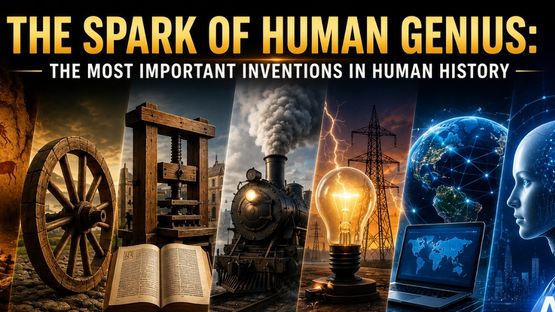
From the moment our early ancestors chipped away at flint to create the first sharp edge, human history has been defined by innovation. We do not just adapt to our environment we alter it.
While thousands of breakthroughs have shaped civilization, a select few stand out for fundamentally changing how we travel, communicate, think, and survive. Here is a look at some of the most important inventions in human history, spanning from ancient mechanical innovations to the modern digital frontier.
1. The Mechanical Foundations: Fire and the Wheel
Before humanity could build civilizations, it first had to master nature and mechanics.
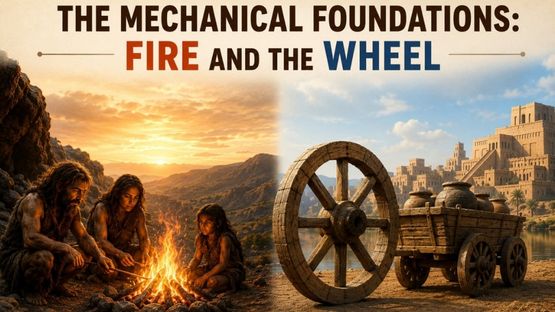
Controlled Fire
Although fire was discovered rather than invented, learning to control it was one of humanity`s greatest achievements. Fire provided warmth, protection from predators, and the ability to cook food. Cooked food offered more usable energy, supporting the development of larger and more complex human brains.
The Wheel (c. 3500 BC)
Invented in ancient Mesopotamia, the wheel revolutionized transportation. Beyond moving carts, it became the foundation for gears, pulleys, waterwheels, turbines, and countless mechanical systems. Without the wheel, modern transportation and industrial machinery would be unimaginable.
2. The Information Revolutions: The Printing Press and the Internet
Human progress depends on the ability to preserve and share knowledge. Two inventions transformed this process forever.
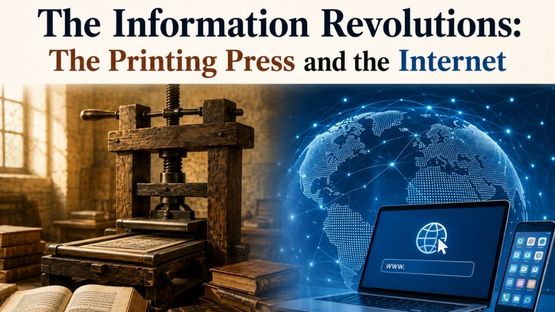
The Gutenberg Printing Press (c. 1440)
Before Johannes Gutenberg introduced movable type, books were painstakingly copied by hand, making knowledge available only to a privileged few. The printing press dramatically reduced the cost of books, expanded literacy, and accelerated the spread of science, education, and new ideas, fueling both the Renaissance and the Scientific Revolution.
The Internet (Late 20th Century)
If the printing press democratized knowledge, the internet globalized it. By connecting billions of people instantly, it transformed communication, commerce, education, entertainment, and research into a borderless digital ecosystem.
3. The Industrial Revolution: The Steam Engine and Electricity
For thousands of years, human productivity depended largely on physical labor. These inventions changed that forever.
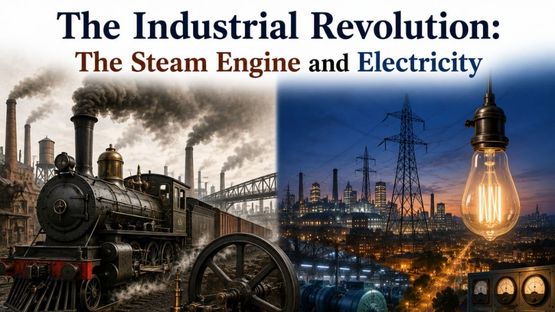
The Steam Engine (1712 onwards)
Developed by pioneers such as Thomas Newcomen and later improved by James Watt, the steam engine converted heat into mechanical power. It launched the Industrial Revolution, powering factories, railways, and ships while enabling mass production on an unprecedented scale.
Electricity (Late 19th Century)
The widespread generation and distribution of electricity transformed nearly every aspect of modern life. It illuminated cities, powered industries around the clock, and became the foundation for all modern electronics—from household appliances to computers and smartphones.
4. The Guardians of Life: Sanitation and Antibiotics
Some of humanity`s greatest inventions are those that protect and extend life.

Plumbing and Sanitation Systems
Modern sewer systems and clean water infrastructure dramatically reduced the spread of deadly diseases such as cholera and typhoid. Safe sanitation enabled the growth of large cities while significantly improving public health.
Antibiotics (1928)
Alexander Fleming`s discovery of penicillin revolutionized medicine. Before antibiotics, even minor injuries or common infections could be fatal. Antibiotics transformed bacterial diseases into treatable conditions and contributed significantly to increased global life expectancy.
The New Frontier: Artificial Intelligence (AI)
Today, another transformative invention is rapidly earning its place among history`s greatest breakthroughs: Artificial Intelligence (AI).
Unlike the steam engine or electricity, which automated physical labor, AI is designed to automate cognitive tasks. It can learn from data, recognize patterns, make predictions, and assist in solving complex problems.
| Era | Transformative Invention | Core Impact |
|---|---|---|
| Ancient | The Wheel | Automated Physical Transport |
| Industrial | The Steam Engine | Automated Manual Labor |
| Digital | The Internet | Global Information Sharing |
| Modern | Artificial Intelligence | Automating Cognitive Tasks |
Why AI Represents a New Era
Artificial Intelligence is no longer a futuristic concept—it is already reshaping industries and everyday life.
Medical Breakthroughs
AI helps researchers analyze massive biological datasets, accelerate drug discovery, improve medical imaging, and detect diseases earlier than ever before.
Economic Transformation
Businesses use AI to optimize supply chains, automate customer service, enhance financial analysis, and improve operational efficiency across industries.
Everyday Convenience
AI powers navigation systems, smart traffic management, virtual assistants, recommendation engines, language translation, and personalized digital experiences that millions rely on every day.
Conclusion: What Lies Ahead?
Every transformative invention has brought both extraordinary opportunities and significant challenges. The printing press enabled the rapid spread of ideas but also misinformation. The Industrial Revolution increased prosperity while contributing to environmental challenges. Likewise, Artificial Intelligence offers immense potential alongside important ethical questions about employment, privacy, bias, and digital security.
History has consistently shown that humanity`s greatest strength is its ability to innovate and adapt. From the invention of the wheel to the rise of neural networks, our greatest creations continue to demonstrate that the most powerful tool ever developed is the human mind.
Top Stories
-
 Tomorrow Panchangam July 21 2026 | Auspicious Timings, Rahu Kalam, Gulikai20/Jul/2026 6:09:46 PM
 -
 Chennai IAS Academy Opens Admissions for UPSC, TNPSC, Banking and RRB Coaching in Vellore20/Jul/2026 5:08:29 PM
 -
 Choosing the Right Gold Investment Option: A Complete Guide20/Jul/2026 4:56:10 PM
 -
 Gold Monetization Scheme 2.0 Needs Major Reforms to Succeed: Economist Anand Srinivasan20/Jul/2026 4:53:55 PM
 -
 Aadi 18: What's Special About Aadi Perukku?20/Jul/2026 4:36:54 PM
 -
 Chennai Metro Weekday Timings: Trains Every 6-7 Minutes During Most Hours20/Jul/2026 4:29:20 PM