
Aadi's Unique Coconut Roasting Ritual: Why 'Thengai Sudum Nonbu' Is Celebrated Only in Kongu Nadu
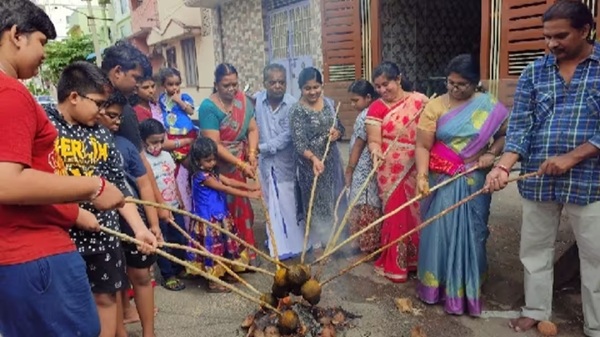
When people think of the Tamil month of Aadi, traditions such as Amman temple worship, Koozh offerings, Mulaipari, and Aadi Perukku usually come to mind. However, villages across the Kongu region, including Salem, Namakkal, Erode, Dharmapuri, and Karur, observe a unique custom to welcome the first day of Aadi-"Thengai Sudum Nonbu" (Coconut Roasting Ritual).
A Tradition That Marks the Beginning of Aadi
As the sun begins to set on the first day of Aadi, families light a small fire outside their homes. Whole coconuts are placed on wooden sticks and slowly roasted over the flames. The aroma of roasted coconut fills the air as children gather around with excitement and elders prepare for the evening prayers.
Although this tradition is unfamiliar in many parts of Tamil Nadu, it remains one of the most cherished cultural practices of Kongu Nadu.
More Than a Cooking Practice
At first glance, roasting coconuts may seem like a simple cooking method, but it is actually a deeply rooted religious ritual.
The Tamil month of Aadi coincides with the onset of the Southwest Monsoon, a crucial period for agriculture. Families perform this ritual to pray for abundant rainfall, prosperous harvests, good health, and the well-being of their households.
A Folk Belief Linked to the Mahabharata
According to a popular Kongu folk tradition, the Mahabharata war is believed to have begun on the first day of Aadi and ended on the eighteenth day.
Local folklore says that devotees offered roasted coconuts to Lord Ganesha, praying for the triumph of righteousness (Dharma). Although this belief is not documented in historical records, it has been preserved through generations as an important part of the region`s oral tradition.
How the Coconut Is Prepared
Unlike the common practice of breaking coconuts in temples, this ritual follows a unique method.
A small hole is made in one of the coconut`s eyes to drain the water. The coconut is then filled with a sweet mixture made from:
- Raw rice
- Jaggery
- Roasted gram
- Sesame seeds
- Green gram
- Flattened rice (Aval)
- Cardamom
Some families also add grated coconut, cashew nuts, and raisins, depending on their family traditions.
As the coconut slowly roasts over the fire, the jaggery melts and blends with the ingredients, creating a delicious sweet prasadam.
The Importance of the Azhinjal Stick
One distinctive feature of this ritual is the use of
Because the wood retains higher moisture, it does not burn quickly, allowing the coconut to roast slowly and evenly. Traditional Siddha medicine also attributes medicinal properties to the Azhinjal tree, and many elders believe that roasting food using this wood offers additional health benefits.
A Celebration of Community and Heritage
In the past, Thengai Sudum Nonbu was more than a family ritual it was a community celebration. Relatives gathered together, children played around the fire, women prepared the sweet filling, and elders shared stories and local folklore.
The ritual transformed an ordinary evening into a neighborhood celebration, strengthening family bonds and preserving local traditions.
Even today, the smoke rising from the roasted coconuts is more than just the smoke of a fire. It symbolizes the history, faith, relationships, and living heritage of Kongu Nadu.
Thengai Sudum Nonbu is not merely a ritual it is a timeless cultural tradition that continues to connect generations and celebrate the rich identity of Kongu Nadu.
Top Stories
-
 How to Apply for the Tamil Nadu Dairy Cow Loan Scheme17/Jul/2026 3:05:00 PM
 -
 Grahaspace's 'Solaras' Nano-Satellite Set for Launch Tomorrow Aboard Vikram-1 Rocket17/Jul/2026 2:46:33 PM
 -
 MBBS, BDS Admissions 2026: Last Date to Apply is July 2317/Jul/2026 2:38:49 PM
 -
 Aadi Month: Things You Should Avoid According to Tradition17/Jul/2026 1:14:05 PM
 -
 Heatwave Alert Issued for Four Tamil Nadu Districts; Light Rain Likely in Chennai17/Jul/2026 1:11:31 PM
 -
 Marundeeswarar Temple, Thiruvanmiyur - History, Legends and Significance17/Jul/2026 1:01:55 PM