
Selling Inherited Gold Jewellery? Here’s How Capital Gains Tax Is Calculated
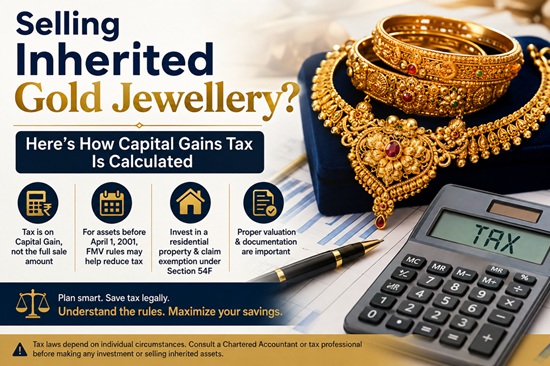
Inherited gold jewellery often holds both emotional and financial value. But if you are planning to sell jewellery passed down from your parents, grandparents or other family members, it is important to understand the income tax implications before completing the transaction.
One important point to remember is that tax is not generally charged on the entire sale amount. Instead, the tax liability is based on the capital gain earned from the sale, calculated according to the applicable provisions of the Income-tax Act.
Here’s a simple explanation of how the tax is calculated and how eligible taxpayers may be able to reduce or even eliminate their capital gains tax liability by investing in a residential property.
Do You Have to Pay Tax on the Full Sale Amount?
No. If you sell inherited gold jewellery for ₹10 lakh, it does not mean you have to pay tax on the entire ₹10 lakh.
The taxable capital gain is generally calculated after taking into account:
- The sale value of the jewellery
- Eligible expenses incurred in connection with the sale
- The applicable cost of acquisition
- Any deductions or exemptions available under the Income-tax Act
In the case of inherited assets, the cost of acquisition is generally linked to the cost incurred by the previous owner, subject to the specific provisions applicable to inherited property.
What If the Jewellery Was Bought Decades Ago and There Is No Purchase Bill?
This is a common concern when selling jewellery inherited from grandparents or other family members.
If the jewellery was acquired by the previous owner before April 1, 2001, the tax rules provide an important option. Subject to the applicable provisions, the cost of acquisition may be determined using either the original cost or the fair market value (FMV) as on April 1, 2001, as permitted under the Income-tax Act.
This can be particularly beneficial when the jewellery was originally purchased several decades ago at a much lower price.
For example, if your grandparents purchased gold in the 1980s or 1990s and the original purchase documents are no longer available, the fair market value of the jewellery as on April 1, 2001 may become relevant for calculating the capital gain.
In such cases, it is advisable to maintain proper supporting documents, including a valuation report from a qualified professional where necessary.
Can You Reduce Capital Gains Tax to Zero?
In certain situations, an individual or a Hindu Undivided Family (HUF) may be eligible to claim a capital gains tax exemption under Section 54F of the Income-tax Act.
Under this provision, an exemption may be available if the net sale proceeds are invested in a qualifying residential house property and all the prescribed conditions are met.
The new residential property can generally be:
- Purchased within one year before or two years after the sale of the original asset, or
- Constructed within three years from the date of the sale.
If the entire eligible net consideration is invested in the new residential property and all the conditions under Section 54F are satisfied, the entire eligible capital gain may qualify for exemption.
If only a portion of the net consideration is invested, the exemption may be available on a proportionate basis.
Important Conditions You Should Know
Simply selling inherited gold and purchasing a house does not automatically make the transaction tax-free.
Section 54F comes with several eligibility conditions and restrictions. Factors such as ownership of other residential properties, the amount invested, the timing of the investment and the retention of the new property can affect eligibility for the exemption.
The exemption may also be withdrawn or affected if the conditions prescribed under the law are not met.
Therefore, the statement that “selling inherited gold and buying a house makes the entire amount tax-free” is not always correct. The actual tax benefit depends on the individual circumstances and compliance with the conditions specified under Section 54F.
A Simple Example
Suppose you sell inherited gold jewellery for ₹10 lakh.
You do not automatically pay capital gains tax on the entire ₹10 lakh. The taxable gain is calculated after considering the applicable cost of acquisition and eligible expenses related to the sale.
If you invest the eligible net consideration in a qualifying residential property within the prescribed time limits and meet all the conditions under Section 54F, you may be eligible for a full or partial capital gains tax exemption.
The final exemption will depend on the amount invested and whether all the eligibility requirements are satisfied.
Key Things to Remember
Before selling inherited gold jewellery, keep these important points in mind:
- Tax is generally calculated on the capital gain, not automatically on the entire sale amount.
- For inherited jewellery, the previous owner`s cost of acquisition and holding period may be relevant.
- For assets acquired before April 1, 2001, the applicable fair market value rules may help determine the cost of acquisition.
- Section 54F may offer a full or partial capital gains tax exemption if all the required conditions are satisfied.
- Proper valuation and documentation are particularly important when the jewellery is old and original purchase bills are unavailable.
Final Word
Before selling high-value inherited jewellery or making an investment to claim a capital gains exemption, it is advisable to consult a qualified Chartered Accountant or tax professional to ensure that the transaction is structured correctly and complies with the applicable tax laws.
Top Stories
-
 HDFC Mutual Fund Lifts Restrictions on Lump-Sum Investments in Gold Schemes from August 1414/Aug/2026 4:13:14 PM
 -
 Private Sector Job Fair in Chennai on August 22, Offering Over 10,000 Vacancies14/Aug/2026 4:04:12 PM
 -
 Indane LPG Gas KYC Online: Step-by-Step Guide to Update Aadhaar and Complete eKYC14/Aug/2026 3:07:00 PM
 -
Selling Inherited Gold Jewellery? Here’s How Capital Gains Tax Is Calculated14/Aug/2026 1:38:19 PM
-
 How to Identify Fake Bank SMS Messages and Protect Your Money14/Aug/2026 1:29:06 PM
 -