
AI Implementation Consultant: A New Career Path Emerging in the AI Era
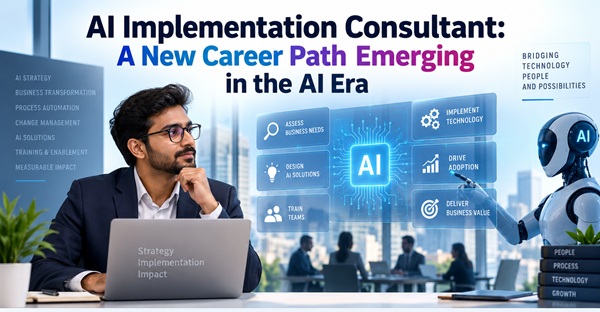
Artificial intelligence is moving rapidly from experimentation into everyday business operations, creating demand for professionals who can help companies turn AI technology into practical solutions. One such emerging career is the AI Implementation Consultant.
Unlike AI researchers and machine-learning engineers, who primarily focus on developing models and technical systems, AI implementation consultants concentrate on applying AI to real business challenges. Their work combines business consulting, technology integration, project management, employee training and responsible AI practices.
What does an AI Implementation Consultant do?
An AI implementation consultant starts by understanding how a business currently operates and identifying processes where AI could save time, reduce costs or improve accuracy.
The consultant may assess a company`s data, software systems and infrastructure before recommending suitable AI tools, large language models, automation platforms or cloud services.
The role can involve developing chatbots, document-processing systems and internal knowledge assistants. Consultants may also connect AI solutions with existing CRM systems, ERP platforms, websites, databases and business workflows.
But implementing an AI system is not simply about installing a new tool. Consultants must also test the technology for accuracy, hallucinations, bias, security, speed and cost. They may train employees, prepare operating guidelines and monitor the system after it goes live.
A combination of technology and business skills
The role requires a mix of technical knowledge and business understanding. Professionals entering this field can benefit from learning about generative AI, large language models, prompt engineering, RAG systems, APIs, databases, cloud platforms and automation.
At the same time, consulting and communication skills are equally important. An AI implementation consultant often has to work with senior executives, software developers, data teams and employees who may have little technical knowledge.
Being able to explain complicated AI concepts in clear business language is therefore an important part of the job.
Finding the right problem to solve
The implementation process usually begins with business discovery. The consultant speaks with managers and employees to understand existing workflows and identify areas where improvements may be possible.
Potential AI projects can then be evaluated based on expected business value, implementation cost, data availability, technical complexity, security and compliance risks, and how easily the results can be measured.
Importantly, the consultant must also recognise when AI is not the right solution. In some situations, conventional software or process improvements may be more appropriate.
Connecting AI with existing systems
Once a suitable use case has been identified, the consultant helps design and integrate the solution with the company`s existing technology.
For example, an AI customer-support assistant could be connected to a company`s knowledge base, ticketing system and CRM. Before deployment, the system needs to be tested using realistic scenarios, with appropriate rules for human intervention and escalation.
Employees can then be trained before the solution is gradually introduced, often through a pilot programme. After launch, performance can be monitored using measures such as response time, number of automated tasks, employee adoption, customer satisfaction, error rates and cost per AI interaction.
How AI implementation could work in real estate
The source material provides a Chennai-based real-estate company as an example.
If the company receives hundreds of apartment enquiries every month, an AI implementation consultant could organise approved information about projects, prices, amenities and locations into a searchable knowledge base.
An AI assistant could then be connected to the company`s website and WhatsApp workflow to handle routine questions. Qualified leads could be passed to the sales team, while human approval could be required before the system provides information about special discounts or makes legal claims.
In this situation, the consultant is doing more than setting up a chatbot. The objective is to redesign the wider customer-enquiry and sales workflow around the technology.
New AI-related careers are emerging
The growth of AI is also creating a range of roles beyond traditional machine-learning jobs.
These include AI product managers, LLM engineers, AI agent architects, RAG engineers, AI governance specialists, AI risk managers, model evaluators, AI trainers, knowledge engineers, AI security engineers, AI UX designers, AI operations engineers and AI adoption managers.
Many of these roles combine AI skills with expertise in a particular industry, such as finance, healthcare, law, manufacturing, education or media.
How can professionals prepare?
For beginners, the learning path can start with generative AI fundamentals, prompt design, APIs, databases and basic automation. Developing strong business communication and problem-solving skills is also useful.
At the intermediate level, professionals can move into Python, SQL, RAG chatbot development, cloud AI platforms, workflow automation, model evaluation and prompt testing.
More advanced learners can explore AI-agent architecture, vector databases, MLOps, enterprise integrations, AI governance and risk management. Building practical projects can also help demonstrate real-world skills to employers.
AIAI careers are expanding beyond model development
As companies move from experimenting with AI to using it in everyday operations, there is a growing need for professionals who understand both technology and business processes.
The opportunity in AI is therefore not limited to building models. It also lies in understanding where AI can be useful, how it can be integrated into existing workflows and how its impact can be measured.
Top Stories
-
 LPG Subsidy: Aadhaar Biometric Authentication Required from October 122/Sep/2026 12:59:26 PM
 -
 Credit Card Lost or Stolen: What Should You Do and Who Pays?22/Sep/2026 12:24:21 PM
 -
 Tesla Chennai Showroom: New Experience Centre to Open This Week22/Sep/2026 12:19:21 PM
 -
 Best 5 Places to Visit in and Around West Mambalam, Chennai22/Sep/2026 12:16:03 PM
 -
 Fake SIM Card Documents: Up to 3 Years Jail and ₹50 Lakh Fine22/Sep/2026 12:03:19 PM
 -
 Missed ITR Deadline? Know How to Claim Your TDS Refund22/Sep/2026 11:43:51 AM