
How Great People View Money: Timeless Lessons from the World’s Brightest Minds
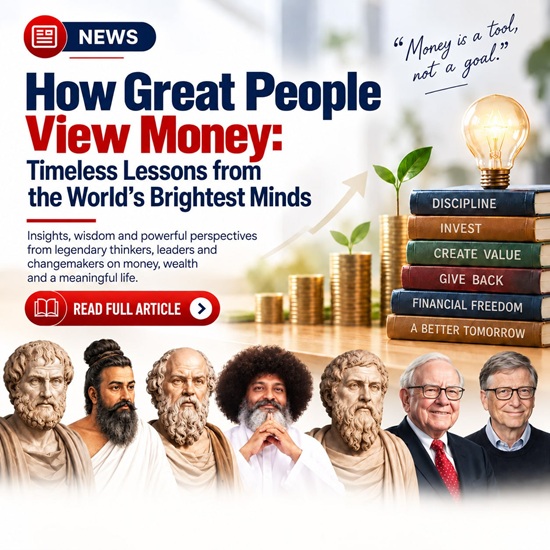
Money influences almost every part of human life. It provides food, shelter, education, healthcare, opportunity and security. It can help people realise their dreams and support others. At the same time, the uncontrolled pursuit of money can produce anxiety, greed, exploitation and conflict.
Money itself has not changed greatly. What has continually evolved is the way human beings understand and use it.
From ancient philosophers and spiritual teachers to industrialists, investors and modern thought leaders, great minds have offered different perspectives on wealth. Some warned us about becoming attached to it. Others regarded it as a source of freedom, responsibility and social progress.
Taken together, their teachings reveal an important truth:
Money is neither inherently good nor bad. Its value depends on how it is earned, managed and used.
Socrates and Plato: Virtue Must Come Before Wealth
Socrates believed that people should first improve their character rather than devote their lives entirely to acquiring property.
In Plato’s Apology, Socrates explains that virtue does not come from money; instead, money and other genuinely good things should emerge from virtue.
Plato developed this idea further in The Republic. He warned that when a society begins honouring wealth more than character, virtue gradually loses its importance.
Their message remains relevant today. Financial success without honesty, discipline and responsibility may create comfort, but it does not necessarily create a meaningful life.
Their lesson: Build character first. Let wealth be supported by values rather than allowing wealth to replace them.
Aristotle: Money Is a Medium, Not the Ultimate Purpose
Aristotle approached money more practically. He recognised that money was created to make exchange easier. It allowed people to trade different products and services using a common measure of value.
However, he distinguished between earning money to support life and accumulating money merely for the sake of accumulation. He was especially critical of economic activity in which money appeared to grow without creating anything useful.
Although modern finance is very different from the economy of ancient Greece, Aristotle’s central question is s still valuable:
Is money serving a useful human purpose, or has making money itself become the only purpose?
Thiruvalluvar: Wealth Must Be Earned Without Harm
Tamil wisdom offers one of the clearest and most balanced views of wealth.
திருக்குறள் 754 – பொருள் செயல்வகை
அறன்ஈனும் இன்பமும் ஈனும் திறனறிந்து
தீதின்றி வந்த பொருள்.
In Thirukkural 754, Thiruvalluvar teaches that wealth acquired through proper means and without wrongdoing produces both virtue and happiness:
“Wealth acquired sinless and well
Yields both virtue and happiness.”
Thiruvalluvar did not reject wealth. He recognised its practical importance. But he connected prosperity with ethics, compassion and responsible conduct.
He reminds us that the method through which money is earned matters just as much as the amount earned.
Money gained through deception, exploitation or harm cannot produce lasting peace. Wealth created honestly, on the other hand, can support one’s family, employees and society.
His lesson: Earn well, but earn rightly.
Spiritual Teachings: Attachment Is More Dangerous Than Money
Many spiritual traditions do not condemn money itself. They caution us about attachment, greed and the belief that possessions alone can produce happiness.
A frequently quoted biblical teaching states:
“The love of money is a root of all kinds of evil.”
This teaching comes from the First Epistle to Timothy. The emphasis is not that money is evil, but that an uncontrolled love of money can lead people away from their principles.
Buddhist teachings similarly identify craving and attachment as major causes of suffering. Possessions are temporary, and depending on them entirely for happiness creates fear—the fear of losing what we have and the frustration of never feeling that we have enough.
The spiritual message is therefore not necessarily to reject prosperity.y. It is to remain inwardly free even while managing material responsibilities.
The lesson: Own money, but do not allow money to own your thoughts, identity or relationships.
Mahatma Gandhi: Wealth as Trusteeship
Mahatma Gandhi introduced the powerful idea of trusteeship.
According to this philosophy, people may create, own and manage wealth, but they should regard themselves as trustees rather than absolute owners. Those who possess greater resources also carry a greater responsibility towards society.
Gandhi did not suggest that entrepreneurs should stop creating wealth. He wanted wealth creators to use their abilities and resources without exploitation and to direct a reasonable share of their prosperity towards the wider good.
This idea provides an early moral foundation for what we now call corporate social responsibility.
His lesson: Wealth brings not only privilege, but also responsibility.
Benjamin Franklin: Time, Discipline and Financial Independence
Benjamin Franklin viewed money through the principles of industry, discipline, thrift and self-reliance.
His famous statement, “Time is money,” originally carried a deeper meaning than simply working every available hour. Franklin wanted people to understand opportunity cost. Time used carelessly represents not only lost minutes, but also lost possibilities.
He also emphasised the productive nature of money. Money saved and used wisely can generate further value. Small financial habits, repeated consistently, can eventually create independence.
Franklin’s philosophy was not about becoming miserly. It was about recognising the connection between time, effort, reputation, credit and financial stability.
His lesson: Respect your time, honour your commitments and allow disciplined habits to build freedom.
George Bernard Shaw: Poverty Also Causes Suffering
George Bernard Shaw provocatively observed:
“Lack of money is the root of all evil.”
His statement challenges the tendency to speak only about the dangers of wealth while ignoring the suffering caused by poverty.
A serious s shortage of money can deny people access to nutrition, healthcare, education and dignified living conditions. It can create desperation, dependence and conflict. Financial security does not guarantee happiness, but financial distress can certainly limit choices.
Shaw’s perspective reminds us that earning and preserving sufficient money is not something to feel guilty about. It is an essential part of protecting human dignity.
His lesson: Financial stability is not greed; it is a foundation for freedom and responsible living.
Mahatria: Money as a By-product of Excellence
Our Guru, spiritual leader Mahatria offers a perspective that connects spirituality with ambition, excellence and material abundance.
He teaches that good people should not remain financially powerless. Money in responsible hands can support families, create employment, educate children and serve society. Therefore, creating abundance can become a moral responsibility when it is guided by good intentions.
Mahatria also offers a crucial warning:
“Money is a wonderful by-product and a very poor point of focus.”
When money becomes the only target, work may lose its purpose and quality. But when people focus on self-expression, excellence, usefulness and contribution, financial success can emerge as a natural result of the value they create.
His lesson: Focus on excellence and contribution. Let money follow the value you create.
Warren Buffett: Wealth Requires Patience and Perspective
Warren Buffett’s approach to money is shaped by patience, simplicity and long-term thinking.
He did not build wealth by constantly chasing excitement. He invested in businesses he understood, allowed compounding to work over long periods and avoided unnecessary changes driven by emotion.
Buffett’s personal lifestyle has also remained relatively modest compared with the scale of his wealth. More importantly, he has pledged that over 99% of his wealth will ultimately go towards philanthropy.
His example demonstrates that creating wealth, displaying wealth and using wealth are three entirely different things.
His lesson: Wealth grows through patience, good judgement and the ability to think beyond immediate gratification.
Bill Gates: Capital as a Resource for Solving Problems
Bill Gates represents another modern view: money as fuel for large-scale solutions.
After building Microsoft, Gates directed much of his wealth towards global health, education, medical research and poverty reduction. He has stated that wealth carries an obligation to give back to society.
In 2025, he announced his intention to give away virtually all his wealth through the Gates Foundation over the following two decades.
His approach demonstrates that capital, when combined with knowledge, technology and organised execution, can address problems on a scale that individual charity alone cannot achieve.
His lesson: The highest purpose of wealth may be the progress it enables.
An Entrepreneur’s Perspective: Value, Cash Flow and Sustainable Growth
From my own entrepreneurial journey, I have come to view money as a result of creating genuine value.
A business may possess assets and receive an impressive valuation, but it still requires healthy cash flow to pay salaries, honour suppliers, fulfil commitments and operate peacefully. Paper wealth cannot replace financial discipline.
Borrowing may sometimes support productive expansion, but continuously raising money merely to cover losses is not sustainable entrepreneurship. A strong business must gradually develop the ability to support itself.
True wealth is therefore not only about net worth. It is also about:
- Creating useful value for customers
- Maintaining dependable cash flow
- Honouring financial commitments
- Growing within one’s capacity
- Taking calculated risks
- Building without losing peace
- Supporting employees, families and society
A sustainable business should be like a healthy tree: firmly rooted, steadily growing, capable of withstanding difficult seasons and eventually providing shade and benefit to many people.
The Common Wisdom: Make Money Your Servant
Across different centuries and cultures, these thinkers disagree on many details. Yet their views point towards several commmmon principles:
1. Earn ethically. Money obtained through harmful methods rarely produces lasting peace.
2. Create value. Sustainable wealth follows useful work, excellence and service.
3. Maintain discipline. Income without proper management can disappear quickly.
4. Protect financial stability. Adequate money provides dignity, security and freedom of choice.
5. Avoid attachment. Your bank balance should not become the measure of your identity or worth.
6. Think beyond yourself. Wealth achieves a higher purpose when it benefits families, employees and society.
7. Preserve peace. Financial growth that destroys health, relationships or integrity is not genuine prosperity.
Conclusion
Great people have viewed money as a temptation, a medium of exchange, a reward for discipline, a protection against poverty, a responsibility and a tool for social progress.
Each perspective contains part of the truth.
Money can provide choices, but it cannot decide wisely for us. It can build a house, but not automatically create a happy home. It can fund education, healthcare and social development, but only when directed by responsible human beings.
The goal should therefore not be to worship money or reject it. The goal is to understand it, earn it honourably, manage it intelligently and use it meaningfully.
Create wealth without losing your values. Build abundance without losing your peace. Let money remain your servant and use that servant to make life better for yourself and for others.
- J. Sampath
Business Growth Strategist
About the Author
J. Sampath is the Founder and CEO of JB Soft System, a premier Chennai-based IT consulting and custom software development firm established in 2001. He is widely recognized for his unique philosophies on debt-free business growth, standard operating procedures (SOPs), and values-driven leadership. He regularly shares his business insights, operational frameworks, and morning reflections to empower the next generation of entrepreneurs.
Top Stories
-
 Lost Your Mobile Phone? 10 Immediate Steps to Protect Your Money, Identity and Personal Data08/Sep/2026 11:59:44 AM
 -
 951 Indian Students Graduate with MD Degrees from Gullas College of Medicine08/Sep/2026 11:18:13 AM
 -

-

-
 Essential Documents Every Indian Should Keep Updated: A Practical Guide for Chennai Residents08/Sep/2026 11:09:40 AM
 -
 B.Ed Second-Round Admissions Begin in Tamil Nadu: Apply by September 1508/Sep/2026 10:54:58 AM