
Home Loan EMI May Increase After Repo Rate Hike: What Borrowers Need to Know
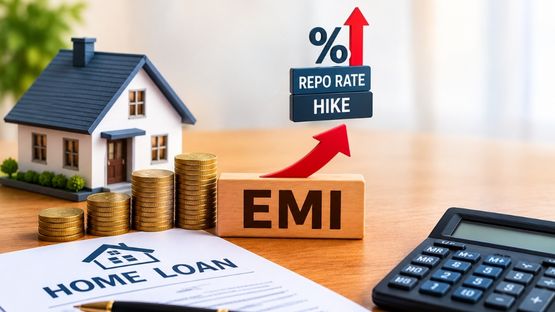
People planning to buy or build a house with a home loan may have to face higher borrowing costs as the increase in the repo rate could push up home loan interest rates.
The Reserve Bank of India (RBI) has increased the repo rate by 25 basis points to 5.50%. Following the hike, both new and existing home loan borrowers could face a higher interest burden. The RBI`s Monetary Policy Committee approved the rate hike unanimously after its three-day meeting held from October 5 to 7.
Why Has the Repo Rate Increased?
For borrowers with floating-rate loans, the impact will depend on how banks pass on the rate increase to customers. The monthly EMI could increase, or the loan tenure could be extended.
The RBI has increased the rate amid rising inflation risks. RBI Governor Sanjay Malhotra has said that the inflation situation is not as favourable as it was last year.
The RBI expects retail inflation to average 5.8% over the next three quarters, while inflation for the full financial year is estimated at 4.4%.
The repo rate is the rate at which the RBI lends money to commercial banks. When the repo rate increases, the cost of raising funds for banks also rises, which can lead to higher interest rates on floating-rate loans.
Will Home Loan EMIs Increase?
If banks increase their lending rates following the RBI`s decision, borrowers with floating-rate home loans may feel the impact.
Banks can pass on the increase in different ways. For some borrowers, the monthly EMI may increase, while for others, the EMI may remain unchanged and the loan tenure may be extended.
The actual impact will depend on the lending bank, type of loan and applicable interest rate.
Homebuyers Need to Be Careful
Higher interest rates can increase borrowing costs for homebuyers and may make some customers more cautious about when to purchase a property.
First-time homebuyers and those looking for affordable housing are generally more sensitive to changes in interest rates. Premium and luxury housing caters to a different segment of buyers, who may place greater importance on property quality, location and long-term value.
Although higher repo rates can make home loans more expensive, this does not necessarily mean that demand for residential properties will immediately decline.
Market experts have advised developers to carefully manage financing costs and keep property prices aligned with actual demand.
What Should Home Loan Borrowers Do?
Existing borrowers should first check whether their home loan is linked to a floating interest rate and understand how their bank is passing on the RBI`s rate increase.
Borrowers should also check whether the bank is changing the EMI, the loan tenure or both.
Those planning to take a new home loan should reassess their affordability rather than immediately postponing their purchase. Even a small increase in interest rates can have a significant impact over a long loan tenure.
Borrowers are advised to review their budget carefully and avoid taking a loan that exceeds their repayment capacity.
Top Stories
-
 Moderate Rain Likely in Several Tamil Nadu Districts for Two Days07/Oct/2026 3:00:47 PM
 -
 Chennai to Get Three Model Urban Mobility Corridors Under CUMTA Phase II07/Oct/2026 2:30:55 PM
 -
 CM Vijay to Host Banquet for Tamil Nadu Asian Games Medal Winners07/Oct/2026 2:22:45 PM
 -
Home Loan EMI May Increase After Repo Rate Hike: What Borrowers Need to Know07/Oct/2026 2:05:47 PM
-
 Chief Minister Vijay Presents Certificates at the Perambur MLA Office07/Oct/2026 1:06:16 PM
 -
 Tirupati Navaratri Brahmotsavam: 72,000 Rs 300 Darshan Tickets Sold Out in 15 Minutes07/Oct/2026 1:03:49 PM

 JB Soft System