
Chennai's Historic Firsts: From India’s First Hospital to South India’s First Railway Station
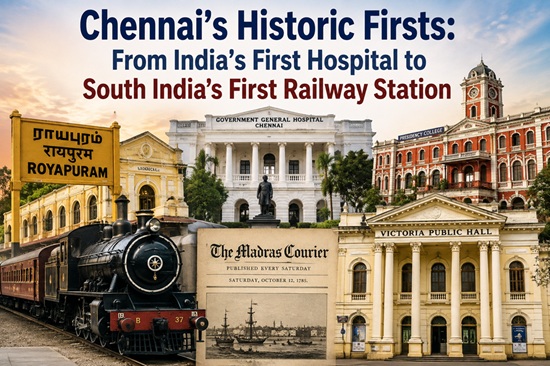
Chennai is a city known for its rich history, but many people may not realise how many important milestones in India’s public life began here. From railways and healthcare to education, journalism and cinema, the city has played a significant role in shaping modern India.
Here are five remarkable “firsts” associated with Chennai and their place in the city’s history.
1. Royapuram Railway Station – A Landmark in India’s Railway History
Royapuram Railway Station holds a special place in the history of Indian railways. It is recognised as South India’s first railway station and is also one of the oldest surviving railway station buildings in the Indian subcontinent.
The station was inaugurated on 28 June 1856 by Governor Lord Harris. The first passenger train began its journey on 1 July 1856, travelling from Royapuram to Wallajah Road (Walajapet), a distance of about 97 km. Another train also operated to Tiruvallur on the same day.
The service was operated by the Madras Railway Company. Today, the historic station continues to function in Royapuram, standing as an important reminder of Chennai’s contribution to the development of rail transport in South India.
2. Government General Hospital – More Than Three Centuries of Healthcare
Chennai is also home to one of the oldest major public hospitals in India. The institution now known as Rajiv Gandhi Government General Hospital (RGGGH) traces its origins to 16 November 1664.
It was established by Sir Edward Winter to provide medical care for East India Company soldiers and was initially located inside Fort St. George. The hospital later moved to its present location around 1772.
Today, RGGGH is closely associated with Madras Medical College and continues to serve thousands of patients. With more than 360 years of history, the institution remains an important part of Chennai’s medical heritage.
3. Presidency College – A Pioneer in Higher Education
Chennai’s educational history also has a significant milestone in Presidency College. Its origins can be traced to the Madras Preparatory School, which began on 16 October 1840 in a rented building in Egmore.
The institution was established under the leadership of Eyre Burton Powell and gradually developed from a preparatory school into a higher educational institution. It became affiliated with the University of Madras after the university was established in 1857.
Presidency College later moved to its present location on Kamaraj Salai, opposite Marina Beach, in 1870. Over the years, it has produced several distinguished personalities, including Nobel laureates C. V. Raman and S. Chandrasekhar.
4. The Madras Courier – Chennai’s Early Newspaper
Chennai also has an important place in the history of Indian journalism. The Madras Courier, launched on 12 October 1785, is regarded as the first newspaper published in Madras and one of the earliest newspapers in India.
The weekly English-language newspaper was founded by Richard Johnston, a British Army officer who later worked as a printer. It carried news, government notifications and other information relevant to the colonial administration and the public.
The newspaper continued publication until 1821, marking an important early chapter in the development of journalism in Chennai.
5. Victoria Public Hall – Where Chennai’s Cinema Story Began
Chennai’s connection with cinema also dates back to the earliest days of motion pictures. Victoria Public Hall is associated with one of the city’s earliest motion-picture screenings, believed to have taken place in December 1896, although some historical accounts place it in 1897.
Early screenings were reportedly conducted by T. Stevenson of the Madras Photographic Store, who projected short films for audiences.
The Victoria Public Hall itself was built in 1887 to commemorate Queen Victoria’s Golden Jubilee. Designed by architect R. F. Chisholm and constructed by T. Namberumal Chetty, the building became an important centre for theatre, culture, politics and public gatherings.
Chennai’s Legacy of Firsts
These five landmarks highlight the important role Chennai has played in India’s journey into the modern era. The arrival of railways, the development of organised healthcare and higher education, the growth of journalism and the introduction of cinema all left their mark on the city.
Even today, places such as Royapuram Railway Station, Government General Hospital, Presidency College and Victoria Public Hall serve as reminders of Chennai’s remarkable historical legacy.
For residents and visitors alike, exploring these landmarks offers more than a sightseeing experience - it provides a glimpse into the events and institutions that helped shape the Chennai we know today.
Top Stories
-
 Tomorrow Panchangam October 27, 2026 | Auspicious Timings, Rahu Kalam, Gulikai26/Oct/2026 6:04:45 PM
 -
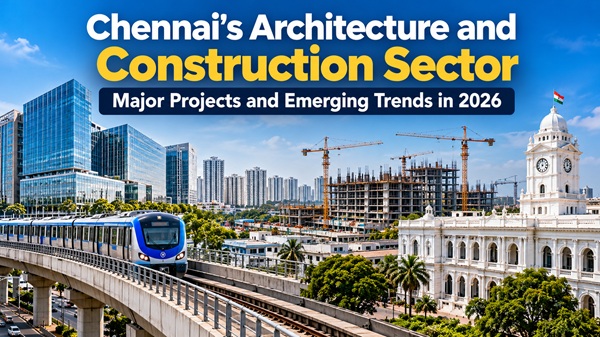 Chennai’s Architecture and Construction Sector: Major Projects and Emerging Trends in 202626/Oct/2026 5:52:19 PM
 -
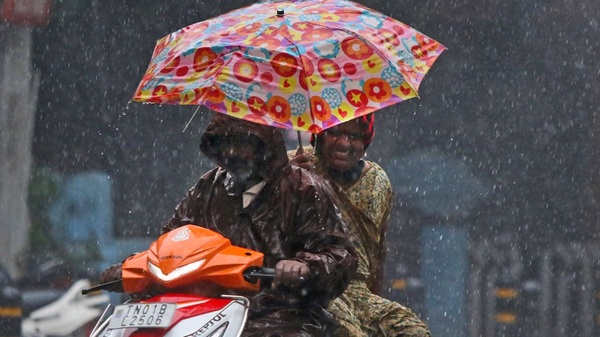 Tamil Nadu Monsoon Alert: Kodaikanal Red Alert, Vaigai Dam Water Level Reaches 50 Feet26/Oct/2026 5:18:23 PM
 -
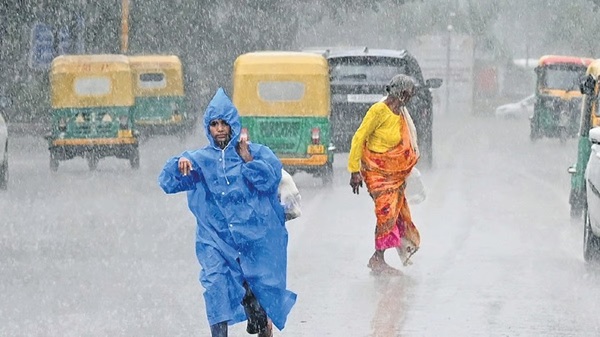 Orange Alert for Nagapattinam: Heavy Rain Expected in 6 Tamil Nadu Districts26/Oct/2026 5:10:58 PM
 -
 Ooty Mountain Train Service Cancelled Until October 29 Due to Restoration Work26/Oct/2026 5:05:55 PM
 -
 Bigg Boss Tamil 10: Actor Raghav Says TTF Vasan’s Fan Base Could Influence the Final Results26/Oct/2026 4:53:00 PM

 JB Soft System