
Gold Jewellery vs Gold ETFs: Which Is Better for Investment? See the Cost Difference and 5-Year Returns
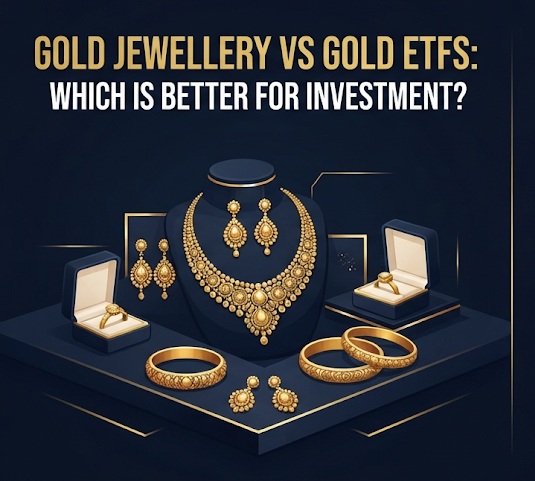
Gold Investment in India | Gold has always been a popular investment choice in India, but choosing between physical gold jewellery and Gold Exchange-Traded Funds (ETFs) can make a significant difference to your returns. While jewellery offers the advantage of physical ownership and can be worn or gifted, Gold ETFs are generally more cost-effective for people looking to invest in gold purely for financial returns.
Making charges, GST and resale deductions can reduce the actual value recovered from gold jewellery. Gold ETFs, on the other hand, allow investors to track gold prices without paying jewellery-related expenses.
Gold Jewellery vs Gold ETF: Understanding the Cost Difference
When purchasing gold jewellery in India, buyers pay 3% GST on the total invoice value, including making charges. Making charges generally range from 6% to 14% of the gold value and may reach 25% for elaborate designs.
These additional expenses are generally not recovered when selling jewellery. The resale value is mainly calculated based on the gold content and prevailing market price, subject to the jeweller`s buyback deductions.
Gold ETFs do not attract the 3% purchase GST or jewellery making charges. However, investors need to account for the fund`s expense ratio, brokerage, bid-ask spread and demat-related charges. The annual expense ratio may be approximately 0.5% to 1%.
|
Cost Factor |
Gold Jewellery |
Gold ETF |
|
GST |
3% on invoice value |
No purchase GST |
|
Making Charges |
Usually 6% to 14% |
None |
|
Resale |
Metal value with possible deductions |
Market price, subject to trading costs |
|
Ongoing Expenses |
Storage and insurance |
Expense ratio and brokerage |
|
Convenience |
Physical ownership |
Requires a demat account |
What Happens When You Invest ₹1 Lakh in Gold?
Consider an investment of ₹1 lakh in different forms of gold. Assuming jewellery resale realises 97% of the underlying metal value and Gold ETF transactions involve a 0.2% round-trip trading cost, the immediate recoverable amounts differ considerably.
|
Investment Type |
Immediate Resale Value |
Approximate Loss |
|
Plain Jewellery (0% Making) |
₹94,175 |
5.8% |
|
Standard Jewellery (8%) |
₹87,199 |
12.8% |
|
Designer Jewellery (12%) |
₹84,085 |
15.9% |
|
High-Design Jewellery (20%) |
₹78,479 |
21.5% |
|
Gold ETF |
₹99,800 |
0.2% |
The figures are illustrative and based on the stated assumptions. Actual jewellery costs and resale deductions vary between jewellers.
With 12% making charges, a ₹1 lakh jewellery purchase provides only around ₹86,685 worth of underlying gold after GST. Consequently, the gold price must increase by approximately 15.4% just to recover the initial purchase amount before additional resale deductions.
How Much Must Gold Prices Increase to Break Even?
Jewellery buyers need a higher increase in gold prices to recover their original investment.
8% making charges: 14.7% price increase required.
12% making charges: 18.9% price increase required.
20% making charges: 27.4% price increase required.
For Gold ETFs, the assumed 0.2% round-trip trading cost requires only a small price movement to break even. However, the annual expense ratio continues to affect long-term returns.
Gold Jewellery vs Gold ETF: Five-Year Return Comparison
Let us consider a scenario where gold prices increase by 8% annually. The calculation assumes 12% jewellery making charges, a 97% jewellery resale value based on underlying metal value, a 0.7% annual ETF expense ratio and an initial ETF trading cost of 0.2%.
|
Year |
Jewellery Value |
Gold ETF Value |
|
0 |
₹84,085 |
₹99,800 |
|
1 |
₹90,811 |
₹1,07,030 |
|
2 |
₹98,076 |
₹1,14,783 |
|
3 |
₹1,05,922 |
₹1,23,098 |
|
4 |
₹1,14,396 |
₹1,32,015 |
|
5 |
₹1,23,548 |
₹1,41,578 |
Under these assumptions, Gold ETFs remain ahead throughout the five-year period because more of the initial investment is exposed to gold prices. The difference in returns highlights the impact of jewellery-related expenses.
Tax Rules for Gold ETFs and Physical Gold
Tax treatment is another important consideration for gold investors.
For Gold ETF units purchased on or after April 1, 2025, gains from holdings of 12 months or less are treated as short-term capital gains and taxed according to the investor`s income-tax slab. Holdings beyond 12 months attract 12.5% long-term capital gains tax without indexation, along with applicable surcharge and cess.
For physical gold, the long-term holding period is 24 months. Gains from holdings beyond this period attract 12.5% LTCG tax without indexation, while shorter-term gains are taxed according to the applicable income-tax slab.
Which Gold Investment Option Should You Choose?
Gold ETFs are generally suitable for investors seeking financial exposure to gold, easy buying and selling, systematic investments and lower initial costs.
Gold Mutual Funds and Fund of Funds (FoFs) are alternatives for investors who do not have a demat account, although they may involve additional fund-level expenses.
Physical gold jewellery remains suitable for wearing, gifting and family traditions. Those purchasing jewellery should preferably choose simple designs, minimise making charges, retain purchase invoices and check the jeweller`s buyback policy.
The bottom line: If your primary objective is wealth creation through gold, Gold ETFs are generally more cost-efficient than jewellery. Jewellery is better viewed as a consumption purchase with investment value rather than as the most efficient way to invest in gold.
Top Stories
-
 Tiruvannamalai Karthigai Deepam 2026: 1,713 Special Buses from Chennai23/Nov/2026 11:12:12 AM
-
 Karthigai Deepam Festival 2026 - Day 8 (Morning)23/Nov/2026 11:02:55 AM
-
-
 Gold Price Prediction 2036: What Will a ₹50,000 Gold Investment Be Worth After 10 Years?23/Nov/2026 10:37:54 AM
-
 Indian Railways May Scrap RAC Ticket System: What Could Change23/Nov/2026 10:28:44 AM
-
 Tiruvannamalai Karthigai Pournami Girivalam 2026: Date, Time and Girivalam Timings23/Nov/2026 10:19:42 AM

 JB Soft System