
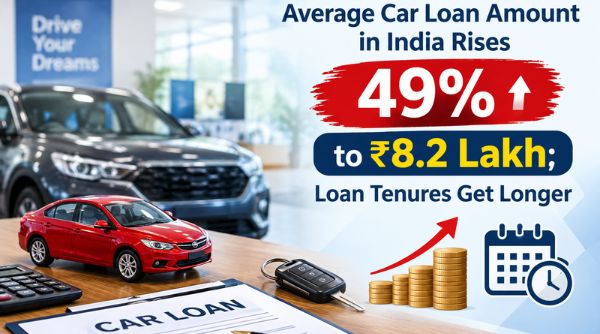
Average Car Loan Amount in India Rises 49% to ₹8.2 Lakh; Loan Tenures Get Longer
India’s vehicle finance market is witnessing a shift towards higher-value cars, longer repayment periods and wider credit access in semi-urban and rural areas, according to a TransUnion CIBIL report.
The average loan amount for passenger vehicles in India increased by 49% to ₹8.2 lakh between the first half of 2019 and the first half of 2026. The trend reflects buyers increasingly opting for higher-value cars and choosing longer repayment periods to manage their monthly financial commitments.
According to TransUnion CIBIL, India`s credit information company, the average repayment tenure for passenger vehicle loans also increased during this period, rising by five months to 62 months.
The findings highlight changing borrowing patterns in India`s automobile market, where vehicle financing is playing an important role in helping consumers purchase cars and two-wheelers.
Higher-Value Car Loans Gain Ground Beyond Major Cities
The shift towards higher-value passenger vehicles is no longer limited to India`s major metropolitan areas. Semi-urban and rural markets are also accounting for a growing share of borrowers taking loans for more expensive cars.
In the first half of 2026, borrowers from semi-urban and rural areas accounted for 51% of loans taken for higher-value cars. This represented an increase of six percentage points compared with 2019.
The trend points to the expanding reach of vehicle financing beyond large urban centres. Longer repayment periods are also allowing buyers to spread their loan obligations over a greater period.
Two-Wheeler Loans See a Shift in Borrower Profiles
India`s two-wheeler loan market is also changing, with a growing proportion of borrowers having an established credit history.
In the first half of 2026, 43% of two-wheeler loan borrowers had more than two years of credit history, compared with 27% in 2019.
Meanwhile, first-time borrowers accounted for 39% of two-wheeler loan originations, a decline of 19 percentage points over the same period. These figures indicate a shift in the composition of borrowers entering the two-wheeler financing market.
The outstanding balance of two-wheeler loans reached ₹1.76 lakh crore in June 2026, representing 3.2 times the level recorded in June 2019.
The active borrower base also expanded significantly, increasing from 1.7 crore in 2019 to 3.3 crore in 2026.
NBFCs Continue to Dominate Vehicle Financing
Non-banking financial companies (NBFCs) remain important players in India`s vehicle loan market, particularly in two-wheeler financing.
According to the report, NBFCs accounted for 37% of passenger vehicle loans and 73% of two-wheeler loans.
The findings also highlight the importance of smaller cities and rural markets in the two-wheeler segment. In the first half of 2026, borrowers from semi-urban and rural areas accounted for 64% of two-wheeler loans.
Younger consumers also represented a significant share of borrowers, with 43% of two-wheeler loan borrowers aged 30 or younger.
India`s Vehicle Finance Market Continues to Evolve
The latest TransUnion CIBIL findings point to a vehicle finance market shaped by rising average car loan amounts, longer repayment tenures and an expanding borrower base.
p>While higher-value cars are contributing to larger passenger vehicle loans, two-wheeler financing continues to reach consumers across different age groups and locations.
The growing participation of semi-urban and rural borrowers further underlines the changing landscape of vehicle ownership and credit access in India.
Top Stories
-
 Kamaraj IAS Academy Chennai: Courses, Facilities and Contact Details15/Oct/2026 2:55:50 PM
 -
 OnePlus 16 Launched with 9,000mAh Battery and 200MP Camera: Price and Specifications15/Oct/2026 2:32:21 PM
 -

-
Average Car Loan Amount in India Rises 49% to ₹8.2 Lakh; Loan Tenures Get Longer15/Oct/2026 1:11:33 PM
-
 What Should Gold Investors Do Now? Gold Falls to ₹1,08,120 per Sovereign in Chennai15/Oct/2026 1:02:39 PM
 -
 Tamil Nadu Ministers’ Contact Numbers and Email IDs Released for Public Complaints15/Oct/2026 12:10:24 PM

 JB Soft System