
Kamakshi Amman Temple, Mangadu: History, Legend, Architecture and Significance
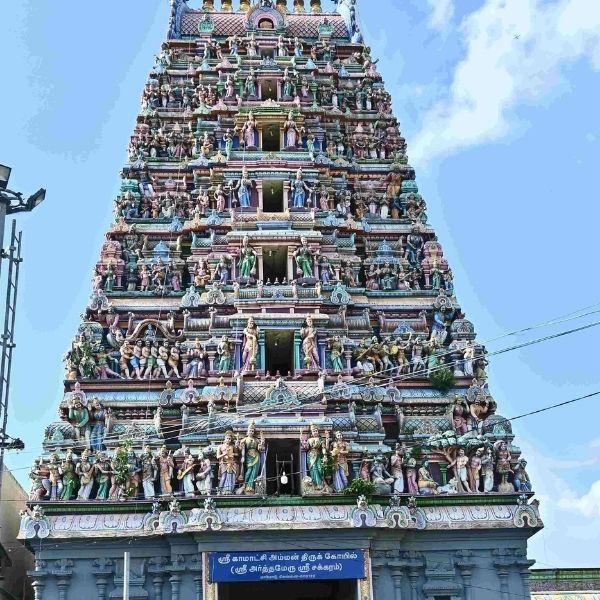
Kamakshi Amman Temple in Mangadu is a well-known Hindu temple dedicated to Goddess Kamakshi, worshipped here as Tapas Kamakshi. Mangadu, which means “mango forest” or “mango grove,” is believed to have been surrounded by dense mango trees in ancient times. The temple is an important pilgrimage centre near Chennai and is administered by the Hindu Religious and Charitable Endowments Department of the Government of Tamil Nadu.
History
The temple is associated with the traditional legend of Goddess Kamakshi’s penance. According to temple tradition, the goddess came to Mangadu to perform intense penance to reunite with Lord Shiva. She is believed to have performed her penance amidst five sacred fires, known as Panchagni, with one leg placed near the fire and the other folded.
The present temple reflects elements of Chola-style architecture. The main Rajagopuram is a seven-tiered structure facing south and features numerous sculptures. The eastern entrance is also commonly used by devotees, with a market selling flowers, lemons and other pooja items along the approach.
Legend and Significance
According to the legend, Goddess Parvati once playfully closed Lord Shiva’s eyes while they were at Mount Kailash. This caused darkness to spread throughout the universe. Lord Shiva then instructed the goddess to undertake penance.
Goddess Kamakshi came to Mangadu and performed severe penance amidst Panchagni, meditating on Lord Shiva with a Japamala in her hand. Lord Shiva later instructed her to proceed to Kanchipuram, where their marriage would take place.
After the goddess left Mangadu, the intense heat generated by the sacred fire was believed to have caused great discomfort in the surrounding area. During his pilgrimage, Adi Shankaracharya is traditionally believed to have visited Mangadu and installed the Sri Ardhameru Chakra to calm the spiritual heat associated with the goddess`s penance.
The Ardhameru Sri Chakra is regarded as the principal object of worship in the temple. It is believed to be made from a combination of herbs, and therefore abhishekam is not performed on it. Instead, Kumkuma Archana is performed regularly. A special abhishekam is traditionally conducted on the Sri Chakra on Vijaya Dashami.
The temple also has a shrine for Tapas Kamakshi, which was installed at the direction of the Kanchi Paramacharya. Other shrines and deities can be found around the temple premises, including Lord Ganesha, Lord Surya and the Sapta Matrikas.
Devotees traditionally visit the temple seeking the blessings of Goddess Kamakshi for various personal wishes, including marriage, childbirth, career progress and purchasing a new home.
Temple Architecture
The temple follllows a traditional South Indian architectural style with a prominent seven-tiered Rajagopuram. A shrine dedicated to Lord Ganesha is located near the entrance. The main sanctum houses Goddess Kamakshi along with the Ardhameru Sri Chakra.
The temple complex includes spacious corridors, subsidiary shrines and a sacred pond. The arrangement of the shrines and the worship of the Ardhameru Chakra give the temple its distinctive religious character.
Vaikunta Perumal Temple
A visit to the Kamakshi Amman Temple is traditionally followed by a visit to the nearby Vaikunta Perumal Shrine, located approximately 500 metres away. Lord Vishnu is worshipped there in a seated posture with Sridevi and Bhoodevi.
According to local tradition, Lord Vishnu is depicted holding a ring associated with the marriage of his sister Kamakshi. The shrine also has separate sanctums for Goddess Lakshmi, Sri Andal and Lord Hanuman.
Top Stories
-

-
 Sell Your Unused Gold Safely in Chennai with Verified Gold Buyers01/Oct/2026 2:50:00 PM
 -
 TBM “Marutham” Breakthrough at Villivakkam Bus Terminus Metro Station01/Oct/2026 2:27:13 PM
 -
 6 Important Identity Documents in India and Their Uses01/Oct/2026 2:10:02 PM
 -
Kamakshi Amman Temple, Mangadu: History, Legend, Architecture and Significance01/Oct/2026 12:56:03 PM
-
 West Mambalam: The Untold History of Chennai01/Oct/2026 12:36:53 PM

 JB Soft System