
Installing CCTV Cameras at Home, Shop or Office? Know These Legal Rules Before You Do
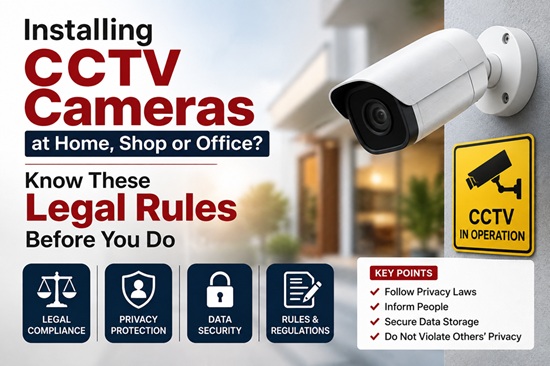
Do you need police permission to install a CCTV camera? Can your camera cover the road outside your house? What happens if it records your neighbour’s property? Here are some important CCTV rules and privacy considerations every homeowner and business owner should know.
CCTV cameras have become an essential part of security systems in homes, shops, offices, apartments and commercial establishments. They help deter theft, monitor suspicious activity and provide valuable evidence when an incident occurs.
However, installing a CCTV camera does not mean that it can be pointed anywhere without restriction.
While protecting your property is important, respecting the privacy of others is equally important.
Do You Need Police Permission to Install CCTV at Home?
Generally, a homeowner does not require prior police permission simply to install CCTV cameras for the security of their own property.
Cameras can normally be installed to monitor areas such as:
- Entrance and exit gates
- Compound areas
- Vehicle parking spaces
- Front yards
- Other areas within the property
However, the positioning and coverage of the camera are important.
A camera installed for your security should not unnecessarily monitor the private areas of neighbouring properties.
Can Your CCTV Camera Cover the Road Outside Your House?
When a CCTV camera is installed to monitor your gate or entrance, part of the public road outside the property may naturally appear in the recording.
This is different from deliberately pointing a camera towards someone else`s private living space.
For security purposes, it may be reasonable for the camera to capture the immediate area around your entrance, particularly as such footage can sometimes help identify vehicles, suspicious persons or the direction in which an offender escaped.
However, the camera angle and zoom should ideally be limited to what is reasonably required for protecting your property.
Be Careful When Your Camera Faces a Neighbour`s Property
This is one of the most important issues homeowners should consider.
A CCTV camera should not be deliberately positioned to continuously monitor a neighbour`s windows, balcony or other areas where they have a reasonable expectation of privacy.
The Supreme Court of India recognised the Right to Privacy as a fundamental right under Article 21 of the Constitution in the landmark K.S. Puttaswamy judgment.
Therefore, the principle should be simple:
Your security should not become someone else`s loss of privacy.
What About CCTV in Shared Residential Properties?
Special care is necessary when CCTV cameras are installed inside shared residential properties.
In a 2025 case, the Calcutta High Court dealt with CCTV surveillance within the residential portion of a property shared by co-occupants. The court found that operating cameras in such circumstances without the consent of other occupants could interfere with their privacy and enjoyment of the property.
The Supreme Court subsequently declined to interfere with the High Court`s ruling.
Therefore, people living in shared properties should consider the privacy rights of all occupants before installing cameras in shared residential spaces.
CCTV Rules for Shops and Commercial Buildings in Tamil Nadu
Tamil Nadu has specific rules governing CCTV installation in certain categories of public buildings.
The Tamil Nadu Urban Local Bodies (Installation of Closed Circuit Television Units in Public Buildings) Rules, 2012 cover several categories of establishments.
Depending on the nature, size and use of the building, the rules may apply to places such as educational institutions, hospitals, lodging houses, marriage halls, theatres, banks, ATMs, jewellery shops, shopping malls, petrol filling stations and certain large commercial establishments.
The rules also prescribe CCTV coverage requirements for applicable buildings, including important locations such as entrances, exits, corridors and reception areas.
Therefore, it is not accurate to simply say that "CCTV becomes compulsory whenever more than 100 people use a building."
The applicable requirement depends on factors including the type of establishment, floor area and other criteria specified under the relevant rules.
Can Recording Someone`s Private Areas Become a Criminal Offence?
Yes, under certain circumstances.
Section 66E of the Information Technology Act, 2000 deals specifically with violation of privacy.
It penalises intentionally capturing, publishing or transmitting the image of a person`s private area without consent under circumstances violating that person`s privacy.
The offence can attract imprisonment of up to three years, a fine, or both.
However, this provision should not be misunderstood to mean that every CCTV recording of a person without prior consent automatically becomes a criminal offence.
The nature of the recording, the location, circumstances and the person`s reasonable expectation of privacy are important considerations.
Where Should CCTV Cameras Be Installed in Apartments?
In apartment complexes and gated communities, cameras are generally most appropriately used in common security areas such as:
- Entrance and exit gates
- Parking areas
- Reception or security areas
- Common passages
- Other common areas requiring security monitoring
Cameras should not intrude into residents` homes or unnecessarily monitor their private activities.
Apartment associations should also consider having a clear CCTV policy covering who can access recordings, how footage is protected and how long recordings are retained.
Should You Display a "CCTV Surveillance" Sign?
Displaying a notice such as:
"This Area is Under CCTV Surveillance"
in a clearly visible location is a good practice, particularly in shops, offices, apartment common areas and commercial establishments.
It informs visitors that surveillance is taking place and promotes transparency.
India`s Digital Personal Data Protection Act, 2023, together with the DPDP Rules, is also relevant to the broader treatment of digital personal data. However, its major substantive provisions are being brought into force in stages. Therefore, businesses should avoid assuming that every CCTV-related requirement attributed to the DPDP framework is already fully operational and should keep track of the applicable compliance requirements as they take effect.
7 Important CCTV Practices to Follow
1. Position cameras only where reasonably necessary for security.
2. Avoid pointing cameras towards a neighbour`s windows, balcony or other private areas.
3. Avoid unnecessary zooming or audio recording.
4. Apartment associations should maintain clear rules regarding CCTV access and usage.
5. Shops and businesses should check whether specific Tamil Nadu local-body CCTV requirements apply to their premises.
6. Do not unnecessarily circulate CCTV footage through WhatsApp, Facebook, YouTube or other social media platforms.
7. Displaying a visible CCTV surveillance notice is a sensible practice in areas accessed by customers, employees or the general public.
Security Matters - Privacy Matters Too
CCTV cameras can be extremely useful in preventing crime and helping authorities investigate incidents.
But a security camera should never become a tool for unnecessarily monitoring another person`s private life.
Install CCTV cameras to protect your home, family and business - but make sure your camera does not cross the boundary into someone else`s privacy.
Security is your right. Privacy is their right. Responsible CCTV usage respects both.
Disclaimer: This article is intended for general public awareness and should not be treated as legal advice. CCTV requirements may vary depending on the type of premises and applicable state/local regulations. For a specific dispute, installation or compliance requirement, consult the relevant local authority, police department or a qualified legal professional.
Top Stories
-
 Today Nalla Neram October 5, 2026 – Rahu Kalam, Yamagandam & Tamil Panchangam03/Oct/2026 6:22:39 PM
 -
 Tomorrow Panchangam October 04, 2026 | Auspicious Timings, Rahu Kalam, Gulikai03/Oct/2026 6:21:18 PM
 -
 Bigg Boss Tamil 10 Day 26: Javeed, Dhanya, Savinya and Ashmitha Face Major Twist03/Oct/2026 5:30:20 PM
 -
 How to Apply for Thai Maaman Thanga Mothiram Thittam 2026?03/Oct/2026 4:27:27 PM
 -
 Tamil Nadu Weather Update: Moderate Rain Expected in 6 Districts03/Oct/2026 3:52:20 PM
 -
 Chennai Flood-Free Areas: 10 Safer Residential Localities - Watch the Full Video03/Oct/2026 3:48:19 PM

 JB Soft System