
Tamil Nadu to Set Up 6 Model Property Registration Centres in Chennai, Tambaram and Other Areas
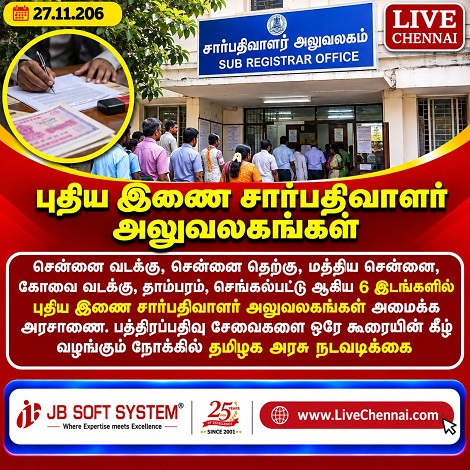
The Tamil Nadu government has issued an order to establish six model property registration centres in Chennai, Chengalpattu, Coimbatore and Tambaram. The initiative aims to provide multiple registration-related services in a single location and make property registration more convenient for the public.
The six registration districts identified for the model centres are North Chennai, Central Chennai, South Chennai, Chengalpattu, Coimbatore North and Tambaram.
25 Model Registration Service Centres
The government had earlier announced plans to establish 25 model registration service centres across Tamil Nadu. As part of this initiative, newly created Joint Sub-Registrar Offices in the six registration districts will function along with the respective existing Registrar Offices.
The announcement was made by Minister Lokesh in the Tamil Nadu Legislative Assembly on September 7, 2026. The government issued the latest order on November 26, 2026, directing the Registration Department to provide the necessary administrative instructions for operating the model centres.
Facilities at the Model Centres
The new centres are expected to have modern facilities for people visiting for registration services. These include:
- Air-conditioned waiting areas
- Seating arrangements for 50 to 100 people
- Automated consent verification facilities
- Aadhaar verification using eye and fingerprint authentication
- Touchscreen-enabled automated machines
- Modern computers and printers
- 24-hour CCTV surveillance
- Generators for uninterrupted power supply
Additional Service Charges
Apart from the regular registration charges, four categories of additional service fees are proposed at these model centres:
| Service | Additional Fee |
|---|---|
| Normal Service | ₹2,000 |
| Emergency Normal Service | ₹5,000 |
| Special Service | ₹5,000 |
| Emergency Special Service | ₹10,000 |
According to the information provided, the additional revenue will be shared between the government and the private operator. For normal services, the government will receive 80% and the private operator 20%. For emergency special services, the share will be 65% for the government and 35% for the private operator.
Top Stories
-
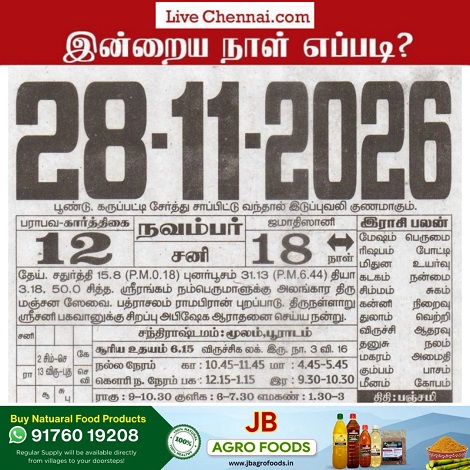 Tomorrow Panchangam November 28, 2026 | Auspicious Timings, Rahu Kalam, Gulikai27/Nov/2026 5:48:15 PM
-
 Bigg Boss Tamil 10: TTF Vasan Gets Emotional With His Mother27/Nov/2026 5:15:20 PM
-
 What Is Term Insurance? Why Is Life Cover Important for Financial Security?27/Nov/2026 5:00:39 PM
-

-
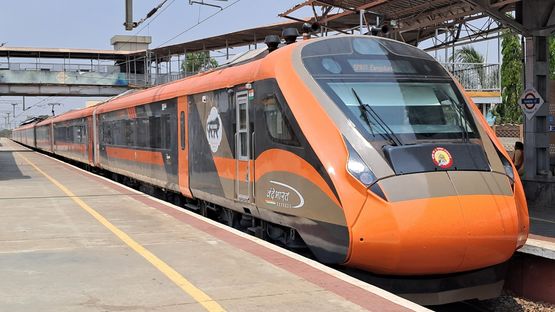 High-Quality Meals Introduced on 3 Vande Bharat Sleeper Trains27/Nov/2026 2:28:32 PM
-
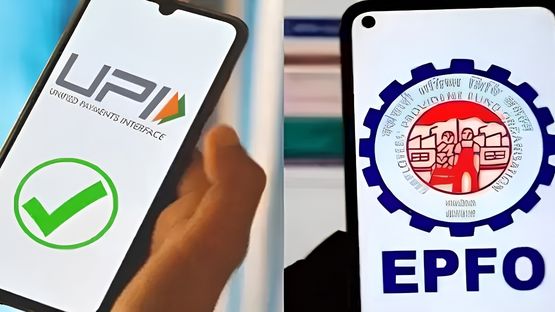 EPF Withdrawal Through UPI to Be Introduced by December-End27/Nov/2026 2:12:57 PM

 JB Soft System