
The History Behind Chennai’s Famous Mount Road Roundana
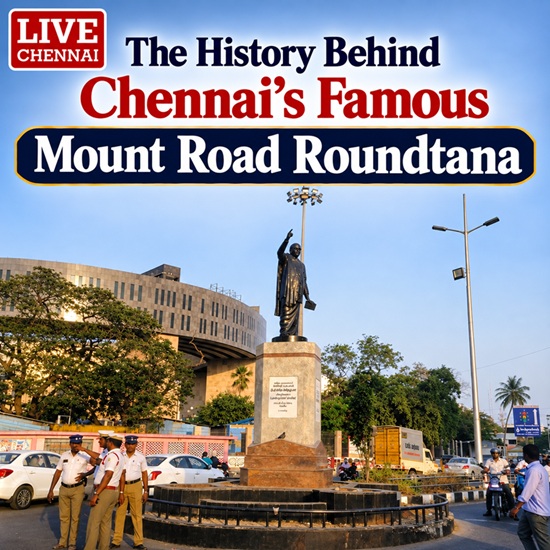
Chennai is known for its unique words and expressions, and “Roundtana” is one such term that has become part of the city’s everyday vocabulary. In Tamil Nadu, the word is commonly used to describe a circular traffic junction or roundabout where vehicles move around a central point.
But have you ever wondered where the name “Roundtana” came from?
The answer takes us back nearly 175 years to colonial-era Madras and reveals a fascinating story involving an old police station, a fountain, a statue, an air-raid shelter and one of Chennai’s busiest pedestrian subways.
The First Reference to ‘Round Thana’
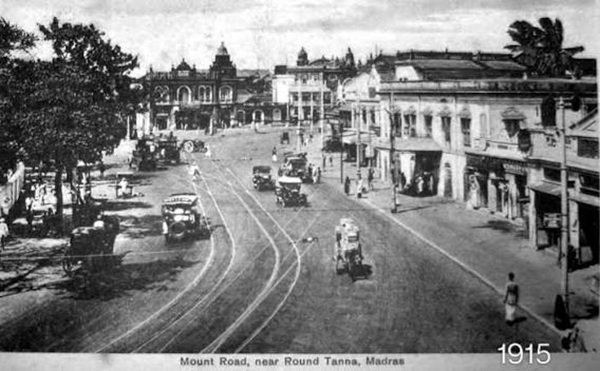
One of the earliest known references to the term “Round Thana” dates back to 1852.
At the time, the British government appointed a commission to study and improve postal services in Madras and the surrounding areas. The commission recommended using bullock carts to transport mail from the General Post Office in George Town to different parts of the city and beyond.
Among the stopping points mentioned in the postal route records was a place called “Round Thana.”
The name was used to identify a circular-shaped police station located at the junction. Historical records also referred to it as “Circular Thana.”
What Does ‘Thana’ Mean?
The word “Thana” has its roots in an earlier administrative system and was commonly used to refer to a police post or police station.
During the nineteenth century, policing in Madras was very different from the organised police station system seen today. In some places, a local police post operated from the veranda or premises of a private residence.
Since such locations could be difficult to identify, especially at night, records from the period mention the use of teak poles fitted with oil lamps to help people locate police stations after dark.
The circular police post at the Mount Road junction eventually became known as Round Thana, and the name gradually entered popular usage.
From a Police Station to a Historic Landmark
By the 1870s, official records continued to refer to the Mount Road police post as Round Thana. However, by the 1880s, the original police station had disappeared from the location.
Records indicate that a new police station was later established near the Walajah Road junction.
Meanwhile, the Round Thana site itself underwent another transformation.
In 1887, to commemorate the Golden Jubilee of Queen Victoria`s reign, the Raja of Vizianagaram constructed a fountain at the junction. Known as the Vizianagaram Fountain, it also served as a watering place for horses used to pull carriages.
The fountain became the main landmark at the circular junction.
When Lord Ripon’s Statue Arrived
Another important chapter was added to the site`s history in 1910, when a statue of Lord Ripon, a former Viceroy of India, was installed near the Vizianagaram Fountain.
The statue was funded by Indians, sculpted in London by Francis Derwent Wood and later transported to Madras.
For several years, both the fountain and the statue stood at the junction. However, during the period surrounding the Second World War, the statue was moved due to concerns that it could be damaged.
It was eventually relocated to the Ripon Buildings, where it remains.
From Fountain to Air-Raid Shelter
The Vizianagaram Fountain gradually fell into disrepair after its water supply dried up. The structure eventually became a neglected site, and the Chennai Corporation decided to demolish it.
A public toilet was later constructed at the location. Beneath it, an air-raid shelter was built during the Second World War to provide protection in the event of aerial attacks.
By the 1940s, both the historic fountain and Lord Ripon`s statue had disappeared from the Round Thana junction.
The Birth of the Roundtana Subway
In 1956, the Chennai Corporation proposed a major redevelopment project for the area. The plan involved removing the toilet and air-raid shelter and constructing a subway.
The proposed design included multiple access points and plans for underground shops surrounding a central open area. However, due to financial constraints, construction was delayed.
Work finally began in 1965, attracting considerable public attention as large excavation equipment was brought to the site.
The subway was completed in 1967 and inaugurated during the tenure of Chief Minister M. Bhaktavatsalam. Although the original plan included underground shops, only the subway was ultimately completed.
Anna Statue Changes the Identity of the Junction
The area above the subway was initially developed for parking. However, following the political changes after the 1967 elections, the arrangement did not last long.
On January 1, 1968, a statue of Chief Minister C.N. Annadurai was installed at the location.
Over time, traffic around the junction increased significantly. The open space and garden surrounding the statue gradually became smaller as Chennai`s roads and traffic demands expanded.
Today, only a limited green space remains around the statue, but the historic name has survived.
Why Is It Still Called ‘Roundtana’?
This is perhaps the most interesting part of the story.
The original circular police station is gone. The fountain has disappeared. The statue and surrounding landscape have changed over time. Even the original circular shape of the junction has largely vanished.
Yet, more than a century later, the name “Roundtana” continues to live on.
The location is still referred to as Roundtana in official records, and the subway built there became known as the Roundtana Subway. Over time, the word also entered common usage across Chennai and Tamil Nadu as a general term for a circular traffic junction or roundabout.
According to the historical account, Chennai Corporation records list around 120 roundtanas across the city.
A Name That Has Survived for Generations
The story of Roundtana is a perfect example of how Chennai`s history continues to survive through its place names.
A circular police post that existed nearly 175 years ago gave birth to a name that is still used every day. While the original structure has disappeared, the word remains firmly rooted in the language and culture of the city.
Next time you hear someone say “Roundtana”, remember that the word is not just about a traffic junction it carries with it a fascinating journey through Chennai`s colonial history, transport system, public spaces and changing urban landscape.
Top Stories
-
 Mahalaya Amavasya 2026: Date, Timings and Significance09/Oct/2026 10:32:29 AM
 -
 Tamil Nadu By-Election Results 2026: Live Updates and Latest Counting Trends09/Oct/2026 10:20:49 AM
 -
 Chennai Gold Rate Today, October 9, 2026: Gold Prices Rise09/Oct/2026 10:16:17 AM
 -
 A new low-pressure area is likely to form over the Bay of Bengal October 13.09/Oct/2026 10:03:41 AM
 -
 India’s Wind Energy Sector Set for 8 GW Installations in FY2709/Oct/2026 9:50:14 AM
 -
 Chennai Ration Card Grievance Camp on October 10 in 19 Zones09/Oct/2026 9:44:00 AM

 JB Soft System