
Health Insurance May Get Cheaper, But Hospital Bills Could Get Costlier: Understanding the 10% Co-Pay
Health insurance premiums could become more affordable if co-payment becomes a more prominent, and potentially mandatory, feature of retail health insurance policies in India. While this could reduce the amount policyholders pay upfront, it would also mean taking on a larger share of the medical expenses when a claim is made.
For policyholders, the focus may soon shift from simply asking how much health cover they have to understanding how much they may have to pay themselves during a hospitalisation.
What is a 10% co-payment?
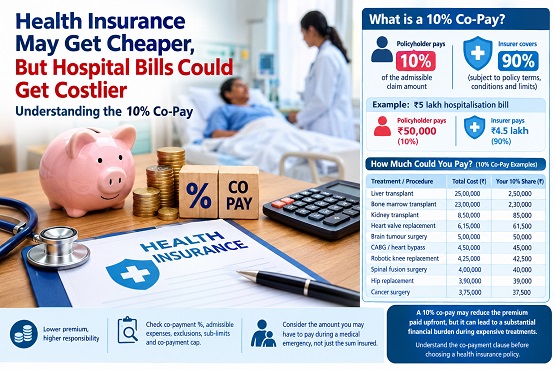
Under a 10% co-payment arrangement, the policyholder would pay 10% of the admissible claim amount, while the insurer would cover the remaining 90%, subject to the terms, conditions and limits of the policy.
For example, if the admissible hospitalisation expense is ₹5 lakh, a 10% co-pay would mean the policyholder has to pay ₹50,000 from their own pocket. The insurer would cover the remaining ₹4.5 lakh, provided the expenses are covered under the policy.
The amount payable by the policyholder can become considerably higher when the treatment involves expensive procedures.
Costly treatments could mean bigger out-of-pocket expenses
Consider a hospitalisation claim of ₹25 lakh. With a 10% co-payment, the policyholder would need to contribute ₹2.5 lakh, while the insurer would cover ₹22.5 lakh, subject to the policy`s terms and conditions.
The accompanying data, based on benchmark hospitalisation costs in Delhi, illustrates how quickly the co-payment can add up.
A liver transplant costing ₹25 lakh would involve a 10% co-payment of ₹2.5 lakh. For a bone marrow transplant costing ₹23 lakh, the policyholder`s contribution would be ₹2.3 lakh. A kidney transplant costing ₹8.5 lakh would require an out-of-pocket contribution of ₹85,000.
Other procedures listed include heart valve replacement at ₹6.15 lakh, brain tumour surgery at ₹5 lakh, CABG or heart bypass at ₹4.5 lakh, robotic knee replacement at ₹4.25 lakh, spinal fusion surgery at ₹4 lakh, hip replacement at ₹3.9 lakh and cancer surgery at ₹3.75 lakh.
Lower premium, higher responsibility
The possibility of paying a lower premium may make co-payment policies attractive to some consumers. However, a cheaper policy does not necessarily mean lower healthcare expenses when a claim arises.
Before purchasing or renewing a health insurance policy, customers should carefully check the co-payment percentage, admissible expenses, exclusions, sub-limits and any applicable co-payment cap.
The actual amount a policyholder pays can vary depepending on the policy terms and whether the entire hospital bill is considered admissible.
What should policyholders consider?
If co-payment becomes more widely adopted, consumers may need to evaluate health insurance differently. The sum insured will remain important, but so will the amount they could be required to contribute during a medical emergency.
A 10% co-pay may reduce the premium paid upfront, but it can result in a substantial financial burden when expensive treatment is required. Understanding the co-payment clause before choosing a health insurance policy can therefore help families prepare for potential medical expenses and avoid unexpected financial pressure.
Top Stories
-
 Tomorrow Panchangam October 08, 2026 | Auspicious Timings, Rahu Kalam, Gulikai07/Oct/2026 5:54:08 PM
 -
 University of Colorado Denver to Set Up Campus in Hyderabad07/Oct/2026 5:48:00 PM
 -
 KCG College of Technology: Courses, Fees, Eligibility and Ranking07/Oct/2026 5:40:45 PM
 -
 Smart Home in Chennai: How to Build a Connected Home Without Overspending07/Oct/2026 4:56:14 PM
 -
 Bigg Boss Tamil 10: Muniyamma Gets Emotional After Receiving Food From Akshitha07/Oct/2026 4:47:43 PM
 -
 Gold Falls While Silver Rises: What Investors Should Know07/Oct/2026 4:29:36 PM

 JB Soft System