
AI Knowledge Managers: Career Opportunities, Salary, Skills and Future Growth
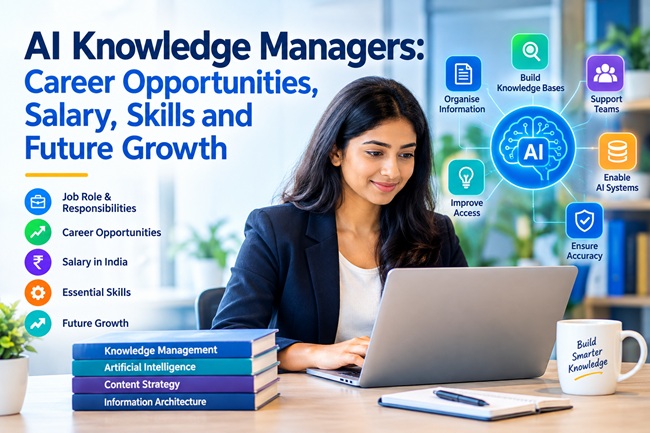
AI Knowledge Management is emerging as an important career opportunity as businesses increasingly depend on artificial intelligence to organise, understand and use information. Organisations generate enormous amounts of data, documents, reports and business knowledge. AI Knowledge Managers help transform this information into structured, reliable and accessible knowledge that both employees and AI systems can use effectively.
With the growing adoption of generative AI, intelligent search tools and AI-powered assistants, professionals who can organise information, maintain knowledge systems and ensure content accuracy are becoming increasingly valuable.
What Does an AI Knowledge Manager Do?
An AI Knowledge Manager is responsible for collecting, organising, maintaining and improving an organisation`s knowledge using artificial intelligence and digital knowledge-management systems.
The role involves transforming scattered information into structured knowledge that can be easily accessed by employees, customers and AI applications.
Typical responsibilities include collecting information from different departments, organising documents and databases, developing knowledge repositories, maintaining accurate information, identifying outdated content and preparing business information for AI-powered search and assistants.
They also work with technical teams to ensure AI systems retrieve relevant information and provide reliable answers.
Future Opportunities in AI Knowledge Management
As companies adopt AI-powered business applications, the demand for professionals who can manage organisational knowledge is expanding.
AI Knowledge Managers can find opportunities across several industries, including:
IT and Technology: Managing technical documentation, software information and internal knowledge platforms.
Healthcare: Organising medical information, clinical documentation and healthcare knowledge resources.
Banking and Finance: Maintaining financial policies, compliance documentation and customer information resources.
Education: Developing digital learning resources, AI-assisted learning platforms and institutional knowledge systems.
Retail and E-commerce: Managing product information, customer FAQs and business knowledge databases.
Corporate Organisations: Building internal knowledge systems that help employees access company policies, procedures and business information.
Potential job titles include AI Knowledge Manager, Knowledge Management Specialist, AI Content Strategist, Knowledge Engineer, Information Architect and AI Enablement Manager.
AI Knowledge Manager Salary and Work Opportunities
AI Knowledgege Managers can work in full-time corporate positions, consulting assignments, technology companies and remote knowledge-management projects.
In India, compensation depends on professional experience, technical expertise, industry and organisational requirements. Professionals with experience in AI integration, enterprise knowledge platforms, information architecture and knowledge engineering may qualify for higher-paying positions.
For example, a recent Bengaluru-based Unisys job listing for a Knowledge Management and AI Content Strategy role advertised an estimated annual salary of ₹15 lakh to ₹22.5 lakh. This illustrates the potential of specialised positions, rather than representing a standard salary for all AI Knowledge Managers.
Experienced professionals can also explore opportunities in enterprise AI implementation, knowledge consulting and AI-powered business transformation.
Essential Skills to Become an AI Knowledge Manager
People interested in this career should develop a combination of information-management, communication and technical skills.
Important skills include:
Knowledge Management: Understanding how to collect, organise, store and share business information.
AI Literacy: Understanding generative AI, large language models and AI-powered knowledge assistants.
Information Architecture: Organising information through categories, metadata, tagging and structured content.
Research and Analysis: Identifying reliable sources, checking information and recognising knowledge gaps.
Content Management: Creating, editing and maintaining documentation, FAQs, guides and standard operating procedures.
AI Tools: Working with platforms such as Microsoft Copilot and other AI-powered knowledge-management solutions.
Communication: Collaborating with employees, subject experts and technical teams to capture and share knowledge.
Data Management: Understanding databases, information security, access permissions and content governance.
Knowledge of technologies such as SharePoint, Confluence, enterprise search, retrieval-augmented generation (RAG), semantic search and knowledge graphs can provide additional career advantages.
How to Start a Career in AI Knowledge Management
People from different educational and professional backgrounds can explore AI Knowledge Management.
A practical starting point is to understand how organisations collect and manage information. Beginners can practise creating structured knowledge bases, organising documents, preparing FAQs and developing searchable information repositories.
Learning popular AI tools and knowledge-management platforms can help c candidates understand how AI retrieves information and generates answers from existing business documents.
Building a portfolio with sample knowledge repositories, organised documentation, AI-powered question-and-answer projects and content-management workflows can demonstrate practical abilities to potential employers.
Candidates can then apply for entry-level opportunities in content management, knowledge operations, documentation, information management and AI support services.
Career Growth and Long-Term Prospects
AI Knowledge Management offers opportunities to progress into specialised and leadership positions.
Professionals may begin as knowledge-management assistants or content specialists and gradually move into AI Knowledge Management, knowledge engineering, information architecture and enterprise AI strategy.
With additional technical expertise, experienced professionals can specialise in RAG systems, knowledge graphs, intelligent search, AI agent development and enterprise knowledge automation.
As AI becomes integrated into everyday business operations, organisations will need professionals who can ensure that their AI systems access accurate, updated, relevant and authorised information.
Conclusion
AI Knowledge Management is an emerging career option for people interested in information, technology, research and artificial intelligence. It combines traditional knowledge-management practices with modern AI technologies to help organisations make better use of their information.
For aspiring professionals, developing AI literacy, content-management expertise, research abilities and technical knowledge can create opportunities in this growing field. The ability to turn large amounts of information into reliable, organised and useful knowledge could become an important professional advantage in the AI-driven workplace.
Top Stories
-
 Tomorrow Panchangam November 14, 2026 | Auspicious Timings, Rahu Kalam, Gulikai13/Nov/2026 6:00:25 PM
-
AI Knowledge Managers: Career Opportunities, Salary, Skills and Future Growth13/Nov/2026 5:44:16 PM
-
 SalesBoost: A CRM Your Sales Team Will Actually Use13/Nov/2026 5:32:27 PM
-
 Robotic Heart Surgery Cost in Chennai: Procedure-Wise Price Guide13/Nov/2026 5:03:00 PM
-
 Chennai Metro Orange Line: T. Nagar to Marina in 12 Minutes, Poonamallee in 25 Minutes13/Nov/2026 4:09:23 PM
-
 Chennai-Mysuru Vande Bharat Express: Route, Timings, Stops and Key Features13/Nov/2026 3:25:48 PM

 JB Soft System