
Solar for Apartments: Benefits and Requirements for Independent Houses and Apartment Buildings
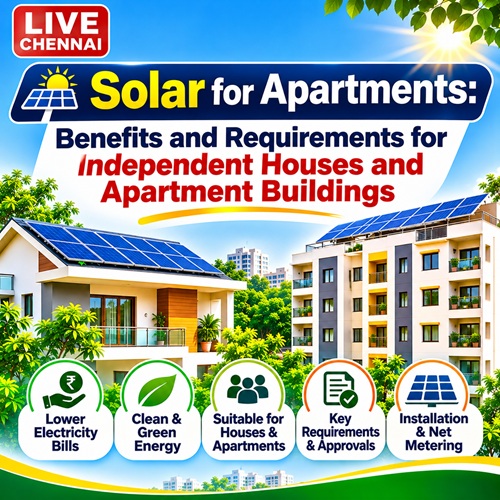
Rooftop solar power is becoming an attractive option for homeowners and apartment communities looking to reduce electricity expenses and adopt cleaner energy. In India, residential rooftop solar systems can help households generate electricity from sunlight and reduce their dependence on grid power.
However, installing solar panels on an independent house is different from setting up a shared solar system in an apartment building. Roof ownership, available space, electricity connections, resident approvals, and subsidy eligibility all need to be considered before installation.
Benefits of Rooftop Solar for Homes and Apartments
1. Lower Electricity Bills
Solar panels generate electricity during daylight hours, helping reduce the amount of power purchased from the grid. A properly sized system can lower monthly electricity expenses, depending on consumption, sunlight, and the applicable billing arrangement.
2. Renewable and Environmentally Friendly Energy
Solar power produces electricity without burning fossil fuels at the point of generation. Using rooftop solar can help reduce household carbon emissions and support cleaner energy use.
3. Better Use of Rooftop Space
Independent houses and apartment buildings can use suitable roof areas to generate electricity instead of leaving them unused. Apartment rooftops may also accommodate systems for common facilities such as lifts, corridor lighting, water pumps, and shared amenities.
4. Long-Term Energy Savings
Although installation requires an initial investment, solar panels can provide electricity for many years. Savings depend on system cost, maintenance, electricity tariffs, and the amount of solar power consumed or exported.
5. Support Through Government Schemes
Eligible residential consumers may receive financial assistance through the PM-Surya Ghar: Muft Bijli Yojana. The central subsidy for individual households is capped at ₹78,000 for systems of 3 kW or more. Group Housing Societies and Resident Welfare Associations may also qualify for assistance for eligible common-facility systems. Official scheme details: https://pmsuryaghar.gov.in
Rooftop Solar for Independent Houses
Independent homeowners generally have more direct control over their rooftops and electricity connections. Before installation, they should:
- Check whether the roof receives adequate sunlight and has sufficient space.
- Confirm that the roof structure can safely support the panels and mounting system.
- Review electricity bills to estimate suitable solar capacity.
- Check the feasibility of grid connection and net metering with the local electricity distribution company.
- Choose an eligible vendor and confirm equipment specifications, warranties, installation costs, and maintenance arrangements.
- Apply through the official PM-Surya Ghar portal before proceeding if seeking subsidy.
A grid-connected system typically includes solar panels, an inverter, mounting structures, safety equipment, and the required metering arrangement. A standard grid-connected system may shut down during a power outage for safety; backup power requires a suitable battery and compatible system design.
Rooftop Solar for Apartment Buildings
Apartment buildings can install solar panels for common electricity needs or, where technically and legally feasible, for individual residential connections.
Solar for Common Facilities
A shared rooftop system can help power common-area loads such as:
- Elevators and water pumps
- Corridor and outdoor lighting
- Security systems
- Clubhouse and other shared amenities
- Electric vehicle charging facilities, where supported
The apartment association or society typically coordinates the project, including resident approval, roof access, cost sharing, vendor selection, and maintenance.
Solar for Individual Flats
Residents who want solar power for their own electricity bills need to check whether the building has suitable space and whether the system can be connected to their individual electricity service. The association’s rules, roof-use rights, wiring arrangements, and distribution-company requirements must be reviewed first.
Requirements Before Installing Solar in an Apartment
Resident and association approval: Obtain the required approval from the apartment association, housing society, or building management before using shared rooftop space.
Roof suitability: Assess available area, shading, structural strength, waterproofing, and safe access for installation and maintenance.
Electricity connection and metering: Confirm the applicable grid-connection, inspection, and net-metering requirements with the local distribution company.
Technical and safety compliance: Use a qualified, eligible installer and ensure the system meets applicable electrical and safety standards.
Financial planning: Decide how installation costs, maintenance expenses, and any common-area savings will be shared among residents.
Subsidy eligibility: Check the current scheme conditions. Under PM-Surya Ghar, assistance for Group Housing Societies and RWAs is intended for eligible common facilities, including EV charging, and is subject to schememe capacity limits and requirements.
PM-Surya Ghar Subsidy: What Residents Should Know
The central subsidy for eligible residential rooftop solar systems is structured as follows:
| Rooftop system capacity | Central subsidy |
| 1 kW | ₹30,000 |
| 2 kW | ₹60,000 |
| 3 kW or more | ₹78,000 maximum |
For Group Housing Societies and RWAs, eligible common-facility systems may receive central assistance at ₹18,000 per kW, subject to the scheme’s overall capacity limits and conditions. The subsidy is not automatically available for every apartment installation; applicants should verify eligibility and current rules on the official portal.
How to Apply for Rooftop Solar
1. Register on the PM-Surya Ghar National Portal: https://pmsuryaghar.gov.in.
2. Submit the electricity consumer details and apply for feasibility approval.
3. Select an eligible vendor after approval.
4. Install the rooftop solar system according to the approved specifications.
5. Complete the required inspection, commissioning, and metering process.
6. Submit the required bank details and documents for subsidy processing, if eligible.
In Tamil Nadu, residents should also check the Tamil Nadu Solar Rooftop Portal: https://www.tnebltd.gov.in/usrp for state-specific procedures, vendor requirements, and subsidy information.
Is Rooftop Solar Worth It for Apartments?
Rooftop solar can be a worthwhile investment for independent houses and apartment communities with adequate sunlight, suitable roof space, and a well-planned electricity connection. Independent homeowners may find installation and decision-making simpler, while apartment buildings need coordinated approvals and clear arrangements for shared benefits and maintenance.
Before investing, compare quotations, estimate expected generation, verify subsidy eligibility, and confirm all technical requirements with the local electricity distribution company.
SEO Title: Solar for Apartments: Benefits and Rooftop Solar Requirements in India
Meta Description: Learn the benefits and requirements of rooftop solar for independent houses and apartments, including installation, approvals, net metering, and PM-Surya Ghar subsidy.
Focus Keywords: solar for apartments, rooftop solar for apartments, rooftop solar for r independent houses, apartment solar installation, PM Surya Ghar subsidy
URL Slug: solar-for-apartments-rooftop-solar-benefits-requirements
Tags: Rooftop Solar, Solar for Apartments, Solar Energy, PM Surya Ghar, Solar Subsidy, Renewable Energy
Top Stories
-
 Lenovo Appoints Amar Babu as Motorola Mobility President from January 202705/Nov/2026 2:58:57 PM
-
 Best Live Music Venues in Chennai for Music Lovers05/Nov/2026 2:48:14 PM
-
 Bigg Boss Tamil 10: Asmitha and Jason Get a Secret Serial Killer Mission05/Nov/2026 2:17:30 PM
-
 What Are the Features and Benefits of a Credit Card in India?05/Nov/2026 2:04:56 PM
-
-
 Best 5 Hospitals in and Around Adyar, Chennai: Top Healthcare Centres05/Nov/2026 1:30:12 PM

 JB Soft System