
Vibe Coding: How AI Is Changing the Way People Build Software
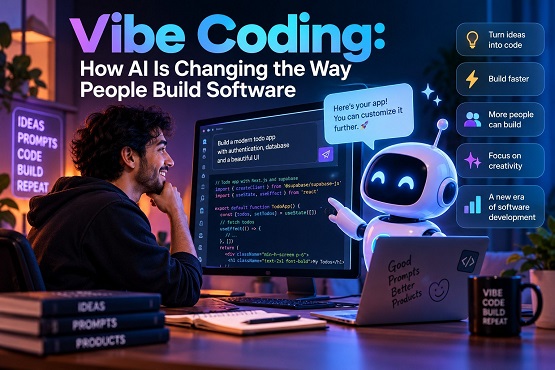
Vibe coding is emerging as a new approach to software development, allowing people to create applications by describing their ideas in plain language. Instead of manually writing every line of code, users can instruct an artificial intelligence (AI) tool to generate code, fix errors and improve an application`s features through simple conversations.
The term was coined by AI researcher Andrej Karpathy in February 2025. The approach is attracting attention because it allows beginners, entrepreneurs and developers to turn ideas into working software with less manual coding.
How Does Vibe Coding Work?
Vibe coding follows a straightforward process that combines natural-language instructions with AI-generated code.
1. Describe Your Idea: Users explain what they want to build. For example, they might ask an AI tool to create an expense tracker with spending categories and monthly charts.
2. Generate the Code: The AI coding assistant produces the initial code needed to create the application or implement the requested feature.
3. Run and Test the Application: Users check whether the application works as expected and identify any errors or missing features.
4. Improve Through Prompts: Users can request changes such as adding input validation, improving the design or introducing new functionality. The AI then modifies the code based on those instructions.
This process continues until the application meets the user`s requirements.
Important Terms to Understand
Several concepts are associated with vibe coding.
- Vibe: The overall purpose, style, functionality and user experience the creator wants to achieve.
- Prompt: A natural-language instruction given to an AI tool, such as creating a login page with email and password fields.
- AI Coding Assistant: A tool that generates code, explains programming concepts, fixes errors or makes changes to an application.
- Iterative Refinement: Repeatedly testing an application and providing instructions to improve its functionality.
- Vibe Deploying: Using AI-assisted instructions or simplified deployment workflows to publish an application online.
Understanding these terms can help beginners approach AI-assisted software development more effectively.
Benefits of Vibe Coding
One of the biggest advantages of vibe coding is faster prototyping. Entrepreneurs can test business ideas, while small businesses can develop basic internal tools without manually writing all the code themselves.
It can also help beginners learn software development by allowing them to experiment with applications and understand how different features work.
Common applications include expense trackers, to-do lists, dashboards, simple websites and demonstration projects. Developers can also use AI assistance to speed up certain coding tasks.
Risks and Limitations of Vibe Coding
Despite its advantages, vibe coding has limitations. AI-generated code may contain bugs, incorrect logic or security vulnerabilities. An application that appears to work during a quick demonstration may still fail under real-world condititions.
Accepting generated code without reviewing it can introduce hidden problems. Applications that handle sensitive information, financial transactions or customer data require particular attention to security and privacy.
Testing, code review, security checks and human oversight remain essential before deploying software for production use.
Is Vibe Coding the Future of Software Development?
Vibe coding is making software creation more accessible by allowing users to focus on their ideas rather than programming syntax. However, successful applications still require clear requirements, careful testing and ongoing maintenance.
For beginners, entrepreneurs and businesses exploring new digital products, vibe coding offers a practical way to turn ideas into prototypes. The best results come from combining AI`s coding capabilities with human judgement, technical review and a clear understanding of the problem being solved.
Top Stories
-
 Bigg Boss Tamil 10: TTF Vasan Praised for His Respectful Gesture Towards Women29/Oct/2026 4:57:22 PM
-
Vibe Coding: How AI Is Changing the Way People Build Software29/Oct/2026 4:54:20 PM
-
 Best Areas Near Nungambakkam, Chennai: Residential and Lifestyle Guide29/Oct/2026 4:50:53 PM
-
 Nexus Vijaya Mall Chennai: Shopping, Restaurants and Entertainment29/Oct/2026 4:41:42 PM
-
 Chennai Filter Coffee: Discover the Rich Aroma and Timeless Taste of Madras29/Oct/2026 4:35:09 PM
-
 Chennai Metro: Do’s and Don’ts for Passengers29/Oct/2026 4:33:12 PM

 JB Soft System