
Gold Loans Surge as Indian Households Shift Borrowing Patterns
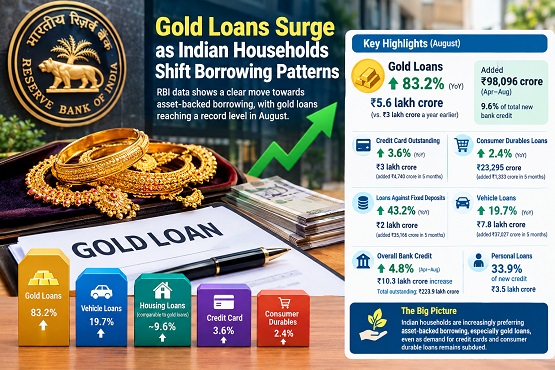
The borrowing habits of Indian households appear to be changing, with consumers increasingly turning to loans backed by assets rather than borrowing for discretionary spending, according to Reserve Bank of India (RBI) data for August.
While credit card spending and loans for consumer durables have grown slowly, gold loans have recorded a sharp increase, reaching a record level during the month.
Gold Loans See Strong Growth
Credit card outstanding balances grew by just 3.6% year-on-year in August, while loans for consumer durables increased by 2.4%. Both were significantly lower than the overall bank credit growth of 19.1%.
Credit card outstanding balances stood at around ₹3 lakh crore in August, with only ₹4,740 crore added during the first five months of the financial year. Loans for consumer durables stood at ₹23,295 crore, increasing by just ₹1,333 crore between April and August.
In contrast, loans against gold jewellery surged 83.2% year-on-year to ₹5.6 lakh crore in August, compared with around ₹3 lakh crore a year earlier.
Banks added ₹98,096 crore in gold loans between April and August, accounting for 9.6% of total new bank credit during the period. This was almost equal to the ₹98,858 crore increase recorded in housing loans.
Loans Against Fixed Deposits Also Rise
Borrowing against fixed deposits also increased significantly. Such loans grew 43.2% to ₹2 lakh crore, with ₹35,166 crore added during the five-month period.
Meanwhile, demand for vehicle loans remained strong. Vehicle loans grew 19.7% to ₹7.8 lakh crore, with an additional ₹37,027 crore disbursed between April and August.
Bank Credit Expands
Overall bank credit increased by ₹10.3 lakh crore, or 4.8%, between April and August, taking total outstanding bank credit to ₹223.9 lakh crore.
Personal loans accounted for ₹3.5 lakh crore, representing 33.9% of the total new credit extended during the period.
The data indicates a growing preference for asset-backed borrowing, particularly gold loans, even as demand for credit cards and consumer durable loans remains relatively subdued.
Top Stories
-
 Arupadai Veedu Murugan Temple, Besant Nagar, Chennai08/Oct/2026 5:24:35 PM
 -
 Flipkart Big Billion Days Sale: Poco Phones Get Up to Rs. 6,000 Discount08/Oct/2026 4:59:38 PM
 -
 2026 Honda Elevate Facelift: Price, Variants, Colours and Features08/Oct/2026 4:50:12 PM
 -
 Tamil Nadu Weather: Heavy Rain Alert for Coimbatore, Nilgiris and Theni08/Oct/2026 4:39:11 PM
 -
 Bigg Boss Tamil 10: Shadhika Suffers Eye Injury, Karishma Injured During Task08/Oct/2026 4:33:18 PM
 -
 Minnagam Service Temporarily Affected: Register Power Cut Complaints via WhatsApp08/Oct/2026 4:21:44 PM

 JB Soft System