
Credit Card EMI: How It Works and What No-Cost EMI Really Costs
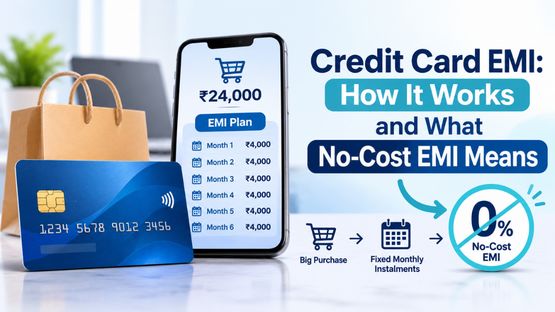
Credit card EMI allows cardholders to convert eligible purchases or outstanding amounts into fixed monthly instalments. It can make large expenses easier to manage by spreading the repayment over several months.
However, EMI does not always mean lower cost. Depending on the option chosen, there may be interest, processing fees, GST and other charges. Even a no-cost EMI offer can involve additional costs that consumers should understand before choosing it.
How Does Credit Card EMI Work?
When an eligible credit card purchase is converted into EMI, the transaction amount is divided into fixed monthly instalments over a selected repayment period. Depending on the card issuer and the EMI facility, tenures may range from a few months to several years.
There are generally two ways to convert a purchase into EMI:
- EMI at checkout: The customer selects the EMI option while making an online or in-store purchase.
- Post-purchase EMI: An eligible transaction is converted into EMI after the purchase through the card issuer`s app, internet banking or customer service.
The entire transaction amount may initially reduce the available credit limit. As the EMI principal is repaid, the available credit limit is gradually restored.
For example, if a cardholder has a ₹1 lakh credit limit and converts a ₹60,000 purchase into EMI, the available limit may initially reduce by ₹60,000. The available limit increases as the outstanding amount is repaid.
What Does Credit Card EMI Cost?
The total cost of an EMI depends on the interest rate, processing fee, tenure and applicable taxes.
Common charges may include:
| Charge | What It Means |
|---|---|
| Interest | The cost charged on the outstanding EMI amount, depending on the applicable rate and tenure. |
| Processing fee | A one-time fee that may be charged when the transaction is converted into EMI. |
| GST | Applicable taxes may be charged on certain fees and interest components as per prevailing rules. |
| Foreclosure fee | A charge that may apply when an EMI is closed before the scheduled tenure ends. |
| Lost rewards | Some EMI transactions may not qualify for regular reward points or cashback, depending on the card`s terms. |
Therefore, consumers should not compare EMI options only by looking at the monthly instalment. The total amount payable is more impoportant.
What Is No-Cost EMI?
No-cost EMI is an offer where the interest component is effectively offset through a discount or subsidy associated with the purchase. As a result, the customer may pay instalments that add up to the product`s listed price, subject to the terms of the offer.
However, no-cost EMI does not necessarily mean that there are no additional charges.
Processing fees, applicable taxes and the loss of other discounts or rewards can affect the final cost. Therefore, customers should check the complete pricing details before choosing a no-cost EMI option.
Example of No-Cost EMI
Suppose a product costs ₹60,000 and is offered with a six-month no-cost EMI option.
If the interest component is offset through an upfront discount, the six instalments may add up to ₹60,000. However, if a processing fee and applicable GST are charged separately, the final amount paid by the customer can be higher than ₹60,000.
This is why it is important to compare the total payable amount, rather than assuming that every no-cost EMI offer is completely free.
No-Cost EMI vs Paying the Full Amount
| Feature | No-Cost EMI | Paying in Full |
|---|---|---|
| Product price | May be adjusted through an offer or discount | Usually the listed purchase price |
| Interest | Offset under the no-cost EMI structure | No EMI interest |
| Processing fee | May apply | Usually not applicable for EMI |
| GST on applicable charges | May apply | Generally no EMI-related GST |
| Reward points | May be restricted | Depends on card terms |
| Credit limit | Remains blocked against the outstanding EMI amount | Available credit is restored after payment |
| Monthly repayment | Fixed instalments | Full payment at once |
If sufficient funds are available, paying in full may be financially simpler. However, EMI can be useseful when preserving cash flow is more important and the overall cost is reasonable.
Purchase EMI vs Credit Card Bill EMI
Credit card EMI can generally be used in two different ways.
Purchase EMI applies to a specific eligible transaction. For example, a customer may convert a ₹50,000 electronic purchase into a six-month EMI.
Bill EMI involves converting an eligible portion of the outstanding credit card bill into instalments. The availability and conditions depend on the card issuer.
These options should not be confused with paying only the minimum amount due. A minimum payment does not convert the remaining balance into a fixed EMI and can result in significant interest charges.
When Does Credit Card EMI Make Sense?
Credit card EMI may be useful in situations such as:
- Making a planned high-value purchase that would be difficult to pay in one go.
- Using a genuine no-cost EMI offer where the total payable amount is reasonable.
- Managing a temporary cash-flow requirement.
- Choosing a short EMI tenure to reduce the overall interest cost.
- Converting an eligible large expense instead of carrying a revolving credit card balance.
However, EMI may not be worthwhile for small purchases when processing fees and taxes make up a significant part of the additional cost.
What Should You Check Before Choosing Credit Card EMI?
Before converting a purchase or bill into EMI, check the following:
- Total amount payable over the entire EMI tenure.
- Applicable interest rate.
- Processing fee and applicable taxes.
- EMI tenure and monthly instalment.
- Foreclosure or prepayment charges.
- Whether reward points or cashback are available on EMI transactions.
- Whether EMI transactions qualify for spending-based benefits or fee waivers.
- Impact on your available credit limit.
- The amount of the EMI included in your monthly bill.
- Conditions for cancelling or closing the EMI.
Comparing the full cost with the original purchase price can help you decide whether the EMI option is actually beneficial.
What Happens If You Pay More Than the EMI Amount?
Making an additional payment on a credit card does not necessarily close an EMI automatically. The EMI may continue according to the original schedule unless the card issuer allows and processes an early closure or foreclosure request.
Therefore, cardholders who want to close an EMI early should check the applicable foreclosure procedure and charges.
What Happens to EMI If the Credit Card Is Closed?
Closing a credit card does not automatically cancel the outstanding EMI in every case. The remaining amount may become payable according to the card issuer`s applicable terms.
Before closing a card with an active EMI, cardholders should check whether the outstanding EMI amount will need to be paid immediately and whether any foreclosure charges will apply.
Disclaimer: Credit card EMI interest rates, fees, eligibility, reward rules and foreclosure conditions vary by card issuer and product. Applicable taxes and charges may also change. Customers should check the latest terms and conditions before convertrting a transaction into EMI.
Top Stories
-
Credit Card EMI: How It Works and What No-Cost EMI Really Costs26/Nov/2026 4:57:24 PM
-
 Child Education Planning: 10 Investment Options Parents Should Know26/Nov/2026 4:15:53 PM
-
 What Is Inflation? How Rising Prices Affect Your Savings and Purchasing Power26/Nov/2026 4:03:19 PM
-
 Tamil Nadu Ration Home Delivery Scheme to Expand From December 202626/Nov/2026 3:21:14 PM
-
 Tamil Nadu Announces 15-Day Paternity Leave for Male Government Employees26/Nov/2026 3:00:38 PM
-
 Train Services Cancelled for Five Days: Check the Affected Routes and Timings26/Nov/2026 2:43:33 PM

 JB Soft System