
SEO and GEO: Help Customers Find Your Business in the Age of AI - Business tips by J Sampath, Founder and CEO of JB Soft System
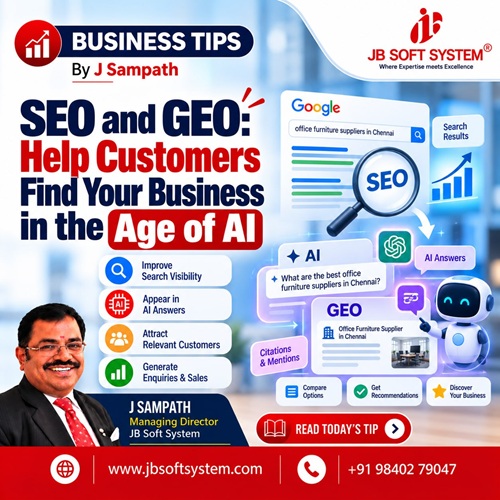
Your next customer may discover your business through a Google search. They may also ask an AI assistant to explain a service, compare suppliers, or help them choose a solution.
For business owners, this creates an important question: Is your online presence clear and credible enough to help customers discover, understand, and choose your business?
Two terms help explain this changing landscape: SEO - Search Engine Optimization, and GEO - Generative Engine Optimization.
Understanding them can help you make better decisions about your website, content, and digital marketing.
What Is SEO?
SEO is the practice of improving your website so search engines can discover and understand its pages, and show them for relevant searches.
For example, a customer might search:
“Office furniture suppliers in Chennai.”
A supplier with useful product pages, clear location details, relevant content, and a technically sound website has a stronger foundation for search visibility.
The business objective goes beyond rankings: attract suitable customers and turn their interest into enquiries and orders.
What Is GEO?
GEO is an emerging term for efforts to improve how a business and its content appear in answers generated by AI systems.
When using web search, AI services may draw on online sources to explain a topic, compare options, mention businesses, or cite supporting pages.
A customer’s question might be:
“What should I check before choosing an office furniture supplier in Chennai?”
A supplier’s detailed buying guide could become a useful source for answering that question. However, publication alone does not guarantee that an AI service will mention or cite it.
SEO and GEO: How Do They Differ?
| Aspect | SEO | GEO |
| Main focus | Visibility in search results | Visibility within AI-generated answers |
| Desired outcome | Relevant visits and enquiries | Accurate mentions, citations, and relevant visits |
| Content approach | Useful pages matching customer searches | Clear explanations that can support customer questions |
| Measurement | Search impressions, clicks, enquiries, and sales | Citations, mentions, referral visits, and resulting enquiries |
These approaches overlap considerably. Modern SEO already involves understanding customer intent, providing useful answers, and building credibility.
Google states that established SEO practices remain relevant to its AI search features. There is no special schema markup required for inclusion in AI Overviews or AI Mode.
For business owners, the practical direction is to strengthen SEO while making information more useful for AI-assisted discovery.
Start With the Questions Customers Actually Ask
Many business websites describe the company extensively but explain very little about the customer’s decision.
Consider a waterproofing contractor whose website says:
“We provide the best waterproofing services with excellent quality.”
Now consider pages answering:
- Why does terrace leakage return after repairs?
- What factors determine waterproofing cost?
- How long does the work take?
- What does the warranty cover?
- When is a site inspection necessary?
The second approach gives customers something useful to evaluate.
Ask your sales and support teams to list the questions they hear repeatedly. Those questions are a practical starting point for website content.
Make Your Business Easy to Understand
Your website should clearly explain:
- What you offer.
- Who you serve.
- Where you operate.
- What your process involves.
- What evidence supports your claims.
- How a customer can take the next step.
For example, “We offer complete business solutions” is vague.
“We develop inventory and billing software for distributors, with implementation, staff training, and ongoing support” gives a prospective customer a much clearer picture.
Use consistent business names, contact details, and service descriptions across your website and business profiles.
Publish Experience That Others Cannot Simply Copy
Your business has knowledge built through daily work. Turn that experience into useful content.
A manufacturer can explain material selection. An accountant can describe the records clients should prepare. A software company can explain implementation challenges. A construction supplier can publish a buying checklist.
Where permission allows, share real project examples covering the customer’s problem, your approach, and the outcome.
Avoid unsupported claims such as “No. 1,” “100% results,” or “guaranteed success.” Specific, verifiable information gives customers a stronger basis for trust.
Keep Your Website Technically Accessible
Useful content needs a reliable website behind it.
Ask your website team to review mobile usability, loading performance, broken links, page titles, internal navigation, and whether important pages can be accessed and indexed.
Keep essential service information available as readable page text instead of placing everything inside images or brochures.
Bing’s webmaster guidance explains that practices supporting discovery, indexing, and content clarity also support eligibility for AI-generated answers and citations.
Build Credibility Beyond Your Website
Review your relevant business listings, professional profiles, industry memberships, and customer reviews.
Keep information accurate. Encourage genuine customer feedback. Seek relevant opportunities to share expertise through industry publications, associations, and community platforms.
Treat these activities as ways to build a verifiable business reputation. They do not guarantee an AI recommendation.
Measure Business Results Along With Visibility
Some customers may get enough information from a search result or AI answer without visiting your website. Others may click through to investigate further.
A mention can create awareness, but it is not automatically a lead. A website visit is not automatically a sale.
Track qualified enquiries, appointments, quotation requests, orders, and revenue alongside traffic and visibility.
Where available, use platform reporting to understand citations. For example, Bing Webmaster Tools offers AI Performance reporting showing how website content is cited across supported AI experiences.
Also ask new customers a simple question: “How did you hear about us?”
A Practical First Step for This Month
Choose one important service and improve its website page.
Add a clear explanation, answer five common customer questions, include one genuine example, update the contact details, and provide an easy enquiry option. Then review the enquiries it generates.
Repeat this process consistently across your main services.
The business principle is simple: make your expertise easy to find, easy to understand, and easy to trust.
Search technologies will continue to change. A business that explains its value clearly and helps customers make informed decisions will have a stronger foundation for digital growth.
- J. Sampath
Business Growth Strategist
About the Author
J. Sampath is the Founder and CEO of JB Soft System, a premier Chennai-based IT consulting and custom software development firm established in 2001. He is widely recognized for his unique philosophies on debt-free business growth, standard operating procedures (SOPs), and values-driven leadership. He regularly shares his business insights, operational frameworks, and morning reflections to empower the next generation of entrepreneurs.
Top Stories
-
 Sri Nitya Kalyana Perumal Temple, Tiruvidandhai: History and Significance21/Oct/2026 2:55:24 PM
-
 SBI Data Leak: 3,897 Customer Records Found on Dark Web; Should Customers Be Worried?21/Oct/2026 2:13:56 PM
-
 TNPSC Group 2 Hall Ticket 2026 Released: Download Admit Card for November 1 Exam21/Oct/2026 2:13:52 PM
-

-
 Jio Platforms IPO Opens Today: Price Band, Minimum Investment and Key Details for Investors21/Oct/2026 2:00:12 PM
-
 NRI Tax Return: How to Correct Wrong Capital Gains Exemption Claims Under India-UAE Tax Treaty21/Oct/2026 12:52:51 PM

 JB Soft System