
Chennai’s Architecture and Construction Sector: Major Projects and Emerging Trends in 2026
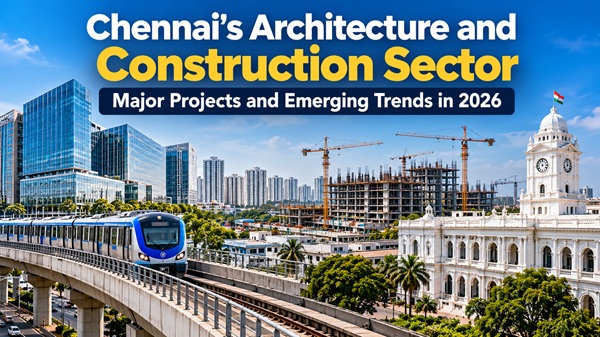
Chennai’s architecture and construction industry is evolving rapidly, driven by major infrastructure investments, metro rail expansion, commercial real estate development and changes to building approval procedures. From large-scale government projects to sustainable residential design, these developments are creating new opportunities for architects, builders, developers and construction companies across the city.
Major Construction Projects Reshaping Chennai
Proposed ₹1,200-Crore Secretariat Complex at Foreshore Estate
Tamil Nadu has granted in-principle approval for a proposed Assembly-cum-Secretariat complex at Foreshore Estate, with an estimated project cost of ₹1,200 crore. Committees are overseeing the selection of consultants, preparation of preliminary designs and the approval process.
The project could open up opportunities for architectural firms specialising in government buildings, institutional design and large-scale urban planning.
RMZ Infinity Development in Porur
Commercial real estate development continues to attract significant investment in Chennai. RMZ has appointed Tata Projects to undertake the main civil works for RMZ Infinity in Porur under a contract valued at approximately ₹670.24 crore.
Spread across 16.4 acres, the development will comprise four commercial towers with around 2.94 million square feet of leasable space. The project reflects continued interest in Chennai’s commercial property market and the demand for modern office infrastructure.
Chennai Metro Construction and Urban Infrastructure
Metro rail expansion is creating additional opportunities for construction and engineering companies. Capacite Infraprojects has secured a ₹368.98-crore Chennai Metro Rail work order for building construction near Thirumangalam Metro Station.
The scope includes civil works, architectural finishes, plumbing, electrical and mechanical systems, heating, ventilation and air conditioning (HVAC), lifts and associated services.
Meanwhile, the Greater Chennai Corporation has announced an urban infrastructure programme worth approximately ₹947 crore for the current financial year, highlighting the continued focus on improving the city’s infrastructure.
New Logistics and Residential Developments
Chennai’s growing transport network is also attracting investment in logistics and residential real estate.
Sumadhura Group has proposed a Grade-A logistics park near the Chennai Peripheral Ring Road at Red Hills. In the residential segment, Prestige Estates has launched Prestige Palm Court along Grand Northern Trunk Road in Madhavaram.
Together, these developments reflect growing interest in logistics facilities and residential projects in areas connected to Chennai’s expanding road network.
Changes to planning permission procedures are expected to influence how architects and developers manage projects in Tamil Nadu.
The state is preparing a Single Window Portal that will bring architects, engineers, town planners and other building professionals onto a unified platform for registration and planning-permission applications. The proposed system could simplify administrative procedures and make it easier for professionals to navigate approval requirements.
The Chennai Metropolitan Development Authority (CMDA) has also published online planning-permission details for 2026. It has reportedly approved around 17 high-rise proposals within a month after receiving greater authority to clear such projects.
At the same time, the Greater Chennai Corporation has strengthened monitoring of unauthorised additions, deviations from approved building plans and changes in building use.
For architects and construction companies, these developments underline the importance of accurate documentation, regulatory compliance and effective supervision throughout the construction process.
Sustainable Architecture Gains Ground
Sustainability is becoming an increasingly important consideration in Chennai’s building sector. Architects are exploring climate-responsive design, passive cooling techniques, water-sensitive planning and low-carbon construction materials to address local environmental conditions.
One example is Studio for Earthen Architecture, led by Krithika Venkatesh. The practice develops cement-free homes using earth and lime while incorporating the skills of local artisans.
Such approaches highlight the potential for traditional building techniques and locally available materials to contribute to more sustainable construction.
Chennai’s Architectural Heritage Remains Relevant
Alongside modern development, Chennai’s architectural heritage continues to receive attention. Members of the Indian Institute of Architects recently explored the neo-classical architecture of Ripon Building and Victoria Public Hall.
The Chennai Architecture Foundation and The Hindu have also released a book documenting contemporary Chennai architecture, contributing to wider discussions about the city’s built environment and architectural identity.
Commercial Real Estate and Future Infrastructure
Commercial property demand remains an important part of Chennai’s construction outlook. TCS has renewed a lease covering 1.5 million square feet in the city, valued at approximately ₹1,420 crore.
Separately, the Confederation of Indian Industry has indicated that Chennai may require a second airport within the next five to ten years. While this remains a long-term infrastructure consideration, it has implications for future transport planning, urban expansion and commercial developmpment.
Outlook for Architects, Builders and Developers
Chennai’s construction industry presents opportunities across several segments, including institutional buildings, metro-related projects, logistics facilities, high-rise residential developments, commercial offices and sustainable architecture.
However, success will depend not only on identifying new projects but also on adapting to evolving approval procedures, maintaining compliance with building regulations and incorporating environmental considerations into design and construction.
With infrastructure investment and urban development continuing to shape the city, architects, builders and developers who combine sound design, efficient project management and sustainable practices will be well positioned to respond to Chennai’s changing needs.
Top Stories
-
 Tomorrow Panchangam October 27, 2026 | Auspicious Timings, Rahu Kalam, Gulikai26/Oct/2026 6:04:45 PM
-
Chennai’s Architecture and Construction Sector: Major Projects and Emerging Trends in 202626/Oct/2026 5:52:19 PM
-
 Tamil Nadu Monsoon Alert: Kodaikanal Red Alert, Vaigai Dam Water Level Reaches 50 Feet26/Oct/2026 5:18:23 PM
-
 Orange Alert for Nagapattinam: Heavy Rain Expected in 6 Tamil Nadu Districts26/Oct/2026 5:10:58 PM
-
 Ooty Mountain Train Service Cancelled Until October 29 Due to Restoration Work26/Oct/2026 5:05:55 PM
-
 Bigg Boss Tamil 10: Actor Raghav Says TTF Vasan’s Fan Base Could Influence the Final Results26/Oct/2026 4:53:00 PM

 JB Soft System