
Mylapore: A Journey Through Chennai’s Rich and Layered History
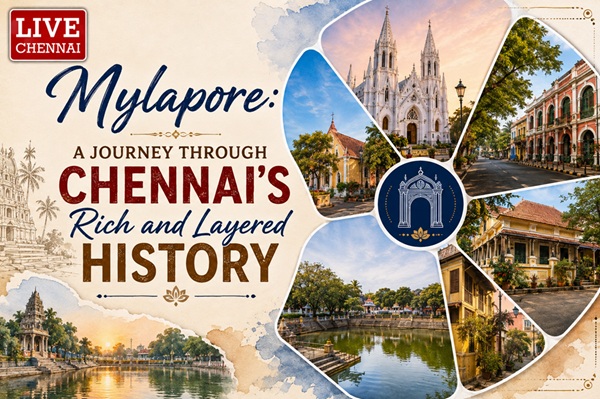
Mylapore is much more than a famous temple neighbourhood in Chennai. Its history stretches back centuries and reflects the influence of maritime trade, weaving, Jainism, Shaivism, Vaishnavism, Christianity and Muslim communities.
Today, Mylapore is a vibrant part of Chennai, but its streets and landmarks preserve traces of a much older settlement. From its ancient port and religious traditions to the rise and fall of the Santhome Fort, the history of Mylapore reveals how different communities and cultures shaped this part of the city.
Mylapore’s Forgotten Maritime Past
One of the most fascinating chapters in Mylapore’s history is its connection with the sea.
Historical accounts refer to a port in the Mylai area that remained active for centuries. In the 18th century, Ananda Ranga Pillai, the well-known dubash of Pondicherry, referred to the Mylai port as “Shahbandar.”
The old port has disappeared completely, and there are no visible remains today. However, historical references suggest that maritime trade was once an important part of Mylapore’s economy.
The area was also known for its weaving industry. Muslim merchants, traditionally referred to as Sonagars, are believed to have come to Mylapore in connection with the textile trade. The existence of Sonagar Street in the Santhome area is often cited as one indication of this historical connection.
Mylapore is also traditionally associated with Thiruvalluvar, with the belief that the celebrated Tamil poet lived and worked as a weaver here.
Thiruvalluvar and the Literary Heritage of Mylapore
Mylapore has long been associated with Thiruvalluvar and the composition of the Thirukkural. According to the tradition described in the source, Thiruvalluvar was born in Mylapore and wrote the great Tamil work here.
A temple dedicated to Thiruvalluvar continues to preserve this literary association, adding another important layer to Mylapore’s cultural identity.
An Ancient Centre of Jainism and Hindu Traditions
Mylapore was not always exclusively associated with Hindu temple traditions. The area was also an important centre of Jainism, with evidence and traditions linking Jain presence in the region to as early as the second century.
A stone image of Neminatha that was once associated with Mylapore was later moved to Mel Sithamur.
Over the centuries, Shaivism and Vaishnavism also became deeply rooted in the area. Mylapore’s religious landscape today reflects this long and diverse history.
The Story Behind Kapaleeshwarar Temple
No discussion of Mylapore’s history is complete without the Kapaleeshwarar Temple.
Interestingly, the tempmple was traditionally located much closer to the seashore than the present structure. Today, the temple stands in the heart of Mylapore, but the existing structure does not preserve clearly identifiable remains from before the 17th century.
The exact circumstances surrounding the destruction of the earlier temple remain uncertain. Historical possibilities include damage caused by the sea, Portuguese involvement or conflict during the period.
Remains of an earlier temple structure and foundation have reportedly been found at the site where the San Thome Basilica now stands, suggesting that a temple once existed there.
The temple was later rebuilt at its present location, eventually becoming the famous Kapaleeshwarar Temple known today.
Mylapore’s Historic Shiva Temples
Kapaleeshwarar Temple is only one part of Mylapore’s extensive Shaivite heritage.
The area is also associated with several other Shiva temples, including Virupaksheeswarar, Valeeswarar, Malleeswarar, Theerthapaleeswarar and Karaneeswarar.
These temples also reflect the importance of weaving communities in the history of Mylapore. Karaneeswarar Temple, in particular, is associated with worship by the weaving community, suggesting the strong connection between religious life and the textile industry.
The Velleeswarar Temple has another interesting connection with the weaving tradition. Its Vinayagar deity was known as Thekkoor Selva Vinayagar, or Kaikola Vinayagar.
According to the tradition, weavers would bring the first piece of cloth produced on their looms and offer it to the deity. This practice is believed to be connected with the names of nearby streets such as Vadakkoor Selva Vinayagar Street and Thekkoor Selva Vinayagar Street.
Mylapore’s Vaishnavite Heritage
Mylapore also has a long-standing Vaishnavite tradition.
The area around Chithirakulam is associated with temples dedicated to Madhava Perumal, Kesava Perumal and Srinivasa Perumal. According to the source, these temples have existed since around the 13th century.
Mylapore is also traditionally regarded as the birthplace of Pey Azhwar, one of the first three Azhwars. A memorial associated with him can be found on Arundale Street.
Amman Worship in Mylapore
Goddess worship has also played an important role in the religious history of Mylapore.
The neighbourhood is home to temples such as Kolavizhi Amman, Mundakakanni Amman and Angala Parameswari Amman. These shrines reflect the region’s long-standing traditions of Amman worship.
The source particularly associates Kolavizhi Amman with the ancient form of Goddess worship represented by Kotravai.
San Thome and thehe Saint Thomas Tradition
Mylapore’s history also has a significant Christian dimension.
According to the Saint Thomas tradition, the apostle arrived in the region in 52 AD, preached here and eventually died in Mylapore. The San Thome Basilica continues to stand as an important symbol of this tradition.
Historical accounts also mention that the 13th-century traveller Marco Polo encountered the local veneration of Saint Thomas during his visit to the region.
The present basilica dates to the 19th century. However, historical records indicate that a church dedicated to the Virgin Mary existed at the site as early as the 15th century.
The Rise and Fall of San Thome Fort
The Portuguese later established a settlement and fort at San Thome during the 16th century after acquiring land from the Vijayanagara Empire.
The fort became an important centre, with several churches located within and around it. These included the church associated with Saint Thomas and the Church of Our Lady, now known as the Rosary Church.
The fort subsequently changed hands. Dutch and Golconda forces occupied the settlement, while French forces also controlled it for a period after laying siege to the fort.
By the end of the 18th century, British power had expanded considerably, and the fort was eventually demolished. Today, virtually no visible remains of the fort survive.
Why Is It Called Kutchery Road?
Some of Mylapore’s street names still preserve memories of its political past.
After a court was established in Santhome under the Golconda administration, the road leading towards it became known as Kacheri Road. The word “Kacheri” refers to a court or administrative office.
The name has survived and continues to be part of Mylapore’s familiar landscape today.
The Story Behind Devadi Street
Another interesting example of Mylapore’s layered history can be found in Devadi Street near Mandaveli.
The name is linked in the source to the longer historical name “Deodi-e-Sardar-ul-Mulk Dilawar Jung Bahadur.” The word “Deodi” referred to the entrance or gateway of the residence or camp of a prominent Muslim nobleman.
The location is associated with the stay of the Nawab of Arcot while his palace was being constructed at Chepauk.
A small mosque known as Saman Masjid still stands in the area, providing another reminder of the neighbourhood’s diverse past.
Mylapore: Where Different Histories Meet
The history of Mylapore is remarkable because it cannot be explainined through a single religious, cultural or political tradition.
Its story includes an ancient port, maritime trade, weaving communities, Thiruvalluvar, Jain traditions, Shaivite and Vaishnavite temples, Amman worship, the Saint Thomas tradition, Portuguese rule, the San Thome Fort, Muslim heritage and the later influence of the British.
Many of these chapters have disappeared from the physical landscape, while others survive through temples, churches, mosques, street names and local traditions.
Mylapore is therefore not simply one of Chennai’s oldest neighbourhoods—it is a living historical landscape where centuries of Tamil, religious, commercial and colonial history continue to meet.
Top Stories
-
 October 26, 2026 Panchangam: Auspicious Timings, Rahu Kalam, Yamagandam & Nalla Neram24/Oct/2026 6:29:12 PM
 -
 Tomorrow Panchangam October 25, 2026 | Auspicious Timings, Rahu Kalam, Gulikai24/Oct/2026 6:28:07 PM
 -
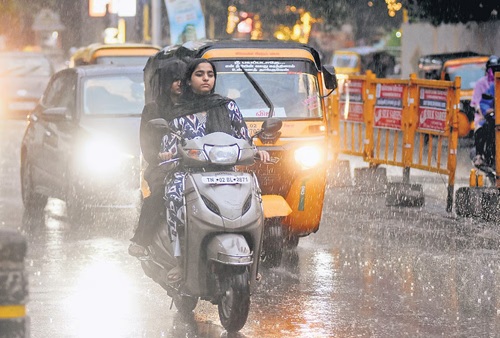 Tamil Nadu Weather Alert: Red Alert for Nilgiris, Heavy Rain Forecast for Chennai24/Oct/2026 6:08:45 PM
 -
 Bigg Boss Tamil 10: Ramya Krishnan to Host This Week Instead of Vijay Sethupathi24/Oct/2026 4:42:45 PM
 -
 Tamil Nadu to Provide Free Hero Cycles to Government School Students Under ₹390 Crore Scheme24/Oct/2026 4:33:23 PM
 -

 JB Soft System