
Why Is Gold Yellow? The Fascinating Science Behind Its Unique Colour
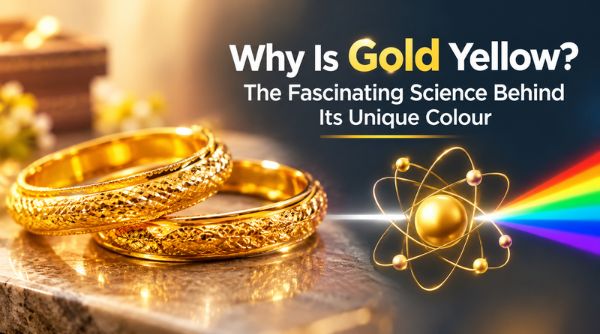
Most metals, including silver and aluminium, have a shiny silver-grey appearance. Gold stands apart with its distinctive yellow lustre. This difference is not caused by a yellow pigment, but by the way gold interacts with light at the atomic level. The explanation combines quantum physics and Einstein’s theory of special relativity.
1. How Light Gives Gold Its Colour
Sunlight contains a range of visible colours. When light strikes a metal, some wavelengths are absorbed while others are reflected. The reflected light determines the colour our eyes perceive.
In metals such as silver, most visible wavelengths are reflected relatively uniformly, giving them a silvery appearance. Gold behaves differently because it absorbs a portion of the blue light in the visible spectrum while reflecting more of the longer wavelengths, including yellow, orange and red. This selective absorption gives gold its familiar golden colour.
2. The Role of Gold’s Atomic Structure
Gold has the atomic number 79, meaning each gold atom contains 79 protons in its nucleus. Its electrons occupy different energy states, and their interactions with incoming light determine how the metal absorbs and reflects particular wavelengths.
In gold, electronic transitions involving the 5d and 6s-related energy bands occur at energies that affect visible light. This helps explain why gold looks yellow, while silver reflects visible light more evenly and appears silver-grey.
3. Einstein’s Theory of Relativity Explains the Difference
One of the most remarkable aspects of gold’s colour is the role of special relativity. Gold’s heavy nucleus creates strong effects on its inner and outer electron states. Relativistic effects alter the energies and distribution of its electrons, changing the energy required for certain electronic transitions.
As a result, gold absorbs some blue light in the visible spectrum. Without these relativistic effects, theoretical calculations suggest that gold would have a much more silver-like appearance. Its yellow colour is therefore an unusual consequence of fundamental physics.
4. Why Does Gold Jewellery Have Different Colours?
Pure 24-karat gold has a rich yellow appearance, but it is relatively soft for everyday jewellery. Jewellers often mix it with other metals to improve its strength and durability.
Yellow gold: Usually contains gold mixed with silver and copper.
Rose or pink gold: A higher proportion of copper creates a reddish or pinkish tone.
White gold: Other metals, such as palladium or nickel in some alloys, give gold a lighter, silvery appearance.
The final colour depends on the proportions and types of metals used in the alloy.
The Science Behind Gold’s Timeless Appeal
Gold’s distinctive colour is a striking example of how atomic structure, light and relativity combine to shape the world around us. The same scientific properties that make gold visually unique have helped make it one of the most recognisable and valued metals throughout history.
Top Stories
-
 WhatsApp Tests a New Green Circle Indicator for Android Users22/Oct/2026 5:13:10 PM
-
 Bigg Boss Tamil 10: TTF Vasan Eats Raw Meat in Survival Task Promo22/Oct/2026 5:08:41 PM
-
 Vetri Veedu Thittam 2026: Eligibility, Benefits, Documents Required and How to Apply22/Oct/2026 5:00:28 PM
-
 Tamil Nadu Weather Alert: Heavy Rain Forecast in 28 Districts with Thunderstorms Today22/Oct/2026 4:20:50 PM
-
 Gold Loan in Chennai: Benefits, Eligibility, Interest Rates and How to Apply22/Oct/2026 4:15:54 PM
-
 Chennai - Arakkonam AC Suburban Train Service: Timings and Ticket Fares Announced22/Oct/2026 4:12:33 PM

 JB Soft System