
Methodology Is More Important Than Technology: Build the Process That Builds Your Business - Business tips by J Sampath, Founder and CEO of JB Soft System
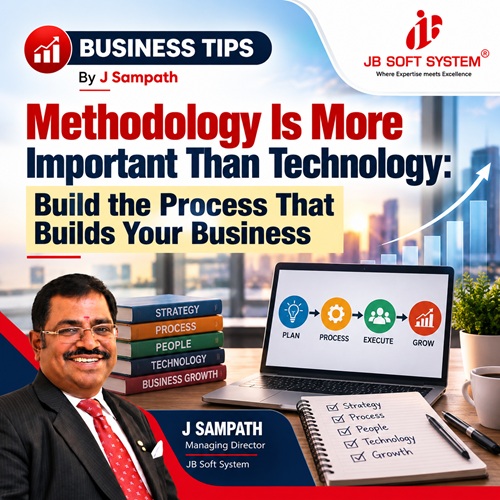
Two businesses can use the same software, advertise on the same platforms and have access to the same AI tools yet achieve very different results.
One responds to enquiries promptly, understands customer needs, delivers on its promises and earns repeat business. The other struggles with missed follow-ups, delayed delivery and dissatisfied customers.
Why does this happen?
Technology gives businesses capabilities. Methodology determines how effectively those capabilities become results.
A CRM can remind you to call a customer. Your method determines whom to call, when to call, what to discuss and what happens next.
An advertising platform can bring enquiries. Your method determines whether those enquiries become profitable orders.
AI can prepare a proposal quickly. Your method determines whether the proposal addresses the customer’s actual requirements.
For business owners, this distinction matters: buying a tool is a decision; making it productive is a discipline.
What Does “Methodology” Mean in Business?
Methodology is the clear, repeatable way your business gets work done.
It answers practical questions:
- What outcome are we trying to achieve?
- What steps must we follow?
- Who is responsible for each step?
- When must the work be completed?
- What standard defines acceptable work?
- How will we measure and improve the result?
Consider a customer enquiry.
“Someone will speak to the customer” is an intention.
“Every enquiry is assigned to a named salesperson, contacted within our agreed response time, recorded with the customer’s requirements and given a next action” is a method.
A business becomes more dependable when good work can be repeated by the team, without the owner having to remind everyone every time.
1. Sales: A CRM Cannot Replace a Follow-Up Method
Imagine two businesses receiving 100 enquiries each through their websites and advertisements. Both use CRM software.
In the first business, enquiries are entered, but responsibilities are unclear. Some customers receive calls; others receive only a quotation. Follow-ups depend on who remembers them.
In the second business, each enquiry has an owner. The salesperson records the requirement, buying timeline and next action. Pending quotations are reviewed regularly. Lost enquiries are recorded with reasons.
The software may be identical. The working method is different.
To illustrate the business impact, suppose one team converts five enquiries while the other converts twelve. At an assumed order value of ₹20,000, that represents ₹1 lakh versus ₹2.4 lakh in order value. These are illustrative figures, but they show why conversion discipline deserves as much attention as lead generation.
Before asking for more leads, check how well your business handles the leads it already receives.
A CRM becomes valuable when it supports a consistent sales routine.
2. Digital Marketing: The Customer Journey Matters Beyond the Advertisement
Consider a Chennai interiors company running social media advertisementnts.
An interested homeowner submits an enquiry. The company responds two days later with a generic brochure. Nobody asks about the location, budget, property stage or expected completion date.
Even an attractive advertisement cannot compensate for that experience.
A better method connects the entire customer journey:
Advertisement → Enquiry → Requirement discussion → Site visit → Relevant proposal → Follow-up → Order → Delivery → Referral
Each stage needs a responsible person and a clear next step.
The company should examine more than impressions and clicks. It should review qualified enquiries, appointments, quotations, orders and the cost of acquiring a customer.
If enquiries are plentiful but appointments are few, the response process needs attention. If appointments happen but orders do not, the proposal, pricing or customer fit may need improvement.
Marketing becomes more useful when the business measures what happens after the customer responds.
3. Retail: Inventory Software Needs Stock Discipline
A grocery store installs inventory software to control purchases and availability.
However, staff do not consistently record damaged goods, returns or stock received. The system shows products as available when the shelf is empty. The owner places orders using unreliable information.
The technology is working with incomplete inputs.
A sound stock-management method includes accurate purchase entries, timely sales recording, checks on fast-moving products, expiry reviews and reconciliation of physical stock with system records.
Reorder decisions should also reflect demand and supplier delivery time.
Software can calculate stock only as reliably as the business records stock movement.
The same principle applies to pharmacies, spare-parts shops, textile businesses and distributors.
4. Manufacturing: Toyota Shows the Strength of a Working Method
Toyota provides a well-documented example of methodology shaping operations.
Its Toyota Production System is built around two central ideas: Just-in-Time, coordinating production around what is needed, when it is needed and in the required quantity; and jidoka, detecting abnormalities and stopping work so problems can be addressed before defects continue through production. :chatgpt-content-reference{index="0"}
The lesson for smaller businesses is practical: organise the flow of work and detect problems early.
A printing unit, for example, can verify customer approval, dimensions, quantity, material and colour requirements before starting production.
That check may take a few minutes. Discovering an error after printing the entire order can require expensive rework.
The machine creates production capacity. The method helps that capacity produce acceptable work.
5. AI: Faster Output Still Needs Clear Thinking
AI can help draft advertisements, proposals, emails and reports. But the quality of the result depends partly on how clearly the task is defined.
Consider a business asking AI to “prepare a websbsite proposal.”
Without a proper brief, the draft may include irrelevant features, omit essential requirements or create expectations the delivery team cannot meet.
A stronger method begins with customer discovery:
- What does the customer want the website to achieve?
- Who will use it?
- What information and functions are required?
- Who will provide and approve the content?
- What is included in the price?
- Who will review the final proposal?
AI can then help prepare the draft, while the responsible person checks its accuracy and commercial commitments.
Clear thinking gives AI direction. Human review makes the output fit for use.
Producing more content is useful only when that content serves a business purpose.
6. Service Businesses: A Task App Needs a Delivery Method
A website agency, consultancy or maintenance company may use a sophisticated project-management platform and still miss deadlines.
Tasks are created, but requirements remain unclear. Customer approvals are delayed. Additional requests enter the project without assessing their effect on cost or completion time.
A dependable delivery method defines the scope, divides work into milestones, identifies approval points and explains how changes will be handled.
It also makes the next action visible. If work is waiting for customer content, the responsible person follows up. If a change affects the deadline, the customer receives a clear explanation.
A deadline becomes more achievable when the steps, dependencies and responsibilities behind it are understood.
Technology and Methodology Must Develop Together
Technology is essential. It can improve speed, accuracy, visibility and scale. Some problems genuinely require better tools.
However, a business should understand its working method before expecting automation to improve it.If quotation approval is slow because nobody knows who can approve a discount, another software subscription will not resolve that uncertainty. The business first needs an approval rule. Technology can then help apply and track it.
The useful sequence is:
Understand the problem → Define the method → Choose suitable technology → Train the team → Measure and improve
Start simple where possible, but choose a process and tool that can support the business as it grows.
A Practical Starting Point for Business Owners
Choose one recurring problem this week: missed enquiries, delayed quotations, stock shortages, late delivery or unresolved complaints.
Write down the current steps. Speak to the people doing the work. Identify where information is missing, responsibility is unclear or work gets delayed.
Then introduce a simple method with:
1. A clear outcome: What should improve?
2. A named owner: Who is accountable?
3. Defined steps: What must happen?
4. A time standard: When should it happen?
5. A review measure: How will you know it works?
Try the method on a small scale, review the result and refine it. Use technology to make the improved process eaeasier to follow.
A good methodology should reduce confusion and unnecessary work. It should be simple enough for the team to practise consistently.
The Business Owner’s Most Valuable Question
When results are disappointing, ask:
“Which part of our working method needs to improve?”
That question directs attention to something the business can examine and change.
More enquiries need better follow-up. More orders need reliable delivery. More employees need clear responsibilities. More data needs useful decisions. More technology needs a purposeful method.
The strongest business advantage is often the ability to serve customers consistently, learn from mistakes and improve how work gets done.
Technology gives your business power. Methodology gives that power direction.
- J. Sampath
Business Growth Strategist
About the Author
J. Sampath is the Founder and CEO of JB Soft System, a premier Chennai-based IT consulting and custom software development firm established in 2001. He is widely recognized for his unique philosophies on debt-free business growth, standard operating procedures (SOPs), and values-driven leadership. He regularly shares his business insights, operational frameworks, and morning reflections to empower the next generation of entrepreneurs.
Top Stories
-
Mobile Phones Allowed in Tamil Nadu Temples, but Devotees Must Switch Them Off14/Oct/2026 11:38:32 AM
-
-
 8 Foods to Avoid During the Monsoon to Reduce Food Poisoning Risk14/Oct/2026 11:21:12 AM
 -
 Tiruvannamalai Pournami Girivalam 2026: Check October Timings and Details14/Oct/2026 10:54:56 AM
 -
 Dry Fruit Coconut Laddoo14/Oct/2026 10:47:16 AM
 -
 Southern Railway Warns of Jail for Loud Music on Trains: ₹1,000 Fine, Six Months in Prison14/Oct/2026 10:45:51 AM

 JB Soft System