
On-Grid vs Hybrid Solar Systems: Which Is Best for Your Home in Chennai?
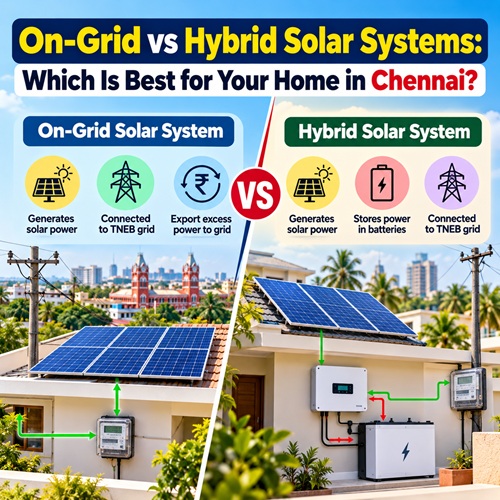
Installing rooftop solar panels is an effective way to reduce electricity expenses for homes in Chennai and other parts of Tamil Nadu. However, before installing a solar system, homeowners must decide between an on-grid solar system and a hybrid solar system.
Both systems generate electricity from sunlight, but they differ in installation costs, battery backup, power-cut performance and overall savings.
An on-grid solar system is generally more affordable because it does not require batteries. A hybrid solar system combines grid connectivity with battery storage, allowing selected household appliances to receive backup power during electricity outages.
Understanding these differences can help homeowners choose a system that matches their budget, electricity consumption and backup requirements.
1. What Is an On-Grid Solar System?
An on-grid solar system connects rooftop solar panels to your home`s electrical system and the electricity grid.
During the day, solar panels generate electricity to power household appliances. If the panels generate more electricity than the home needs, the surplus can be exported to the grid under the applicable solar billing arrangement.
When solar generation is insufficient, electricity can be drawn from the grid.
Advantages of On-Grid Solar
Lower installation cost: Batteries are not required.
Reduced electricity bills: Solar generation can reduce the amount of electricity purchased from the utility.
Simple maintenance: There is no solar battery bank to maintain or replace.
Efficient use of rooftop space: More of the budget can be allocated to solar panels.
Potential financial assistance: Eligible residential installations may qualify for applicable rooftop solar subsidies.
Tamil Nadu`s official rooftop solar portal explains how grid-connected solar systems work and outlines the applicable billing and application procedures.
Disadvantages of On-Grid Solar
No backup during a power cut: Standard grid-tied inverters shut down during a grid outage for electrical safety.
Dependence on grid availability: The system cannot normally power your home independently when the grid fails.
Limited energy storage: Without batteries, excess daytime generation cannot be stored for use at night.
Savings depend on billing rules: The financial value of exported electricity depends on the applicable settlement arrangement.
Best for: Homes in Chennai that have a reasonably reliable electricity supply and primarily want to reduce their electricity bilills.
2. What Is a Hybrid Solar System?
A hybrid solar system combines rooftop solar panels, a hybrid inverter, battery storage and a connection to the electricity grid.
During sunny hours, the panels supply electricity to household appliances. Surplus energy can charge the battery, depending on the system configuration. Once the battery is charged, additional electricity may be exported to the grid if the system and approved connection support it.
During a power cut, a compatible hybrid inverter can supply electricity from the battery and available solar generation to designated backup circuits.
The backup duration depends on battery capacity, appliance consumption, solar generation and inverter configuration.
Advantages of Hybrid Solar
Battery backup: Essential appliances can continue operating during power cuts.
Better energy management: The system can use stored solar energy when sunlight is unavailable.
Reduced dependence on grid electricity: Stored energy can support selected loads in the evening and at night.
Flexible operation: Depending on the inverter, the system can coordinate solar generation, battery charging and grid power.
Useful for frequent outages: Battery storage provides additional flexibility where uninterrupted electricity is important.
Disadvantages of Hybrid Solar
Higher initial investment: Batteries and hybrid inverters increase the installation cost.
Battery replacement expenses: Batteries have a limited service life and may need replacement.
More complex installation: Battery sizing, backup circuits and electrical protection require careful planning.
Limited backup capacity: Large appliances can drain batteries quickly.
Additional maintenance considerations: Battery health, ventilation requirements and operating conditions must be considered according to the battery type.
Best for: Homes that experience frequent power cuts or need backup for essential appliances such as lights, fans, Wi-Fi routers and selected refrigeration equipment.
3. On-Grid vs Hybrid Solar: Comparison Table
| Feature | On-Grid Solar | Hybrid Solar |
| Connection to electricity grid | Yes | Yes |
| Battery storage | Not normally included | Included |
| Power-cut backup | No, with a standard grid-tied inverter | Yes, if configured for backup |
| Initial installation cost | Lower | Higher |
| Electricity bill savings | Yes | Yes |
| Use of stored solar energy at night | No | Yes |
| Battery maintenance or replacement | Not applicable | Required over the system`s life |
| System complexity | Relatively simple | More complex |
| Solar export to grid | Possible, subject to approval and billing rules | Possible, subject to equipment and connection approval |
| Best suited for | Homes prioritising lower costs | Homes prioritising backup and energy flexibility |
4. On-Grid vs Hybrid Solar Installation Cost in Chennai
The installation cost depends on system capacity, solar panel brand, inverter specifications, mounting structures, wiring, battery capacity and installation requirements.
The following figures are indicative planning estimates, not official quotations. Actual prices can vary by installer and equipment.
| Solar System Capacity | On-Grid System | Hybrid System with Battery |
| 1 kW | ₹60,000–₹85,000 | ₹1 lakh–₹1.5 lakh |
| 2 kW | ₹1 lakh–₹1.5 lakh | ₹1.5 lakh–₹2.5 lakh |
| 3 kW | ₹1.5 lakh–₹2.2 lakh | ₹2 lakh–₹3.5 lakh |
| 5 kW | ₹2.5 lakh–₹3.5 lakh | ₹3.5 lakh–₹5.5 lakh |
Prices are indicative estimates for comparison. The hybrid figures assume battery storage, but the battery capacity and backup capability may differ significantly between quotations.
For context, Tamil Nadu`s official rooftop solar portal currently displays an indicative market-price range of ₹1.8 lakh–₹2.2 lakh for a 3 kW residential rooftop solar system. Its displayed benefit calculator also lists applicable assistance for eligible residential installations. Check the current portal for the latest prices and scheme conditions.
Which System Is Cheaper?
An on-grid solar system is generally cheaper because it does not include batteries.
For homeowners whose main goal is reducing their electricity bills, on-grid sosolar is often the more economical starting point.
A hybrid system costs more initially, but it can offer additional value to households that need backup electricity during outages.
5. Solar Battery Backup: How Long Will It Last?
Battery backup depends on the amount of usable stored energy and the total power consumption of the appliances connected to the backup circuit.
For example, a battery with approximately 5 kWh of usable energy could theoretically power a combined load of 500 watts for around 10 hours.
In practice, the duration may be shorter because of inverter losses, battery operating limits, changing loads and other system conditions.
Example: Essential Household Appliances
| Appliance | Illustrative Power Consumption |
| Three LED lights | 30 W |
| Two ceiling fans | 100 W |
| Wi-Fi router | 10 W |
| One television | 100 W |
| Total | 240 W |
At an illustrative continuous load of 240 watts, 5 kWh of usable battery energy would theoretically last about 20.8 hours before accounting for conversion losses or changes in consumption.
Actual backup time will depend on the equipment and operating conditions.
Air conditioners, water heaters, induction stoves and water pumps can consume considerably more power and may require a larger battery and inverter.
Important: Solar panels alone do not guarantee power during an outage. The inverter must support backup operation, and the installation must have the required battery storage and properly configured backup circuits.
6. Which Solar System Is Better for Chennai Homes?
The right choice depends on your priorities.
Choose On-Grid Solar If:
- Your home usually receives a reliable electricity supply.
- Your main objective is to reduce your electricity bill.
- You want a lower upfront installation cost.
- You do not require solar-powered backup during outages.
- You prefer a relatively simple solar installation.
Choose Hybrid Solar If:
- Your area experiences frequent power cuts.
- You want backup for lights, fans, Wi-Fi anand other essential appliances.
- You need greater flexibility in using solar electricity after sunset.
- Your budget can accommodate battery storage.
- You want a system designed around both electricity savings and backup requirements.
Before choosing, ask the installer to specify the battery`s usable capacity, inverter output, supported backup loads and expected backup duration.
7. Can You Get a Solar Subsidy in Tamil Nadu?
Eligible residential consumers may qualify for rooftop solar financial assistance under the applicable central and state schemes.
Tamil Nadu`s official solar portal provides information about residential assistance, application procedures and approved vendors. Eligibility and assistance depend on the scheme`s current conditions, the installation and the required approvals.
Before paying an advance:
1. Check the current subsidy eligibility requirements.
2. Confirm whether your selected system and equipment qualify.
3. Verify the installer`s empanelment where required.
4. Confirm whether the quoted price includes the inverter, mounting structure, wiring, protection equipment and installation.
5. Obtain a written quotation showing the battery capacity separately, if applicable.
6. Confirm the approved grid-connection and metering requirements.
Do not assume that every hybrid system or battery component qualifies for a subsidy. Confirm the applicable conditions through the official portal.
Official resource: https://www.tnebltd.gov.in
Conclusion: On-Grid or Hybrid Solar?
Both on-grid and hybrid solar systems can help Chennai households make better use of renewable electricity.
An on-grid solar system is generally the better choice for homeowners who want to reduce installation costs and electricity bills. A hybrid solar system is more suitable for households that also need battery backup during power cuts.
Before making a decision, compare installation quotations, estimated electricity generation, battery capacity, warranty coverage and applicable subsidy conditions. Choosing a system based on your actual electricity consumption and backup needs can help you get better long-term value from your solar investment.
Top Stories
-
 AI Trainer Jobs: Career Opportunities, Salary and Future Growth30/Oct/2026 2:24:44 PM
-
On-Grid vs Hybrid Solar Systems: Which Is Best for Your Home in Chennai?30/Oct/2026 2:18:31 PM
-
 Apple MacBook Pro Touchscreen: New Features, OLED Display, Price and Release Date30/Oct/2026 1:50:19 PM
-
 How to Track and Understand Your Power Consumption Using the Official TNEB Mobile App30/Oct/2026 11:26:34 AM
-
 Mettupalayam - Ooty Toy Train Cancelled on October 30, 31 and November 1 Due to Landslide30/Oct/2026 11:20:15 AM
-
 Train Number Changes from January 2027: Vande Bharat, Express Services to Get New Numbers30/Oct/2026 11:18:37 AM

 JB Soft System