
Jawaharlal Nehru: 5 Reasons Why India Remembers Its First Prime Minister
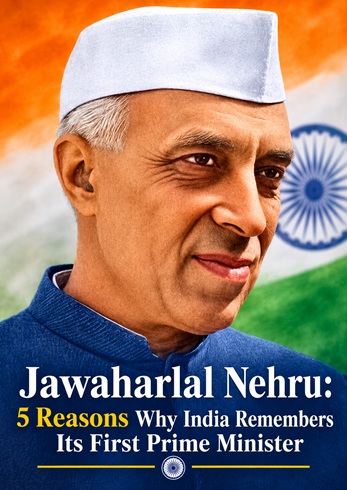
From his contribution to the freedom struggle to building institutions for education, science and democracy, Jawaharlal Nehru played a significant role in shaping modern India. His birth anniversary, November 14, is celebrated across the country as Children`s Day.
Jawaharlal Nehru remains one of the most influential figures in India`s modern history. As a prominent leader of the freedom movement and the country`s first Prime Minister, he played an important role in shaping India`s political, educational and scientific foundations after independence.
On his birth anniversary, November 14, here are five important reasons why Nehru`s contributions continue to be remembered.
1. A Key Leader in India`s Freedom Struggle
Nehru was one of the central leaders of India`s independence movement. He actively participated in the nationalist struggle against British rule, spent several years in prison and worked alongside other leaders to achieve freedom. His contribution helped strengthen the political movement that ultimately led to India`s independence in 1947.
2. India`s First Prime Minister
After independence, Nehru became India`s first Prime Minister, serving from 1947 to 1964. His leadership came at a challenging time when the country was dealing with Partition, the resettlement of refugees and the enormous task of building a stable government. He played a major role in transforming newly gained political freedom into a functioning democratic nation.
3. Strengthening Indian Democracy
Nehru strongly supported parliamentary democracy and universal adult suffrage, ensuring that every adult citizen had the right to vote. Under his leadership, India conducted its first general elections in 1951-52. Establishing a democratic system in a country with diverse languages, cultures and communities was one of the major achievements of the early years of independence.
4. Building Institutions for Education and Scientific Progress
Nehru believed that education, scientific research and technology were essential for India`s development. His governments helped establish several important institutions, including the Indian Institutes of Technology (IITs), All India Institute of Medical Sciences (AIIMS), Indian Institutes of Management (IIMs) and National Institutes of Technology (NITs). These institutions continue to contribute to India`s progress in education, healthcare, research and technology.
5. His Concern for Children and Secular India
Nehru had a special affection for children and believed that their education and welfare were essential for the country`s future. This is why his birthday, November 14, is celebrated as Children`s Day in India.
He also supported secularism, equal citizenship and religious freedom, while promoting India`s independent foreign policy through the Non-Aligned Movement during the Cold War.
Nehru`s legacy has also faced criticism, particularly over certain economic policies, foreign-policy setbacks and the handling of political challenges. However, his contributions to India`s democratic institutions, educational system, scientific development and secular constitutional framework remain significant.
As India observes Children`s Day on November 14, remembering Jawaharlal Nehru offers an opportunity to reflect on the early foundations of modern India and the importance he placed on education, democracy and the future of children.
Top Stories
-
 Chennai Fitness Run 2026: 10K, 5K and 3K Run on November 15 at Besant Nagar14/Nov/2026 3:41:51 PM
-
Jawaharlal Nehru: 5 Reasons Why India Remembers Its First Prime Minister14/Nov/2026 2:40:42 PM
-
 Oppo 12,000mAh Battery Smartphone in Development? New PNC110 Model Spotted Online14/Nov/2026 2:34:49 PM
-
 Sriperumbudur Nemili Toll Plaza Introduces Barrier-Free Toll Collection14/Nov/2026 1:43:30 PM
-
 Palani Murugan Temple Darshan Cancelled After 11 AM Tomorrow for Kandha Sashti Soorasamharam14/Nov/2026 1:25:30 PM
-
 TNPDCL Summer Power Purchase 2027: Electricity Rates Fixed at ₹9.50 - ₹1314/Nov/2026 1:07:06 PM

 JB Soft System