
Tamil Nadu Auto Fare Revised 2026: Check New Minimum Charges Per KM
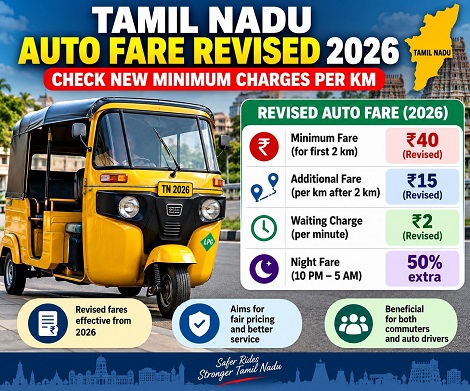
The Tamil Nadu government has revised auto-rickshaw fares across the state, addressing a long-standing demand from auto drivers. The new fare structure increases the minimum charge and per-kilometre rate, taking into account rising fuel prices, vehicle maintenance expenses and other operating costs.
New Auto Fare Details in Tamil Nadu
Under the revised fare structure, the minimum fare for the first 1.8 km has been fixed at ₹50. Passengers will have to pay an additional ₹25 for every kilometre travelled beyond the initial distance.
For autos operating on hill routes, the fare will be 1.2 times the regular rate. The minimum charge for the first 1.8 km on these routes will be ₹60, followed by ₹30 for every additional kilometre.
The revised fare structure also allows higher charges during night hours and for waiting time.
Night Charges and Waiting Charges
Passengers travelling between 10 PM and 5 AM will be charged 1.5 times the regular fare. The waiting charge has been fixed at ₹1 per minute.
Why Were Auto Fares Revised?
The previous auto fare structure was introduced in 2013. Under the old system, passengers were charged ₹25 for the first 1.8 km and ₹12 for every additional kilometre.
Auto drivers had been demanding a fare revision for several years due to increasing fuel prices, vehicle maintenance costs and insurance expenses. Driver associations had requested a minimum fare of ₹60 to ₹70 for the initial distance, along with ₹25 to ₹30 for every additional kilometre.
Consumer organisations, however, had recommended fixing the minimum fare at ₹50. After considering the demands of both sides, the state government announced the revised rates.
Auto Meter Rules and Implementation
The Transport Department has instructed auto owners to update their meters according to the revised fare structure within six months. Until the meters are recalibrated, drivers must display the new fare chart inside their vehicles where passengers can easily see it.
The department is also expected to monitor whether drivers operate their meters and collect fares according to the government`s revised rules. Action may be taken against those who violate the instructions.
Auto Drivers Seek Digital Meters and App-Based Fare Regulation
Auto driver associations have also requested the government to provide free digital meters with GPS facilities. They have urged authorities to apply the revised fare structure to ride-hailing platforms such as Rapido, Ola and Uber.
They have also suggested introducing a government-operated mobile application to help passengers book autos at regulated fares.
Comparison of Auto Fares in Other States
The revised Tamil Nadu fares are higher than the rates mentioned for neighbouring states in the report.
- Kerala: ₹30 for the first 1.5 km, followed by ₹15 for every additional kilometre or ₹1.50 for every 100 metres.
- Karnataka: ₹36 for the first 2 km, followed by ₹18 for every additional kilometre.
- Andhra Pradesh: ₹20 for the first 1.6 km, followed by ₹11 for every additional kilometre.
Bike Taxi Services and Auto Drivers` Concerns
Auto driver associations have also raised concerns about the impact of bike taxi services on their livelihood. They have requested the government to either regulate or prohibit such services.
The report notes that bike taxi services have not received legal approval in Tamil Nadu and that the Madras High Court has previously asked the state government to take a decision on the issue.
The revised auto fares are expected to provide some relief to drivers while offering passengers a regulated fare structure. Proper implementation, meter usage and monitoring will be important to ensure that both drivers and passengers benefit from the new system.
Top Stories
-
 Cold Water vs Warm Water After Meals: Which Is Better for Digestion?31/Oct/2026 10:21:19 AM
-
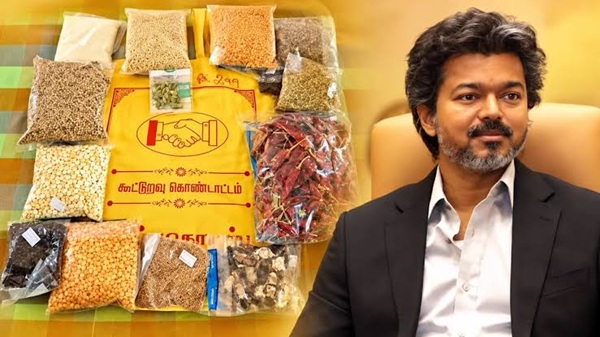 Tamil Nadu Launches Rs 200 Essential Grocery Kit to Help Control Price Rise31/Oct/2026 10:13:02 AM
-
 Chennai Gold Rate Today: Gold Prices Fall Sharply by ₹310 per Gram on October 3131/Oct/2026 9:48:35 AM
-
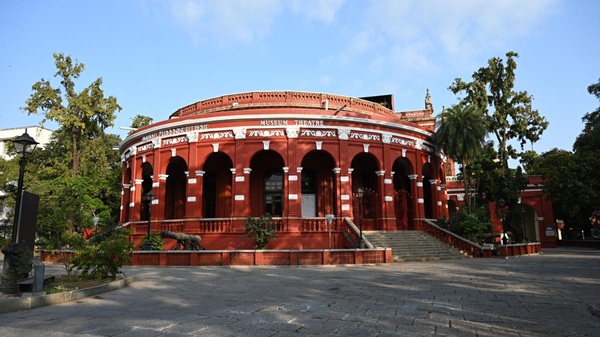 Tamil Nadu Day Celebrations to Be Held at Chennai Museum Theatre on November 131/Oct/2026 9:38:35 AM
-
Tamil Nadu Auto Fare Revised 2026: Check New Minimum Charges Per KM31/Oct/2026 9:36:45 AM
-
 Bay of Bengal Low-Pressure Area Likely to Intensify; Rain Forecast for Tamil Nadu31/Oct/2026 9:35:33 AM

 JB Soft System