
AI Trainer Jobs: Career Opportunities, Salary and Future Growth
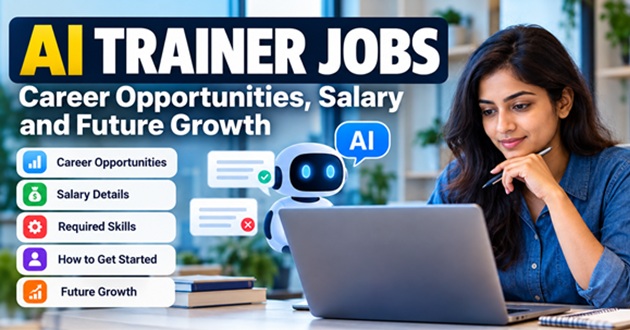
AI training is emerging as a promising career path, offering opportunities in remote work, freelancing and full-time employment. As businesses increasingly adopt artificial intelligence, human expertise is becoming essential for improving AI accuracy, evaluating responses and ensuring safe, reliable results. People with strong communication skills, critical thinking abilities or specialised professional knowledge can explore opportunities in this growing field.
What Does an AI Trainer Do?
An AI trainer helps improve artificial intelligence systems by reviewing their responses, preparing training data and providing feedback. The role involves more than simply interacting with chatbots; it requires careful judgement, research and the ability to identify errors.
Typical responsibilities include evaluating AI-generated answers for accuracy and clarity, labelling text, images, audio and video, creating examples for training datasets, and testing systems for bias, misleading information and safety concerns.
Experienced AI trainers may also develop evaluation guidelines, establish quality standards and work with engineers and data scientists to improve model performance.
Future Opportunities in AI Training
AI training and evaluation are relevant across industries, including healthcare, finance, law, education, retail, customer service and autonomous vehicles.
As organisations introduce AI-powered products, they need people who can assess whether these systems provide useful, accurate and appropriate responses.
Career opportunities include general AI evaluation, specialist training, data annotation, AI safety testing, quality assurance and prompt evaluation engineering.
Professionals with expertise in medicine, law, accounting, engineering, programming or education may qualify for specialised assignments that require deeper subject knowledge.
AI Trainer Salary and Work Opportunities
AI trainers can work through freelance platforms, remote contract projects, specialist consulting assignments or full-time positions within technology companies.
One industry guide cited in the supplied information estimates contractor rates at approximately $25–$75 per hour, while full-time salaries may range from $62,000 to $150,000 annually, depending on expertise, experience and seniority.
These figures are indicative estimates rather than guaranteed earnings. Actual compensation varies by employer, location, project requirements and professional qualifications.
Entry-level opportunities may involve rating chatbot responses or labelling datasets. Experienced professionals can progress into AI operations, quality management, model evaluation and specialist consulting.
Essential Skills to Become an AI Trainer
People intererested in AI training should focus on developing a combination of technical knowledge and human judgement.
Important skills include:
Communication: Writing clear feedback and evaluating responses in English.
Research and fact-checking: Identifying inaccurate information and unsupported claims.
AI literacy: Understanding large language models, prompt writing and AI limitations.
Data annotation: Labelling and reviewing training information accurately.
Quality assurance: Applying evaluation criteria consistently.
Technical skills: Learning spreadsheets, basic Python and data analysis.
Domain expertise: Developing knowledge in areas such as finance, healthcare, law, education, marketing or programming.
These skills can help candidates progress from routine evaluation tasks to more specialised and technical positions.
How to Start a Career in AI Training
Beginners can start by learning how AI tools work and practising the evaluation of AI-generated responses.
Creating a portfolio of sample evaluations is a useful first step. Candidates can demonstrate how they identify factual errors, compare alternative responses, explain their decisions and apply consistent quality standards.
They can then explore legitimate freelance opportunities, remote projects offered by AI research organisations and data service companies, or full-time openings in AI quality assurance and operations.
Professionals should also consider specialising in a field where they already have relevant knowledge or experience.
Career Growth and Long-Term Prospects
A potential career progression is from general AI trainer to domain specialist, senior reviewer, quality assurance professional or evaluation engineer. Further opportunities may include AI operations, product development and AI ethics.
However, routine data-labelling work may increasingly be automated. Long-term career prospects will depend on the ability to handle complex cases, establish evaluation standards and apply specialised knowledge that automated systems cannot reliably replace.
Conclusion
AI training offers several possible entry points for people interested in technology, research and quality evaluation. While basic annotation work may provide initial experience, combining AI literacy with professional expertise, strong communication and critical thinking can open doors to more advanced roles.
For aspiring AI trainers, the practical approach is to build relevant skills, develop a portfolio and gain experience through legitimate projects before pursuing higher-level opportunities.
Top Stories
-
 Diwali 2026: How Home Insurance Can Protect Your House from Fire Accidents30/Oct/2026 3:23:21 PM
-
 Vibe Coding: How AI Is Changing the Way People Build Software30/Oct/2026 3:01:01 PM
-
 Diwali 2026 Safety Tips: Dos and Don'ts to Prevent Fire Accidents30/Oct/2026 2:55:27 PM
-
AI Trainer Jobs: Career Opportunities, Salary and Future Growth30/Oct/2026 2:24:44 PM
-
 On-Grid vs Hybrid Solar Systems: Which Is Best for Your Home in Chennai?30/Oct/2026 2:18:31 PM
-
 Apple MacBook Pro Touchscreen: New Features, OLED Display, Price and Release Date30/Oct/2026 1:50:19 PM

 JB Soft System