
What Is an E-Way Bill? GST Rules, When It Is Required and How to Generate It Online
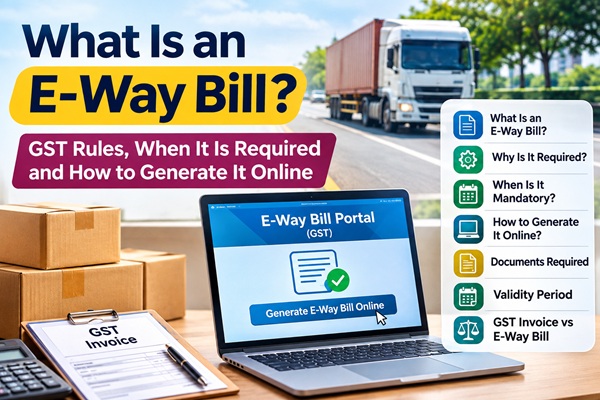
An E-Way Bill is an important document under India`s GST system for transporting goods. Businesses, traders, manufacturers and commercial vehicle operators should understand when it is required, the applicable value limits, validity period and online generation process.
Businesses involved in the transportation and sale of goods regularly come across the term E-Way Bill. Whether goods are moved between business locations, delivered to customers or transported to another state, understanding E-Way Bill requirements is essential to ensure compliance with GST regulations.
What Is an E-Way Bill?
An E-Way Bill (Electronic Way Bill) is an electronic document required under India`s Goods and Services Tax (GST) system for the movement of goods under specified circumstances.
It contains important information about the movement of goods, including:
- Details of the sender (consignor).
- Details of the receiver (consignee).
- Invoice or bill details.
- Value of the goods.
- HSN code.
- Transportation details.
- Vehicle registration number, wherever applicable.
Once an E-Way Bill is successfully generated, the system issues a unique E-Way Bill Number (EBN), which can be used to identify and verify the document during transportation.
Why Is an E-Way Bill Required?
The E-Way Bill system was introduced to monitor the movement of goods and improve transparency under GST.
Its main purposes include:
- Monitoring the movement of goods across locations.
- Preventing GST tax evasion.
- Ensuring goods are transported through legitimate business transactions.
- Providing supporting documentation during GST inspections.
- Facilitating the movement of goods between states.
It also helps businesses maintain proper transportation records and comply with GST requirements.
When Is an E-Way Bill Mandatory?
Generally, an E-Way Bill is required when the value of a consignment exceeds ₹50,000, subject to applicable GST rules and exceptions.
Common situations include:
1. Movement Between Business Locations: When goods are transported from one shop, warehouse or business establishment to another.
2. Inter-State Transportation: When goods are moved from one state to another.
3. Transportation for Sale: When goods are transported as part of a sale or supply transaction.
4. Job Work: When goods are sent to another location for processing, manufacturing or other job-work activities.
5. Business or Personal Use: When goods are moved for purposes other than sale, subject to applicable GST provisions.
Generally, goods valued below ₹50,000 do not require an E-Way Bill. However, certain exceptions apply depending on the nature of the goods and the circumstances of transportation.
Businesses transporting goods within Tamil Nadu should also check the applicable state-specific requirements.
For checking applicable E-Way Bill requirements, goods categories and value thresholds, businesses can use the following online tool:
E-Way Bill Checker: https://baeltrade.com/free-tools/e-way-bill-checker
How to Generate an E-Way Bill Online?
Businesses can generate an E-Way Bill through the official GST E-Way Bill portal.
Official portal: https://ewaybillgst.gov.in
Follow these steps to generate an E-Way Bill.
Step 1: Log in to the Portal
Visit the official E-Way Bill website and log in using your registered username and password. First-time users must complete the required registration process.
Step 2: Select Generate New
After logging in, navigate to the E-Way Bill menu and select the `Generate New` option.
Step 3: Enter Part A Details
Part A contains information about the goods and the transaction.
The following details must be entered:
- Transaction Type – Outward or Inward.
- Supplier GSTIN – GST identification number of the supplier.
- Recipient GSTIN – GST identification number of the receiver.
- Place of Dispatch – Location from where the goods are sent.
- Place of Delivery – Destination of the goods.
- Invoice Number – Relevant invoice number.
- Invoice Date – Date of the invoice.
- Value of Goods – Total value of the goods.
- HSN Code – Harmonised System of Nomenclature code.
- Reason for Transportation – Purpose of moving the goods.
All information should match the relevant invoice and transaction documents.
Step 4: Enter Part B Transportation Details
Part B contains details about how the goods will be transported.
Important details include:
Transport Mode – Road, Rail, Air or Ship.
Vehicle Number – Registration number of the vehicle, wherever applicable.
Transporter ID – GSTIN or registered transporter identification details, as applicable.
Transport Document Number – LR (Lorry Receipt) or GR (Goods Receipt) number, wherever applicable.
Approximate Distance – Distance between the dispatch and delivery locations.
For goods transported by lorry or other road vehicles, entering the correct vehicle registration number is particularly important.
Step 5: Submit and Generate the E-Way Bill
After entering the required information, verify all the details and click `Submit`.
Once the information is successfully processed, the system generates a unique E-Way Bill Number (EBN).
The E-Way Bill can then be downloaded as a PDF or printed. The person in charge of the conveyance should carry the required E-Way Bill information and supporting documents during transportation.
What Documents Are Required to Generate an E-Way Bill?
Businesses should keep the following information and documents ready:
1. GST Invoice or Tax Invoice.
2. Supplier`s GSTIN.
3. Recipient`s GSTIN, wherever applicable.
4. HSN code of the goods.
5. Value of the goods.
6. Transporter`s GSTIN or Transporter ID, as applicable.
7. Vehicle registration number, wherever applicable.
8. LR Number or GR Number, wherever applicable.
Having these details ready helps reduce errors and makes the generation process easier.
How Long Is an E-Way Bill Valid?
The validity of an E-Way Bill generally depends on the distance the goods are transported.
For general cargo, the standard validity is:
- Up to 200 km – 1 day.
- For every additional 200 km or part thereof – 1 additional day.
Different validity provisions may apply to certain categories of goods, including over-dimensional cargo.
If an E-Way Bill expires before transportation is completed, it can create compliance complications. Businesses should monitor the validity period and follow the applicable extension provisions.
Who Is Responsible for Generating an E-Way Bill?
Depending on the transaction and transportation arrangements, an E-Way Bill can be generated by:
Supplier: When the supplier is responsible for arranging the movement of goods.
Recipient: When the recipient arranges the transportation, subject to applicable GST provisions.
Transporter: When goods are handed over to a transporter who is required to generate or update the E-Way Bill details.
When goods are transported in an own vehicle, the supplier or recipient can generate the E-Way Bill, as applicable.
Difference Between a GST Invoice and an E-Way Bill
A GST Invoice and an E-Way Bill are two different documents used for different purposes.
| GST Invoice | E-Way Bill |
| Document issued for the supply of goods. | Electronic document for the movement of goods. |
| Contains details of the sale and transaction. | Contains details of goods and transportation. |
| Records the value of goods and applicable GST. | Helps monitor the movement of goods. |
| Issued by the supplier. | Generated by the supplier, recipient or transporter, as applicable. |
Both documents serve different purposes and may be required together when goods are transported under applicable GST regulations.
Conclusion
Understanding E-Way Bill requirements is important for traders, manufacturers, wholesalers, distributors, transporters and commercial vehicle operators. Generating the document correctly, entering accurate vehicle details and checking its validity can help businesses avoid unnecessary transportation delays and GST compliance issues.
Before moving goods, businesses should verify the applicable GST rules, consignment value limits and any relevant exemptions to ensure smooth transportation.
Top Stories
-

-
What Is an E-Way Bill? GST Rules, When It Is Required and How to Generate It Online04/Nov/2026 11:53:15 AM
-
 Vetri Special Vegetable Pack: Get 10 Vegetables for ₹100 in Tamil Nadu04/Nov/2026 11:42:25 AM
-
 Milk Tea vs Black Tea vs Green Tea: Which Is Healthier?04/Nov/2026 11:42:20 AM
-
 Why Do More Cyclones Form in the Bay of Bengal During October and November?04/Nov/2026 11:29:00 AM
-
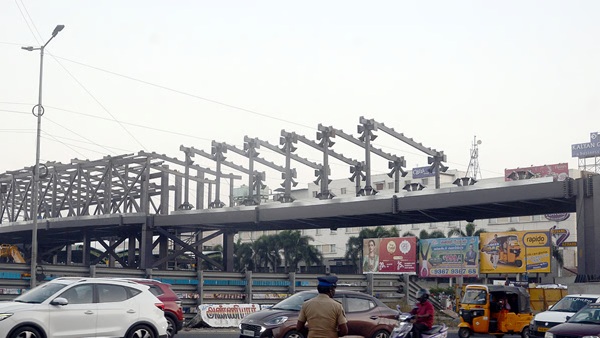 Kilambakkam Skywalk Misses Another Deadline; Completion Pushed to Pongal04/Nov/2026 11:20:28 AM

 JB Soft System