
Future AI Jobs: AI Agent Managers and the Careers Shaping Tomorrow
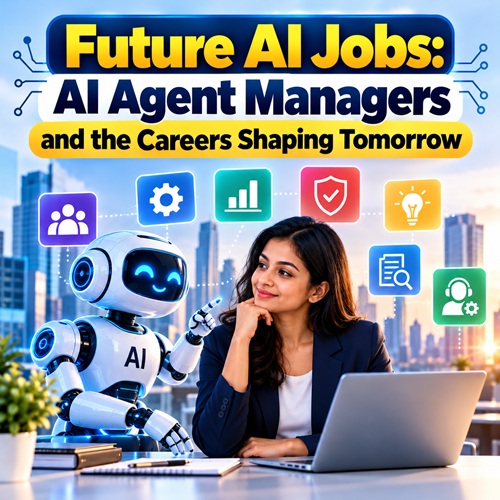
Artificial intelligence is changing the way businesses operate, creating new career opportunities across technology, management, marketing, finance and customer service. As companies increasingly adopt AI-powered tools to handle everyday tasks, a new category of professionals is gaining attention: AI Agent Managers.
These professionals do more than work with AI tools. They ensure that AI agents perform their assigned tasks accurately, follow company policies and contribute to business goals. The growing importance of this role reflects a wider change in the job market, where combining technical knowledge with business expertise and human judgement is becoming increasingly valuable.
What Does an AI Agent Manager Do?
An AI Agent Manager oversees the planning, implementation and performance of AI agents used in business operations. These agents can respond to customer enquiries, analyse information, prepare reports, qualify sales leads and carry out approved tasks using connected software applications.
For example, a business might use AI agents to answer customer questions, organise sales enquiries or assist its content team. The AI Agent Manager ensures that these systems work as expected, identifies errors and establishes clear rules for situations that require human intervention.
The role also involves monitoring performance, improving instructions, reviewing AI-generated outputs and measuring business results. For sensitive activities involving payments, confidential data or important business decisions, the manager must ensure that appropriate human approval mechanisms are in place.
In simple terms, an AI Agent Manager helps businesses get the best out of AI while keeping its limitations and risks under control.
Why Are AI Agent Managers Becoming Important?
Businesses are looking beyond basic chatbots towards AI agents that can perform multiple steps in a workflow. These systems can retrieve information, use software tools, update records and complete certain tasks with limited human involvement.
However, automation does not always guarantee accurate results. An AI agent may misunderstand an instruction, provide incorrect information or perform an action that falls outside its intended purpose. Without proper monitoring and safeguards, such mistakes can affect customer relationships, business operations and data security.
This is where AI Agent Managers play an important role. They connect business objectives with AI capabilities, ensuring that automated systems remain reliable, secure and useful.
As companies expand their use of AI, professionals who can manage these systems and demonstrate measurable business benefits may find opportunities across a wide range of industries.
10 Emerging AI Careers to Watch
The development of AI is creating opportunities beyond traditional software development. Several roles are expected to become increasingly relevant as businesses adopt AI-powered workflows.
1. AI Agent Manager
AI Agent Managers supervise AI agents, establish operating rules, monitor performance and ensure that automated tasks meet business requirements. Professionals with backgrounds in operations, project management and team leadership may be well suited to this role.
2. AI Automation Manager
These professionals identify repetitive tasks and develop automated workflows using AI tools and business applications. Their goal is to reduce manual work, improve productivity and help organisations use their resources more efficiently.
3. AI Product Manager
AI Product Managers determine what an AI-powered product should do, understand customer needs and work with technical teams to develop useful solutions. They also monitor product performance and identify opportunities for improvement.
4. AI Evaluation Specialist
AI Evaluation Specialists test AI systems to assess their accuracy, consistency and reliability. They identify weaknesses, develop test scenarios and help teams improve the quality of AI-generated responses.
5. AI Governance Specialist
As AI becomes part of important business decisions, organisations need professionals who can establish guidelines for responsible use. AI Governance Specialists focus on privacy, transparency, accountability, compliance and risk management.
6. AI Operations Manager
AI Operations Managers oversee AI systems after deployment. Their responsibilities include monitoring performance, resolving operational issues, managing costs and ensuring that systems continue to function effectively.
7. AI Trainer and Knowledge Specialist
These professionals improve AI performance by developing clear instructions, organising verified information and creating useful examples. People with experience in content writing, education, customer service and industry-specific knowledge may find opportunities in this field.
8. Human-AI Workflow Designer
Human-AI Workflow Designers determine how employees and AI systems can work together effectively. They identify tasks suitable for automation while ensuring that people retain responsibility for decisions requiring judgement, experience or empathy.
9. AI Security Specialist
AI Security Specialists help protect business information and control what AI agents can access or do. Their work includes managing permissions, preventing unauthorised actions and reducing the risk of data exposure.
10. AI Strategy Director or Chief AI Officer
At the leadership level, senior professionals guide an organisation`s AI strategy. They identify opportunities, prioritise investments, establish policies and evaluate whether AI initiatives are delivering meaningful business results.
Skills Needed to Build a Career in AI
A career in AI management does not necessarily require advanced expertise in machine learning. However, professionals need to understand how AI systems work, where they can be useful and when human supervision is necessary.
Some of the most valuable skills include:
- AI literacy: Understanding AI agents, large language models, automation and their limitations.
- Prompt and instruction design: Giving AI systems clear instructions, examples and operating rules.
- Process management: Identifying repetitive activities and designing efficient workflows.
- Quality assurance: Testing outputs, identifying errors and measuring reliability.
- Technical knowledge: Learning the basics of APIs, databases, JSON, Python and automation platforms.
- Risk management: Establishing access controls, approval procedures and monitoring systems.
- Communication and leadership: Working with technical teams, training employees and helping organisations adapt to new technology.
The ability to solve real business problems is particularly important. Employers need professionals who can do more than operate AI toolsthey need people who understand how to apply them effectively.
Can Non-Technical Professionals Enter This Field?
Yes. Several emerging AI careers offer potential pathways for professionals who already have experience in business operations, marketing, customer service, project management or quality control.
For example, digital marketing and SEO professionals can explore AI-powered content operations. Customer service managers can move towards AI support management, while project managers can develop skills in AI product management and automation.
Similarly, business analysts can specialise in workflow automation, and quality assurance professionals can focus on testing and evaluating AI systems.
The most practical approach is to build on existing professional experience rather than starting from scratch. Learning to apply AI to familiar tasks can help individuals develop relevant skills and demonstrate their value to employers.
Salary and Career Growth
Salaries for AI-related roles vary considerably depending on the job, location, experience and level of technical responsibility. Senior leadership and specialised technical positions may offer higher compensation, while entry-level opportunities may focus on testing, implementation, support and workflow improvement.
International salary figures should be considered carefully, as compensation in the United States and other markets may differ significantly from that in India.
For aspiring professionals, gaining hands-on experience, building a portfolio of AI projects and demonstrating measurable improvements in productivity can be more useful than relying solely on salary forecasts or certificates.
How to Prepare for Future AI Jobs
Getting started does not require mastering every aspect of artificial intelligence. A more effective approach is to identify a problem in your current work and explore how AI could help solve it.
For example, professionals can experiment with an AI assistant for customer enquiries, an automated lead qualification system, an AI-supported reporting workflow or a content quality-checking process.
The next step is to test the results, identify errors, measure the time saved and document the improvements. These practical projects can demonstrate an understanding of both AI technology and business requirements.
It is equally important to learn when automation should stop and a human should take over. Reliable AI implementation depends on clear responsibilities, appropriate safeguards and continuous evaluation.
Conclusion
Artificial intelligence is creating new career possibilities for people with both technical and non-technical backgrounds. AI Agent Managers, automation specialists, evaluation experts, governance professionals and AI product managers are among the roles gaining attention as organisations explore more advanced automation.
For professionals planning their next career move, the opportunity lies in combining existing expertise with practical AI skills. Understanding business needs, improving workflows, evaluating results and managing risks will be important advantages in the changing workplace.
The future of AI will not depend only on the people who develop the technology. It will also depend on professionals who can manage it effectively, use it responsibly and turn its capabilities into real-world results.
Top Stories
-
 Sell Gold in Chennai for the Best Value Through Trusted Gold Buyers on LiveChennai.com14/Oct/2026 4:30:50 PM
 -
 Material Handling Expo 2026 to Be Held in Chennai from October 15 to 1714/Oct/2026 3:45:34 PM
 -
 Tamil Nadu 12th Public Exam Timetable 2027 Released: Check Subject-Wise Exam Dates14/Oct/2026 3:32:31 PM
 -
 A Journey Through Lucknow’s Culinary Heritage at Mynt, Vivanta Chennai, IT Expressway14/Oct/2026 3:13:29 PM
 -
 Tamil Nadu Weather Alert: Heavy Rain Forecast for 3 Districts Today14/Oct/2026 3:11:17 PM
 -
 Ayudha Pooja Special Trains 2026: Southern Railway Announces 10 Special Services14/Oct/2026 3:07:03 PM

 JB Soft System