
Smart Home Upgrades for Chennai Homes: 5 Practical Devices to Start With
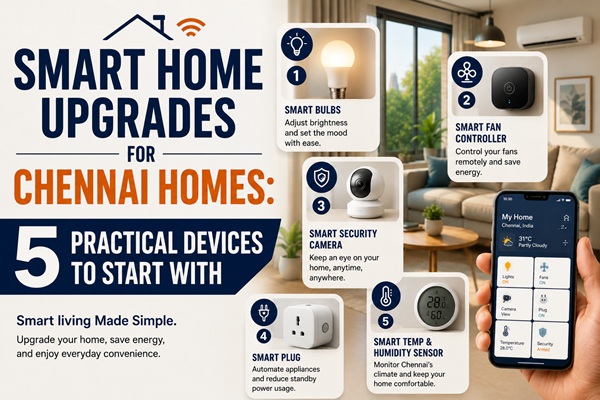
From AC automation and monsoon protection to apartment security, these smart-home upgrades can make everyday life more convenient without requiring an expensive full-home setup.
Smart-home technology is becoming increasingly practical for Chennai households, particularly when it addresses everyday concerns such as heavy AC usage, monsoon-related electrical risks and apartment security.
The good news is that homeowners do not need to automate the entire house at once. A reliable Wi-Fi connection, followed by a few carefully chosen devices, can provide useful benefits while keeping costs under control.
The key is to choose products that continue to work with existing wall switches and offer manual controls when the internet or app is unavailable.
Smart Switches and Fan Controllers
For frequently used rooms, smart switches and fan controllers can be more practical than simply replacing conventional bulbs with smart bulbs.
They allow lights and fans to be controlled remotely or through automation while retaining normal wall-switch operation. This means essential appliances can still be used if the app, internet connection or automation system goes offline.
For existing apartments, Wi-Fi-based retrofit solutions can also reduce the need for rewiring or civil work.
Use an IR Blaster to Control Your AC
An IR blaster is among the most useful and relatively affordable smart-home upgrades for Chennai.
It can connect compatible air conditioners and televisions to a smart-home system, allowing users to schedule operation and control devices remotely. For example, homeowners can avoid leaving an AC running unnecessarily when nobody is at home.
Many Chennai smart-home providers also offer app-based control of lights, fans and air conditioners through combinations of smart switches and IR blasters.
Smart Plugs for Everyday Appliances
Smart plugs are useful for appliances such as water heaters, coffee makers, lamps, routers and mosquito repellents.
However, homeowners should check the plug`s rated capacity before connecting an appliance. Underspecified smart plugs should not be used for high-load equipment such as large air conditioners, pumps or geysers.
Energy-monitoring smart plugs can also help households understand how much electricity certain appliances consume.
Video Doorbells and Security Cameras
A video doorbell or outdoor camera can be particularly useful for apartments and independent homes. They can help monitor deliveries, entrances and visitors and may also be useful for families with elderly members at home.
Before purchasing a camera, check whether it supports local storage or requires a cloud subscription. Understanding the ongoing subscription cost and storage options can help avoid unexpected expenses later.
Chennai`s Monsoon Makes Surge Protection Important
Chennai homes also need to consider local weather conditions when installing smart-home equipment.
Monsoon thunderstorms and power fluctuations can pose risks to electronic equipment. A surge protector or surge-protected distribution board can therefore be useful for sensitive devices such as routers, televisions, cameras and automation hubs.
Outdoor equipment requires additional protection. Cameras, lights and enclosures installed on balconies, terraces, gates or car parks should ideally have an IP65 rating or higher. Indoor-only products may not withstand Chennai`s rain, dust and humidity.
Don`t Ignore Coastal Humidity and Salt Air
Homes located closer to the coast, particularly around ECR, Thiruvanmiyur, Besant Nagar, Neelankarai and Injambakkam, should also account for salt air.
Outdoor smart-home installations should use corrosion-resistant fittings and properly protected junction boxes to improve long-term reliability.
A Strong Wi-Fi Network Is the Foundation
Smart-home devices depend heavily on a stable network, particularly when homeowners want to control them remotely.
A good dual-band router should be the starting point. Larger 2- or 3-BHK apartments may benefit from adding a mesh Wi-Fi node to improve coverage.
A small UPS for the router, along with the camera NVR or automation hub where applicable, can help keep essential smart-home functions connected during short power interruptions.
Always Keep a Manual Backup
Convenience should not come at the expense of reliability.
Essential lights, fans, locks and gates should have a physical fallback wherever possible. Homeowners should avoid systems where internet access is the only way to operate an important device or enter the property.
For smart locks in particular, keeping physical keys or another independent emergency-entry option is advisable.
Choose One Smart-Home Ecosystem
Before buying multiple devices, choose a primary platform such as Alexa, Google Home, Apple Home or a compatible local automation hub.
Checking compatibility in advance can prevent the frustration of managing several unrelated apps and systems. Starting with one or two devices within a single ecosystem is generally a more practical approach than automating the entire house immediately.
Smart-Home Setup by Home Type
| Home type | Practical setup | Priority |
| Rental / Studio | Smart plugs, bulbs, IR blaster, indoor camera | Portable and no rewiring |
| 2–3 BHK Apartment | Smart switches, fan controls, AC automation, video doorbell, leak sensor | Daily convenience and safety |
| Independent House / Villa | Wired or mesh-based automation, gate control, CCTV, smart locks, water-tank monitoring | Reliability and future expansion |
For existing apartments, Wi-Fi retrofit systems can help avoid major civil work and rewiring. More advanced wired systems are better planned during construction or a complete renovation.
Smart-Home Security and Privacy Checklist
As more household devices become connected to the internet, security and privacy should be part of the installation process.
- Change default passwords immediately after setting up devices.
- Enable two-factor authentication on the manufacturer`s account.
- Where possible, place IoT devices on a separate guest Wi-Fi network.
- Position cameras carefully and avoid unnecessarily recording neighbours` homes, shared corridors or areas where privacy is expected.
- Check who has access to camera feeds, particularly installers, and remove their accounts after installation is complete.
- For smart locks, retain physical keys or another independent emergency-entry method.
How Much Does a Smart Home Cost in Chennai?
The cost depends heavily on the number of devices, type of automation and whether the system is DIY or professionally installed.
A basic DIY setup consisting of smart plugs, a few lights or switches and AC control can start at a few thousand rupees. Chennai-oriented starter packages are advertised from around ₹3,999, while professional 1-BHK packages nationally may start at approximately ₹24,990.
For a professionally installed 2-BHK, basic automation packages are cited from roughly ₹50,000. More comprehensive systems involving Wi-Fi and mesh networks, wired automation, security, AV equipment, motorised curtains and additional circuits can cost significantly more.
The 5 Smart-Home Purchases to Make First
For homeowners who want to start small, these five purchases offer a practical balance between cost, convenience and future expansion:
1. Router UPS and a good dual-band Wi-Fi router
2. Two smart switches for the living room and bedroom
3. One IR blaster for AC control
4. Two energy-monitoring smart plugs for low-load appliances
5. A video doorbell or professionally installed entry camera
Start Small and Expand Over Time
A smart home does not have to mean an expensive, fully automated property from day one. For Chennai homes, the most useful upgrades are often the ones that solve everyday problems reducing unnecessary AC usage, protecting electronics during monsoon conditions and improving home security.
Starting with a reliable network and a handful of practical devices also gives homeowners the flexibility to expand later without committing to an expensive system from the beginning.
Top Stories
-
 Tomorrow Panchangam September 03, 2026 | Auspicious Timings, Rahu Kalam, Gulikai02/Sep/2026 5:50:09 PM
 -
Smart Home Upgrades for Chennai Homes: 5 Practical Devices to Start With02/Sep/2026 5:05:43 PM
-
 Gold vs Silver: Which Metal Should Investors Buy Now?02/Sep/2026 4:56:53 PM
 -
 8 Best Areas to Buy Property in Chennai 2026 – See This Full Video02/Sep/2026 4:21:49 PM
 -
 Tamil Nadu Rain Alert: 20 Districts to Receive Rain, Chennai Weather Forecast02/Sep/2026 3:11:05 PM
 -
 Maruti Suzuki Increases Invicto Prices02/Sep/2026 3:02:06 PM