
Gold Adulteration Alert: Chinese Rhenium Powder Raises Concerns as BIS Issues Strict Warning
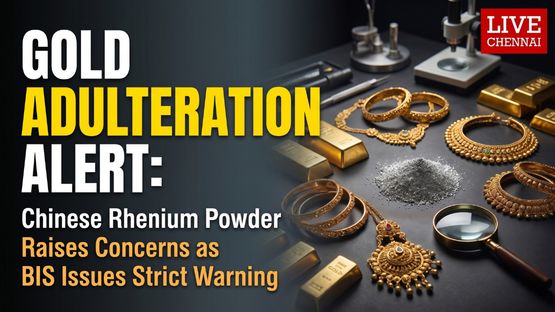
New reports of rhenium powder being mixed with gold jewellery have raised concerns across India. The Bureau of Indian Standards (BIS) has warned that strict action will be taken against anyone involved in manufacturing, supplying or using materials intended to adulterate gold.
Gold adulteration allegations have created concern among jewellery buyers across the country, following reports that a metal powder called rhenium, reportedly sourced from China, is being used to increase the weight of gold ornaments without making the adulteration easily detectable.
Gold prices have been witnessing a continuous decline, encouraging more people to purchase jewellery. However, allegations of irregularities in the gold jewellery market have raised questions about purity and quality. The BIS hallmark is widely recognised as a guarantee of gold purity in India. Nevertheless, concerns have emerged over possible irregularities in hallmark certification and gold testing procedures.
Rhenium Powder Used in Gold Adulteration Test
A report published by a Hindi newspaper highlighted a possible new method of gold adulteration. As part of an investigation, an experiment was reportedly conducted in collaboration with jewellery shops in Rajasthan to examine whether rhenium powder could be mixed with gold without being easily identified.
For the test, rhenium, a metallic powder, was purchased and used to prepare gold jewellery. Around one gram of rhenium powder was mixed with approximately seven grams of gold to produce an ornament weighing eight grams, equivalent to one sovereign.
According to the reported test results, the finished jewellery contained only around 81.73 per cent actual gold, which is approximately equivalent to 20-carat gold.
The adulterated jewellery was subsequently taken to hallmarking centres in Jodhpur, Rajasthan, for testing.
XRF Machines Failed to Detect the Adulteration
One of the major concerns highlighted by the investigation was the performance of conventional gold-testing equipment.
When the jewellery was examined using the commonly available X-ray fluorescence (XRF) machines used by jewellery shops, the equipment reportedly failed to identify the presence of rhenium.
More surprisingly, the adulterated jewellery reportedly received a 22-carat (916) hallmark certificate despite containing a lower proportion of actual gold.
According to the report, customers purchasing such adulterated jewellery could potentially suffer a financial loss of up to Rs.15,000 per sovereign.
The experiment also reportedly indicated that gold mixed with rhenium powder could be melted and reshaped into jewellery without an obvious change in its original appearance. This has raised concerns about whether ordinary testing methods are sufficient to identify such adulteration.
BIS Monitoring the Gold Adulteration Allegations
Followiwing the circulation of these reports, concerns have increased among consumers and industry representatives. However, some experts have questioned whether such adulteration is technically possible.
Despite these differing opinions, the Bureau of Indian Standards has taken note of the allegations and is closely monitoring the situation.
Rajesh Rokde, Chairman of the All India Gem and Jewellery Domestic Council (GJC), issued a statement explaining the organisation`s position on the matter.
He said that information about the alleged gold adulteration had been brought to the attention of BIS and that the situation was being monitored seriously.
Strict Action Against Those Involved
According to Rajesh Rokde, BIS has assured the jewellery industry that strict action will be taken against anyone found manufacturing, distributing or using materials intended to adulterate gold.
He further stated that if any powder or other substance used for mixing with gold is identified, appropriate stringent action will be initiated against those responsible.
No Formal Complaints Received So Far
Rajesh Rokde also referred to informal information suggesting that mixing rhenium with gold may increase the overall weight of the jewellery without proportionately increasing its gold purity.
However, he clarified that no formal complaints regarding this particular issue had been received from any part of the country so far.
The allegations have nevertheless brought renewed attention to gold purity, hallmark certification and the reliability of jewellery-testing methods. BIS has assured the industry that the matter is being monitored and that strict action will follow if the alleged adulteration is established.
Top Stories
-
 Gold Prices Continue to Decline for the Fifth Consecutive Day: Will the Downward Trend Continue?21/Nov/2026 10:54:43 AM
-
Gold Adulteration Alert: Chinese Rhenium Powder Raises Concerns as BIS Issues Strict Warning21/Nov/2026 10:43:05 AM
-
 Gold Loan LTV Explained: How Much Loan Can You Get Against Your Gold? RBI Rules and Calculation21/Nov/2026 10:26:08 AM
-

-

-


 JB Soft System