|
||
|
||
Articles...................................................................................................................................................................................................................................................................................
Parkinson disease (Parkinson's disease, PD) is a progressive neurodegenerative disorder associated with a loss of dopaminergic nigrostriatal neurons. Dopamine is a nerve chemical which is very essential for all movements. In Parkinson’s disease the amount of dopamine gets reduced (like insulin in diabetes). Parkinson disease is recognized as one of the most common neurological disorders, affecting approximately 1% of individuals older than 60 years. The incidence has been estimated to be 4.5-21 cases per 100,000 population per year. Estimates of Parkinson disease prevalence range from 18-328 per 100,000 population, with most studies yielding a prevalence of approximately 120 per 100,000. Studies have shown that in India the incidence is bound to double in ten years. Symptoms: The most common symptoms include resting tremor (shaking), rigidity (stiffness), bradykinesia (poverty of movement) and postural instability (frequent falls). Onset in Parkinson disease is typically asymmetric, with the most common initial finding being an asymmetric resting tremor in an upper extremity. About 20% of patients first experience clumsiness in one hand (difficulty in writing) but over time progressive bradykinesia, rigidity, and gait difficulty set in. Sleep disturbances are common. The characteristic Parkinson disease tremor is present and most prominent with the limb at rest. It is described as pill rolling tremor. Rigidity refers to an increase in resistance to passive movement about a joint. Bradykinesia refers to slowness of movement but also includes a paucity of spontaneous movements and decreased amplitude of movement. Bradykinesia is also expressed as micrographia (small handwriting), hypomimia (decreased facial expression), decreased blink rate, and hypophonia (soft speech).Postural instability refers to imbalance and loss of righting reflexes. Its emergence is an important milestone, because it is poorly amenable to treatment and a common source of disability in late disease. Patients may experience freezing when starting to walk (start-hesitation), during turning, or while crossing a threshold, such as going through a doorway. Dementia generally occurs late in Parkinson disease and affects 15-30% of patients. Short-term memory and visuospatial function may be impaired, but aphasia is not present. Causes: Most cases of idiopathic Parkinson disease are believed to be due to a combination of genetic and environmental factors. At both ends of the spectrum are rare cases that appear to be due solely to one or the other. A recent hypothesis suggests that Parkinson disease is caused by abnormalities of the proteosome system, which is responsible for clearing abnormal proteins. Parkinsonism can be caused by a variety of degenerative disorders, as well as toxins, infections, and vascular or structural lesions. Parkinsonism also can be induced by medications that block dopamine receptors (eg, neuroleptics, antiemetics) or deplete intraneuronal dopamine stores (eg, reserpine, tetrabenazine). Investigations: No laboratory biomarkers exist for Parkinson disease. Magnetic resonance imaging (MRI) and computed tomography (CT) scan are usually unremarkable or may show age specific changes in Parkinson disease. Positron emission tomography (PET) and single photon emission CT (SPECT) are also not needed for routine clinical diagnosis in patients with a typical presentation. However they may be useful in diagnostic dilemmas. Treatment: Most cases of Parkinsonism especially in the initial phases are
well controlled on medications. The goal of medical management of
Parkinson disease is to provide control of signs and symptoms for as
long as possible while minimizing adverse effects. Medications
usually provide good symptomatic control of motor signs for 4-6
years. After this, disability progresses despite best medical
management, and many patients develop long-term motor complications
including fluctuations and dyskinesia. Additional causes of
disability in late disease include postural instability (balance
difficulty) and dementia. For good results the four contact points of the electrode needs to be in the
STN.
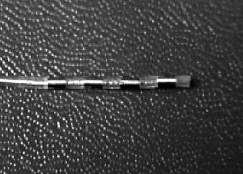
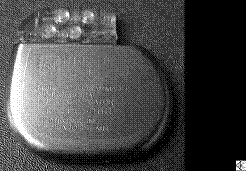
The DBS electrode and the battery For good results the four contact points of the electrode needs to be in the STN. 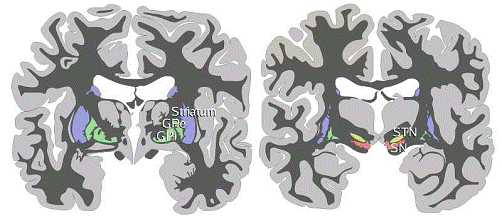
Coronal cross section of brain showing
the basal ganglia (green and blue) in the left and the subthalamic
nucleus (yellow) and the substansia nigra (red) STN DBS involved inserting the electrodes shown above
into the subthalamic nucleus. This procedure is done using the
stereotactic frame and under local anaesthesia. STN DBS for
Parkinsonism usually resolves tremor, dyskinesias, pain and
hallucinations. Symptoms which are improved by drug therapy are maximally improved with surgery. Tremor improves by
80%-100%, slowness (Bradykinesia) by 50%-60%, stiffness (Rigidity)
by 50%-70%, gait,
freezing, and balance by 50%, dyskinesias
and dystonia (drug induced) by 80%- 90% and motor fluctuations are
virtually eliminated. Independence and quality of life are
substantially improved. Complications are very rare and include
haemorrhage (2-3%), Infection (1 -3%), mechanical hardware breakage
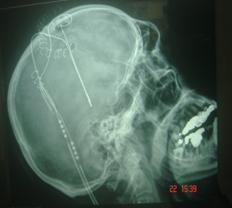
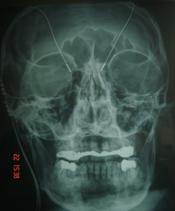
(1-5%) and cognitive decline (2%). Postoperative Xrays of one case is shown here.
Post Your Queries Now
|
|