|
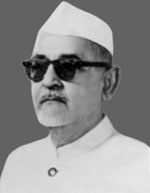
Dr. Zakir Hussain was born
at Hyderabad on February 8, 1897 and suddenly death on 3
May, 1969.
DR. ZAKIR HUSSAIN was born at Hyderabad on February 8, 1897,
he came of a Pathan family of the upper middle-class, settled
at Qaunganj in the District of Farrukhabad, Uttar Pradesh.
His father, Fida Hussain Khan, went to Hyderabad, studied
Law and had a most successful career. Unfortunately, he
died when Dr. Zakir Hussain was only ten years old.
Dr. Zakir Hussain was sent first for his education to the
Islamia High School in Etawah (U.P.) which specialised in
puritanical strictures. After finishing school, he joined
the M.A.O. College at Aligarh and studied upto the M.A.
When the Indian National Congress and the All India Khilafat
Committee joined hands in launching the Non-Cooperation
Movement, Mahatma Gandhi toured the country to induce teachers
and students to leave Government administered schools and
colleges. The young Zakir Hussain, who was then half-student
and half-teacher, very prominent among the students and
very popular with a large section of the staff, persuaded
Hakim Ajmal Khan and other leaders to establish a national
institution at Aligarh, and the Jamia Millia Islamia came
into being on 29 October, 1920. But Zakir Hussain did not
wish to leave his studies incomplete and he went to the
University of Berlin in Germany for higher studies in 1923,
returning with a doctorate in Economics three years later.
He rejoined the Jamia Millia in February-March, 1926 and
became the Shaikhu Jamia (Vice-Chancellor). It was at the
Jamia Millia that Dr. Zakir Hussain developed his gifts
as an educationist. It was his experience here as well as
his deep study of the philosophy of education which enable
him to take charge of the scheme of Basic National Education
when it was launched in 1938. He was the President of Hindustani
Talimi Sangh, Sevagram from 1938 to 1948.
In November 1948, Dr. Zakir Hussain was appointed Vice-Chancellor
of the Aligarh Muslim University. He was also nominated
a member of the Indian Universities Commission. The World
University Service made him the Chairman of the Indian National
Committee and in 1954 he was elected the World President
of the organization. He was also nominated to the Rajya
Sabha and made the Indian representative on the Executive
Board of the UNESCO from 1956 to 1958. He remained the Chairman,
Central Board of Secondary Education, till 1957, a member
of the University Grants Commission till 1957, a member
of the University Education Commission in 1948-1949 and
of the Educational Reorganisation Committee of Bihar, Uttar
Pradesh and Madhya Pradesh. In 1957 he was appointed the
Governor of Bihar and in 1962 he was declared elected as
the Head of the State and was formally sworn in as the Third
President of the Indian Republic four days later. He held
the highest office of the country with exemplary grace and
dignity till his sudden death on 3 May, 1969. Dr. Zakir Hussain was awarded Padma Vibhushan in 1954 and
Bharat Ratna in 1963. He was awarded D.Litt. (Honoris Causa)
by the Universities of Delhi, Calcutta, Aligarh, Allahabad
and Cairo.
Many demands were made on Dr. Zakir Hussain's time and he
was not able to undertake many scholarly projects which
he had in mind. His interest in literary and academic work
was so keen that he translated Plato's 'Republic' and Cannon's
'Elementary Political Economy'into Urdu soon after joining
the Jamia Millia in 1920. While in Germany, he got an edition
of the 'Diwan-I-Ghalib' printed - doing much of the compositing
himself, because the press did not have enough staff - and
also brought out a book in German on Mahatma Gandhi (Die
Botschaft des Mahatma Gandhi') . He delivered a series of
lectures on economics under the auspices of the Hindustani
Academy and another series in English, on Capitalism: Essays
in Understanding, under the auspices of the Delhi University
in 1945. He also translated Friedrich List's 'Nationalockonomic'.
His Convocation Addresses have been collected and published
under the title "The Dynamic University". But he excelled
in writing for children and his stories are masterpieces
of style.
Tall, well-built, fair in complexion, with anoble forehead,
a sensitive aristocratic nose, a well-trimmed beard and
always neatly and tastefully dressed in sherwani and pyjama,
Dr. Zakir Hussain was an imposing embodiment of culture
and refinement. He was sensitive to beauty in all its forms
and had an intense passion for excellence. His varied tastes
and hobbies, his love of roses, his collection of cacti,
fossils, paintings and specimens of calligraphy, objets
d'art, and curios and above all, his rich library are evidence
of his versatile personality.
He was steeped in the spiritual and aesthetic culture and
the ethical principles of the Muslim Sufis and poets. He
had the sufi's indifference towards the externals of religion
and, though a deeply religious man, his religiosity was
never obvious. It was the inspiration for secularism by
which he endeared himself to men of different religious
communities.
Dr. Zakir Hussain's nationalism was, like Gandhiji's, a
reflection of his allegiance to the highest moral values
and to the ideals of a culture which had become the whole
of his own self. It was a nationalism which demanded for
the individual that freedom which is the essence of democracy,
that self-discipline which is the foundation of democratic
citizenship and that identification with the good of the
society which gives substance and meaning to the life of
the individual.
|