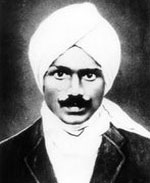
Mahakavi Subramania Bharathiyar is is celebrated as one
of India’s greatest poets, with many of his composed poems
and songs in the Dravidian language Tamil, being popularised
in schools, movies and households across India over the
years. He is a renowned poet of Tamil Nadu, South India,
and his literature is popular among Carnatic musicians.
As a person, Bharathiyar was a simple man, interested in
his writing alone. His wife would leave the house to bring
food somehow, while he wrote and brought in little income
for the poor family. However, his writings have earned him
the title (or laudatory epithet) “Mahakavi,” which in Tamil
means “Great Poet.” Bharathi was prolific and adept in both
prose, and poetry, known for its appeal to the liberty and
strength of the people - which also helped rally the masses
to support the Indian independence movement in Southern
India. Bharathi lived during an eventful period of Indian
history; his contemporaries included other prominent leaders
of the Indian independence movement such as Mahatma Gandhi,
Tilak, Aurobindo and V.V.S.Aiyar.
Born to Chinnaswaamy Iyar and Lakshmi Ammal in 1882 at Ettiyapuram,
he lost his mother at 5, and at 11 was invited to a conference
of Ettiyapuram court poets and musicians. There he was given
the title Bharathi for his ability to compose poems and
songs - he accepted a challenge and composed a Chindu on
the model of a Kavadi Chindu of Annamalai Reddiar. He married
Chellamal in 1897, and in 1898, his father died.
At 22, he became a Tamil teacher at Setupati High School
in Madurai and the same year was appointed Assistant Editor
of a daily newspaper called “Swadesamitran.” In 1906, he
was editor of a weekly magazine called “India” in Madras
and the next year a friend of his, Krishnaswaamy Aiyyar
received from him songs he had composed on patriotism and
published them, titled “Sudhesa Geetangal”. In 1908 the
government wanted to arrest him, but he escaped to Pondicerry
(under French rule) and published “India” from there. In
1912 he translated the Bhagavad Geeta into simple Tamil
(making it accessible to Tamils who couldn’t understand
Sanskrit) and composed songs on Krishna (Kannan Paattu),
“Kuyil”, and “Panchali Sabadam” (on Draupadi of the epic
Mahabharata). Other types of songs he composed can be distinguished
by; Patriotic, Phillosophical, Auto-biographical, Devotional,
Killikani (Kavadi Chindus), Kannamma (songs addressed to
his wife, Chellamma), Taalaatu (lullabies) and Miscellaneous
songs. When he left Pondicherry in 1918, he was arrested
and later released.
His national integration songs earned him the title “Dhesiya
Kavi” (National Poet). He composed Tamil keertanais on love,
devotion, fearlessness, mysticism. His stepbrother C. Vishwanaata
Iyer and V.V.S. Iyer tells us that he himself set his songs
to music and could sing them well in a variety of raagams.
In “Bharata Dheviyin Thiru Dasangam” he used 10 different
raagams. His patriotic songs emphasize nationalism, unity
of India, equality of man and the greatness of the Tamil
language, set himself to folk tunes. He sang these himself
at Congress meetings at the Madras beach.
Though he was fluent in Sanskrit (and other languages including
Bengali, Hindi, Sanskrit, Kutchi, French and English), he
only composed 2 compositions purely in Sanskrit, with the
vast majority being in the rich language of Tamil. His voracious
appetite for learning ancient and contemporary Tamil literature
derived some very astonishing insights from the ancient
poems.
In an article “Sangeeta Vishayam” (Issues in Music), Bharathiyar
rebukes musicians for singing songs of the Trinity, Patnam
Subramania Iyer and others without knowing the meaning because
the songs are all in Sanskrit or Telegu. Without knowing
the meaning, singers are unable to sing with proper expression.
He also says songs usually portray devotion and love and
not other emotions like courage, anger, wonder, fear, and
hatred. He emphasized that musicians should not sing songs
which they don’t understand and should learn from Hindustani
musicians how to train their voices.
Bharathi’s health was badly affected by the imprisonments
and by 1920, when a General Amnesty Order finally removed
restrictions on his movements, Bharathy was struggling in
penury and failing health resulting in his tragic premature
death. Bharathi was struck by an elephant at Parthasarathy
temple, Thiruvallikeni, Chennai. He however survived the
mishap. A few months later his health deteriorated and he
died on September 11, 1921, not yet forty years of age.
His funeral was attended by only seven people.
Bharathiyar tuned a lot of his songs, however, not all of
them were recovered, so other musicians tend to tune his
compositions too. Some of the songs of Bharathiyar that
are very popular in the Carnatic music concert circuit include:
Theeratha Vilaiyattu Pillai, Chinnanchiru Kiliye, Suttum
Vizhi, Thikku Theriyaatha, Senthamizh Nadenum, and Paarukkule
Nalla Naadu. Usually, Bharati’s songs are rendered towards
the end of the concert more for their aesthetic appeal rather
than musical grammar alone. However, recently, many musicians
have held thematic concerts, rendering Bharathiyar’s items
alone.
|