|
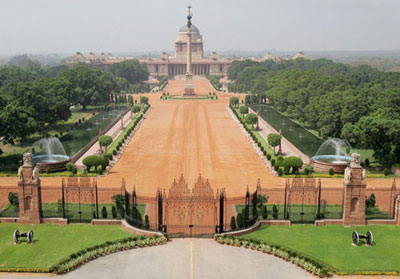
RASHTRAPATHI BHAVAN The splendour of the Rashtrapati Bhavan is multi-dimensional. It is a vast mansion and its architecture is breathtaking. More than these, it has a hallowed existence in the annals of democracy for being the residence of the President of the largest democracy in the world. Few official residential premises of the Head of the State in the world will match the Rashtrapati Bhavan in terms of its size, vastness and its magnificence. The present day Rashtrapati Bhavan was the erstwhile residence of the British Viceroy. Its architect was Edwin Landseer Lutyens. The decision to build a residence in New Delhi for the British Viceroy was taken after it was decided in the Delhi Durbar of 1911 that the capital of India would be shifted from Calcutta to Delhi in the same year. It was constructed to affirm the permanence of British rule in India. This building gave the impression, in the words of a critique, the setting of a perpetual Durbar. The building and its surroundings were supposed to be 'an empire in stone', 'exercising imperial sway' and containing in it, "the abode of a disinterested elite whose rule was imposed from above". That 'empire in stone' and the perpetual Durbar was transformed to be the permanent institution of democracy on 26th January 1950 when Dr. Rajendra Prasad became the first President of India and occupied this building to preserve, protect and defend the Constitution of India. It was from that day that this building was renamed as Rashtrapati Bhavan - the President's House. Apart from Edwin Lutyens, the Chief architect and Chief Engineer Hugh Keeling there were many Indian contractors who were involved in the construction of this building. While a Muslim contractor Haroun-al-Rashid did most of the work of the main building the forecourt was built by Sujan Singh and his son Sobha Singh. Surprisingly the names of these Indians did not find a place in the official biography of Lutyens. The sanctioned amount for the building was earmarked at 400,000 pounds. However the long span of seventeen years required for the construction of the building raised its cost to 877,136 pounds (then Rs. 12.8 million). The actual amount incurred in not only the construction of the building but also the Mughal Garden and the staff quarters amounted to Rs. 14 million. Edwin Lutyens was reported to have remarked that the money invested in the construction of the building was smaller in amount as compared to the cost of two warships. It is interesting to note that the building which was scheduled to be completed in four years took seventeen years and on the eighteenth year of its completion India became independent. This vast mansion has got four floors and 340 rooms. With a floor
area of 200, 000 square feet it is built by using 700 million bricks
and three million cubic feet of stone. Hardly any steel has gone
into the construction of the building. After India became independent, the sheer size of the building overwhelmed its new keepers. Mahatma Gandhi suggested it be turned into a hospital. Thankfully, nobody took him seriously. The Durbar Hall served as a museum for several years till the building which now houses the National Museum was completed. Here’s what Mark-Bence Jones remarked about life at the Viceroy’s
House in his book Palaces of the Raj. Do note the then-and-now
comparison he makes on a later visit to the palace, long after the
British had gone. "In India that replaced the Raj, Lutyens’ Palace has managed to keep some of its glory. …As the home of a modern democratic President, it is certainly on the large side, but the Indians have been wise enough to maintain a Presidential establishment worthy of the setting. Scarlet-clad guards still sit on their chargers beneath the stone sentry boxes, khitmagars in white, red and gold line the corridors." |
|
||||||||
|
|
|||||||||