|
Victoria Protrait Series
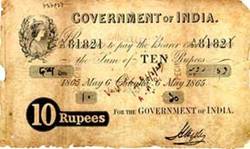
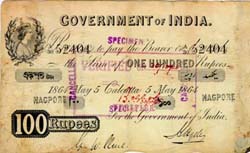
The first set of British India notes were the 'Victoria Portrait'
Series issued in denominations of 10, 20, 50, 100, 1000. These were
unifaced, carried two language panels and were printed on hand-moulded
paper manufactured at the Laverstock Paper Mills (Portals). The
security features incorporated the watermark (GOVERNMENT OF INDIA,
RUPEES, two signatures and wavy lines), the printed signature and
the registration of the notes.
Rupees Ten
Rupees Hundered
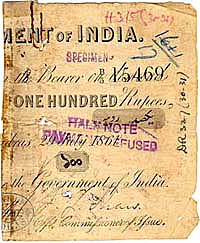
British India Notes facilitated
inter-spatial transfer of funds. As a security
precaution, notes were cut in half. One set was sent by
post. On confirmation of receipt, the other half was
despatched by post.
Half
note
This series
remained largely unchanged till the introduction of the 'King's Portrait'
series which commenced in 1923.
Green
Underprint - Rupees Five Hundred
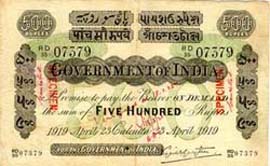
Red Underprint - Rupees Fifty
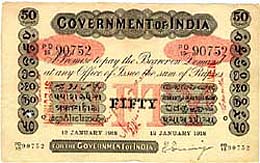
Small Denomination Notes!
The introduction of small denomination notes in India was
essentially in the realm of the exigent. Compulsions of the first
World War led to the introduction of paper currency of small
denominations. Rupee One was introduced on 30th November, 1917
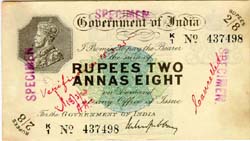
followed by the exotic Rupees Two and Annas Eight. The issuance of
these notes was discontinued on 1st January, 1926 on cost benefit
considerations. These notes first carried the portrait of King
George V and were the precursors of the 'King's Portrait' Series
which were to follow.
Rupee One - Obverse
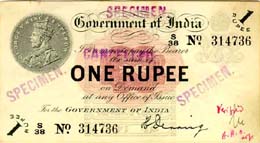
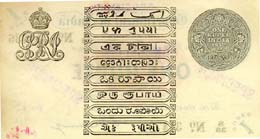
Rupee One - Reverse
Rupees Two and Annas Eight - Obverse
King's Portrait Series
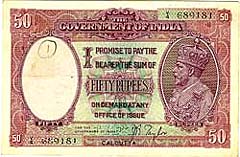
Regular issues of this Series carrying the portrait of George V were
introduced in May, 1923 on a Ten Rupee Note. The King's Portrait
Motif continued as an integral feature of all Paper Money issues of
British India. Government of India continued to issue currency notes
till 1935 when the Reserve Bank of India took over the functions of
the Controller of Currency. These notes were issued in denominations
of Rs 5, 10, 50, 100, 500, 1000, 10,000.
Rupees Fifty
|